
Tucker Carlson Is A Sexist Jerkish American

Here is an excerpt from a transcript of his show:

CARLSON:   That was Hillary Clinton talking to women, the women who host ABC‘s”The View”and the millions of American women presumably who watch that show.   According to polls, Mrs. Clinton has widespread appeal to female voters.   If you talk to her campaign, it‘s women who are going to carry her to the nomination and eventually the White House.

A memo from chief Clinton strategist Mark Penn says that 94 percent of women under the age of 35 said they are more likely to vote next November if a woman, Hillary, is on the ballot.   Can that be?   How much would it matter were it true?   Here to tell us the”Washington Post‘s”Eugene Robinson and the president of the Foundation for the Defense of Democracy, Cliff may.

Gene, this is an amazing statistic; 94 percent of women say they would be more likely to vote if a woman were on the ballot.   I think of all the times I voted for people because were male.   the ballot comes up, he‘s a dude.   I think I‘ll vote for him.   We‘ve got some more genitalia, he‘s getting my vote.

ROBINSON:   Look, you didn‘t have a choice all those times you were voting, right?   You didn‘t have choice of genitalia.

CARLSON:   I do.   I always vote the man.

ROBINSON:   It‘s a:when firsts happen they are significant.   They say something about the society and how far it‘s come and where it is.   And, you know, not just that figure in that poll, but if you look at all the polls, really, that show her amazing strength among women, and you look at a state like South Carolina, my home state, where both in my paper, the Post and in”New York Times,”over the weekend there were stories about black women and how in a sense conflicted:

CARLSON:   That‘s interesting:

ROBINSON:   — they feel about Obama versus Hillary Clinton.   Part of that:not all of that, certainly, but part of it is, he‘s African American.   She‘s a woman.

CARLSON:   Part of it is loyalty to the Clintons, as specifically the Clintons, don‘t you think.   It‘s not just the female.

ROBINSON:   Absolutely.

MAY:   Because if gender solidarity trumps all other interests I think that‘s kind of sad.   I don‘t think racial or religious solidarity should trump all others either.

CARLSON:   Do you think that people who are voting on the basis of gender solidarity ought to be allowed to vote in a perfect world?   Of course they shouldn‘t be allowed to vote on those grounds.   That‘s moronic.     I‘m sorry, I get bounced off the air for saying it.   But it‘s true.

ROBINSON:   It doesn‘t trump all other characteristics.   There are a lot of women who are going to vote for Republicans in November because they‘re conservative.

CARLSON:   I‘m merely saying the obvious, that you shouldn‘t vote for her because she‘s a woman.   Here is what the Clinton campaign says; Hillary isn‘t running as a woman.   As Hillary says, she‘s not running as a woman candidate.   The only reason to vote for her is that you believe she‘s the most qualified to be president.

That‘s actually completely false considering the Hillary campaign:I get their e-mails:relentlessly pushes the glass ceiling argument.   You should vote her because she‘s a woman.   They say that all the time.   She just said that on”The View.”   That‘s their rationale.

MAY:   At least call her a vaginal American.

CARLSON:   Is that the new phrase.   I don‘t think I can say that.

ROBINSON:   You don‘t say that.

CARLSON:   I‘m not going to say that.

ROBINSON:   It‘s kind of working, number one.

CARLSON:   It‘s definitely working.

ROBINSON:   This is effective.

CARLSON:   Don‘t you think it‘s a little embarrassing.

ROBINSON:   No, it‘s not embarrassing.

CARLSON:   I talked to two women today who I love and admire, who:I work in their proximity and they both said, I‘m embarrassed that women would vote just on the basis of her gender or that would influence their vote.

ROBINSON:   We‘re talking about Democrats, first of all.

CARLSON:   How would she be a different president because she‘s a woman?   Here is what I don‘t understand.   We need a woman.   How is she going to be a different president because she‘s a woman.   I don‘t get that.

ROBINSON:   I don‘t think she will be.   But I think it will be significant if a woman is elected president of the United States, as it would be significant if an African American were elected president of the United States.   For some people it was significant when a southerner is elected as opposed to northerner, when the first Catholic was elected president of the United States.   It‘s says something about the country.

MAY:   Did Margaret Thatcher have more women voting for her than men?

I wonder.

CARLSON:   I suspect she had more men.

MAY:   I suspect that is true.

CARLSON:   She ran and governed as a man.

ROBINSON:   Most of her election he she won pretty big.   She probably did have.

MAY:   She ran governed based on her views and her determination and her mettle.   I think that‘s the way it‘s supposed to be.

ROBINSON:   Talk to Margaret Thatcher about John Major and she thought he was kind of a woos.   She leaned close and said, if only he were a man.

CARLSON:   She was a tougher dude than he ever was, no doubt about it.

Watch the video here, if you can stomach it.

–Ann Bartow

Share
Posted in Feminism and Politics, Sexism in the Media | Comments Off on Tucker Carlson Is A Sexist Jerkish American

Two Porn Spammers Are Going To Jail

Via Information Week:

Two men convicted of sending pornographic spam under the Can-Spam Act have been sentenced to serve more than five years in prison, the U.S. Department of Justice said Friday.Assistant Attorney General Alice S. Fisher of the criminal division and interim U.S. Attorney Dan G. Knauss of the District of Arizona said that Jeffrey A. Kilbride, 41, of Venice, Calif., and James R. Schaffer, 41, of Paradise Valley, Ariz., had been sentenced to 72 months and 63 months in prison, respectively, for running an international pornographic spam ring that took in more than $1 million.

Kilbride received a longer sentence because the court found that he had obstructed justice by trying to deter a government witness from testifying in the case, according to the Department of Justice.

Kilbride and Schaffer were fined $100,000, ordered to pay $77,500 to AOL, and will forfeit more than $1.1 million in illegal proceeds from their spam operation.

The Department of Justice claims the trial, which concluded in June, was the first to include obscenity charges under the Can-Spam Act. The Federal Trade Commission announced the first successful criminal prosecution under the Can-Spam Act on April 29, 2004.

Kilbride and Schaffer began spamming in 2003, sending out millions of spam messages advertising hard-core porn sites. The messages contained graphic images that were visible to whoever opened the e-mail. Later in 2003, the two men began using servers in Amsterdam to make messages they were sending from Phoenix appear to be coming from outside the United States.

On June 25, a federal jury in Phoenix convicted the two men of sending spam messages with forged headers and domain names, conspiracy, fraud, money laundering, and obscenity charges.

Woo-hoo! Maybe some day I’ll be able open the e-mail account for this blog without flinching.

–Ann Bartow

Share
Posted in Feminism and Law, Feminism and Technology | Comments Off on Two Porn Spammers Are Going To Jail

“Ouch.”

Know what these are?

“South of the Border”
“Marble Sac” with Shaft
Backdoor Treatment
“Crackdown”
Full Moon Rising

Answer here, in the left column. No, the listings in the right hand column don’t sound any more appealing or less painful, but none are in “quotes.”

Share
Posted in Acts of Violence, Bloggenpheffer | Comments Off on “Ouch.”

Best NY-Based (No Further Adjective) Bloggers

Two Feminist Law Professors,  Caitlin Borgmann (also of Reproductive Rights Prof Blog) and Bridget Crawford,  are nominated in the “Best NY-based Blogger” contest over at suigeneris.   You can vote here.

Share
Posted in Bloggenpheffer | Comments Off on Best NY-Based (No Further Adjective) Bloggers

Justice Scalia – the Catholic not-Catholic Judge

Justice Scalia spoke at Villanova University yesterday and declared that, despite being Catholic, he is not, nor is there any such thing as, a Catholic Judge. I wasn’t at the event, so I have to rely on the local news coverage of it for my impressions of it, but I’m left with one striking observation (certainly not original, but definitely raised by what he talked about yesterday): why is it then that the outcomes he reaches on contested social issues that the Church cares about just happen to correspond with the Church’s position?

First, a couple of excerpts from the article about the speech:

“Just as there is no ‘Catholic’ way to cook a hamburger,” he said to a murmur of laughter, “I am hard-pressed to tell you of a single opinion of mine that would have come out differently if I were not Catholic.”

****

He concluded that Americans should disabuse themselves of the notion that “everything you care about personally is in the Constitution.”

“Well, it’s not,” he said. “What it says, it says. What it does not say, it does not say.

This final quote leads to my observation here. Is Scalia then just lucky that the Constitution just happens to, in his analysis, correspond with his personal (Catholic) views on social issues? Catholicism doesn’t like abortion, gay rights, and the right to die; well, according to Scalia’s jurisprudence, neither does the Constitution. That’s not because he’s Catholic, but rather because he just happens to hold views personally that correspond with the Constitution? Lucky him!

What about the death penalty though? Catholicism is widely connected with anti-death penalty views, but Scalia’s jurisprudence, to put it mildly, is not. Well, this is where the article made his argument that his faith does not affect his judging appear like a fake. When questioned about the death penalty at the speech yesterday, Scalia could have easily said that Catholicism looks askance at the death penalty but the Constitution allows it, and that’s all that matters. But, instead, he took pains to mesh his view of Catholicism and his view of the Constitution:

Scalia’s assertion that he was comfortable with capital punishment – despite the Catholic Church’s strong discouragement of its use – did provoke a challenge.

“You defend a right of conscientious doubt [regarding Catholic teaching] on the death penalty,” a woman in the audience asked during the question period. “That sounds liberal.”

“I have a basis for dissent,” Scalia replied: “Several millennia of Catholic practice.”

He said that – unlike on abortion – the Catholic Church had never issued an infallible judgment that capital punishment was universally wrong.

“The church has always set forth a philosophy of punishment that an evil act sets forth disorder, and must be punished,” he said.

Despite Pope John Paul II’s 1995 encyclical Evangelium Vitae decrying capital punishment and other forms of violence, Scalia said, “I don’t think Catholic dogma has changed on this.”

If his Catholic views are irrelevant to his judging on the death penalty (and abortion and sexual orientation and the right to die and other issues), isn’t his answer to this question irrelevant based on what he previously said matters? He certainly could have just been engaging the questioner, but I suspect instead that he was giving a bit of insight into how he really feels his understanding of his faith affects his constitutional interpretation.

– David S. Cohen

Share
Posted in Feminism and Law | Comments Off on Justice Scalia – the Catholic not-Catholic Judge

Lavender Languages & Linguistics XV (Feb. 15-17, 2008)

The Lavender Languages and Linguistics Conference examines language use in lesbian, gay, bisexual, transgender, and/or queer life. Languages and linguistics are broadly defined here, to include studies of: pronunciation, vocabulary and meaning, conversational structures and styles, life stories and other narratives, fiction, and poetry, the”language”of scientific and historic documents and print media, meanings encoded in spatial practices, sign language, non-verbal communication, and communication through photography, cinema and other visual arts. While presentations usually focus on local linguistic practices, they do not neglect the global spread of North Atlantic “gayspeak” and the growing tensions between (homo)sexuality and citizenship worldwide, or the need to position site-specific practices within broader contexts of social, cultural and linguistic theory. Presentations from established scholars and from those just beginning to explore lavender language issues are welcomed.

This site displays information about the upcoming Lavender Languages & Linguistics Conference (Lav Lgs XV, February 15–17, 2008) and archives conference agendas and abstracts from conferences in previous years. Submit a proposal here.

Share
Posted in LGBT Rights, Sociolinguistics | Comments Off on Lavender Languages & Linguistics XV (Feb. 15-17, 2008)

Using Facebook to Identify Attackers

An earlier post described how police used bragging posts on Facebook to identify suspects in the beating of an Indiana woman.   Now this from cnn.com:

Using a Facebook profile, police arrested a suspect in an attack on the Georgetown University campus.

The victim searched through Facebook profiles to identify his attacker.

The university sophomore appeared in court Friday, charged in connection to what police called a hate-crime attack near campus nearly two weeks ago.

Phillip Anderton Cooney of Southlake, Texas, is charged with simple assault with a bias/hate crime specification, according to police officials and an official in the U.S. attorney’s office.

Prosecutors added the “bias/hate crime specification” to the case because the victim, a 19-year-old who is also a Georgetown student, said the attacker was yelling homophobic epithets during the attack.

The victim was attacked on September 9 just off campus near the intersection of 36th and O streets in the Georgetown neighborhood. Police said he suffered cuts and bruises to the face and a broken thumb in the attack.

After the attack, the victim started looking on Facebook to see if he could find the person who attacked him, according to Lt. Alberto Jova of the Metropolitan Police Department’s Gay and Lesbian Liaison Unit.

When he found a profile of someone who looked like his attacker, police investigated, then created a photo spread of possible suspects. The victim picked Cooney’s photo from the photo spread and Washington police worked with Georgetown University Public Safety officers to arrest him.

Cooney was taken into custody by a University Public Safety officer during an exam. Jova said he’d never heard of a crime victim using Facebook to help police catch a suspect before.

The full story is here.   Hat tip to Ralph Michael Stein.

-Bridget Crawford

Share
Posted in Acts of Violence, Feminism and Technology, LGBT Rights | Comments Off on Using Facebook to Identify Attackers

Hillary/Elizabeth

This week saw the release of “Elizabeth: The Golden Age.”   Quick on the heels of the imprimatur of the solidly conservative Economist stating that the 2008 election is Hillary’s to lose, the film gives life to our culture’s fascination with the fantasy of a strong (feminist?) woman’s leadership.  
 
The film caps off a decade-long fascination with the “Virgin Queen,” with some of the leading actresses of our time, Helen Mirren, Cate Blanchett, and even Judi Dench, playing her.     Not to mention the fabulous Quentin Crisp as her in the film version of Virginia Woolf’s Orlando.   This latest features Cate Blanchett at the moment of threats to her by the Catholic Monarchy of Phillip II.   With the tag line, “Woman  Warrior Queen,” we see a strong woman in her prime defending a nation under mortal threat.    
 
As the New York Times’ Manohla Dargis writes, “she invokes God and country, blood and honor, life and death, bringing to mind at once Joan of Arc, Henry V, Winston Churchill and Tony Blair in one gaspingly unbelievable, cinematically climactic moment.”     Marching to the same drummer, Hillary meticulously exudes presidential gravitas, sticking to an ardently militarist method to overcome her gender – joining the Armed Services Committee, positioning herself as a strong leader for the country in a time of crisis.   Although Hillary hasn’t donned armor as Elizabeth does in the film, she has no qualms about ditching feminist norms on militarism.
 
In the film, Spain here evokes Al Qaeda’s fundamentalism.   Multiple references to their religious intolerance and the Inquisition. Elizabeth states prior to the Spanish Armada’s attack that should they win, there will be no freedom of conscience in England.   It all sounds familiar.
 
The film may reflect a deeper hunger for an earthy but glamorous woman’s leadership.   Or maybe our need to become more comfortable with the prospect of a woman as our savior President.    Hillary may not have engineered the release of the film, but it helps build a consensus around the possibilities of a woman to lead the country.      
 
– Darren Rosenblum

Share
Posted in Feminism and Culture, Feminism and Politics | Comments Off on Hillary/Elizabeth

ENDA

Thursday the House Education and Labor Committee is holding a special meeting to discuss the strategy proposed by some House leaders to pass an ENDA that does not protections for transgender people.

More information about ENDA here. Additional information at Pam’s House Blend.

Share
Posted in LGBT Rights | Comments Off on ENDA

“Public censure for judge who said lawyer had ‘nice butt'”

From the NY Daily News:

When a local judge laughingly said in open court that criminal defense lawyer Ruth Boyer had “a nice butt,” she was not flattered.

The sexist comment by LaGrange Town Justice Edmund Caplicki, made in July 2005, was reported to the state Commission on Judicial Conduct, which yesterday publicly scolded the jurist for his “inappropriate” remark.

Caplicki, 62, told the watchdog group he was merely parroting the comments Boyer’s client – a man accused of theft – had made about the lawyer’s backside. But the panel noted the jurist not only quizzed three other male defendants on whether they agreed with the evaluation, but then mentioned it again to Boyer.

“Is that so bad?” Caplicki was quoted by the commission as asking Boyer, laughing as he spoke.

Boyer’s supervisor at the Dutchess County Public Defender’s office had the incident reported to the commission. Friends described Boyer, 42, as being anything but thin-skinned.

“She has a very cordial, respectful and diplomatic approach to everything,” an assistant at Boyer’s law office, Larry Clark, told the Daily News. “It’s very hard to get a rise out of her.”

The commission, which holds the power to strip judges of their robes, decided Caplicki’s behavior amounted to “an aberration” and limited his punishment to a public censure.

Caplicki and Boyer did not return calls seeking comment. Caplicki’s lawyer, Sara McShea of Manhattan, declined to comment.

Cripes.

Share
Posted in Feminism and Law, Sociolinguistics | Comments Off on “Public censure for judge who said lawyer had ‘nice butt'”

MRAs 101

Shakespeare’s Sister writes:

A few days ago, one of my readers emailed me asking what an MRA is. Given that the term tends to get thrown around at Shakes without much explanation, I asked Shakes contributor Jeff Fecke — a favorite target of MRAs because he has the unmitigated temerity of being a feminist man — if he’d be interested in writing an MRA 101 kind of post.

He ended up writing just a great post, which can be found here. The ensuing comments thread, which I left totally unmoderated, is a perfect microcosm of their delusional philosophy: Even as they dominate the thread, they whine and complain about the meanie feminists won’t let them speak. It’s a flawless specimen if you ever need to reference such a thing.

Amanda also did a follow-up here.

NB: E-mail quoted with permission.

–Ann Bartow

Share
Posted in Feminism and Culture, Feminist Blogs Of Interest, Sociolinguistics | Comments Off on MRAs 101

Allen’s “Atmospherics”

Feminist Law Prof Anita L. Allen (U. of Pennsylvania) has posted to ssrn her working paper, “Atmospherics: A Llewellynesque Comment on Abortion Law.”   Here is the abstract:
In 1934, Karl N. Llewellyn published a lively essay trumpeting the dawn of legal realism,”On Philosophy in American Law.”The charm of his defective little piece is its style and audacity. A philosopher might be seduced into reading Llewellyn’s essay by its title; but one soon learns that by”philosophy”Llewellyn only meant”atmosphere”. His concerns were the”general approaches”taken by practitioners, who may not even be aware of having general approaches. Llewellyn paired an anemic concept of philosophy with a pumped-up conception of law. Llewellyn’s”law”included anything that reflects the”ways of the law guild at large”- judges, legislators, regulators, and enforcers. Llewellyn argued that the legal philosophies implicit in American legal practice had been natural law, positivism and realism, each adopted in response to felt needs of a time. We must reckon with many other implicit”philosophies”to understand the workings of the law guild, not the least of which has been racism. Others, maternalism and paternalism, my foci here, persist in American law, despite women’s progress toward equality. Both maternalism and paternalism were strikingly present in a recent decision of the U.S. Supreme Court, Gonzales v. Carhart, upholding the federal Partial-Birth Abortion Ban Act.

The full paper is available here.

-Bridget Crawford

Share
Posted in Feminist Legal Scholarship, Reproductive Rights | Comments Off on Allen’s “Atmospherics”

Lolita Buckner Inniss, “A ‘Ho New World: Raced and Gendered Insult as Ersatz Carnival and the Corruption of Freedom of Expression Norms”

The abstract:

Carnivalization, a concept developed by literary theorist Mikhail Bakhtin and later employed in broad social and cultural contexts, is the tearing down of social norms, the elimination of boundaries and the inversion of established hierarchies. It is the world turned upside down. Ersatz carnival is a pernicious, inverted form of carnival, one wherein counter discourses propounded by outsiders are appropriated by elites and frequently redeployed to silence and exclude those same outsiders. The use of the slur ‘ho by gangsta’ rappers is an example of carnivalization. However, when words like ‘ho are appropriated by mainstream elites and wielded as jokes, as was the case in the Imus debacle, this is a form of ersatz carnival. Tolerating raced and gendered insults such as nappy headed ‘ho in public discourse, whether as authentic carnival from the mouths of gangsta’ rappers themselves or as ersatz carnival from Imus and his ilk is troubling because in either case, women remain the victims of an entrenched patriarchy. However, in this essay I argue that citing freedom of expression norms in support of the use of ersatz carnival is especially pernicious. The use of raced and gendered epithets in such contexts demeans and undermines the contestative, counter-hegemonic aspects of gangsta’ rap discourses. Using the First Amendment and its values as both a sword and a shield, ersatz carnival appropriates a means of revolt, albeit a flawed and imperfect one, and redeploys it as a tool of retrenchment, thereby silencing subalternate voices.

This terrific paper can be downloaded here.

Share
Posted in Feminism and Culture, Feminist Legal Scholarship, Race and Racism, Sexism in the Media, Sociolinguistics | Comments Off on Lolita Buckner Inniss, “A ‘Ho New World: Raced and Gendered Insult as Ersatz Carnival and the Corruption of Freedom of Expression Norms”

Lapdancing, Fertility, Economics and Feminism

A supposedly academic study about the economics of lapdancing and fertility is discussed in this post at Pure Pedantry, wherein Kara Contreary notes:

Ask anyone who’s spent any time in a strip club, and one of the things he will almost certainly not mention is the ovulatory state of his favorite gal. But, according to a recent paper by Geoffrey Miller et. al., how much money he spent on her may have more to do with where she is in her cycle than he’d comfortably acknowledge. …

… Now, I went back and forth for a while on how to write this study up. A big part of me wants to treat it as mental candy, write something like, “Hey look! It’s science about strippers!” and let it go at that. But this is exactly the sort of paper that makes for great sound bites in the news (it’s already starting to make the rounds in papers and magazines of varying journalistic integrity). And sure enough, not too long from now it will be treated as common knowledge that women wear their fertility on their sleeve (literally, in some cases, as other research has shown that women dress more provocatively around ovulation), and men respond.

I don’t usually let my feminist flag fly, but it seems obvious to me that that if this study had been conducted by three women instead of three men, we would be looking at a very different set of results and a veeeeery different set of conclusions. First of all, 18 women does not a reliable sample make. The 95% confidence intervals for the findings on earnings at different points in the cycle are in every case larger than the earnings differences between the phases. Also, the authors go to the trouble of collecting information on “age, ethnicity, work experience, sexual experience and attitudes, menstrual cycle characteristics, contraception use, physical characteristics, education, intelligence, and personality” and ask the women to report their mood as well as their earnings, but then don’t seem to use any of that information when looking at their results. The mood reporting is especially crucial. Anyone who has been intimate enough with a woman to be aware of her cycle shouldn’t be surprised that the week when she’s riding the cotton pony isn’t likely to be her sexiest.

I don’t really have a problem with the claim that women feel sexier around the time of ovulation; in fact I think that’s pretty well established. And likewise I have no problem with the claim that women don’t feel quite so sexy when Aunt Flo is in town. I think the authors really missed out on a prime opportunity for some field work here. They could have made like urban Dian Fosseys of vice, concealing themselves in the shadowy corners of gentlemen’s clubs and observing the behavior of the women employed there. Could it be that women who feel sexier give more energetic, arousing performances than women who feel sluggish and irritated? Even professional performers can get more or less “into” the performance depending on how they’re feeling. If the authors had said, “women behave differently at different points in their ovulatory cycles, and men respond favorably to confident, flirtatious behavior”, I’d have nothing to argue with. I just really don’t see anything here to indicate that men tip more based on increased “soft-tissue body symmetry” during estrus.

My criticisms of many aspects of this study are a bit more harsh than Contreary’s, but she definitely focused on its primarily problems, which are the study author’s determination to focus only on the behavior and reactions of the men in the equation, and failure to consider obvious variables.

–Ann Bartow

Share
Posted in Academia, Feminists in Academia, Women and Economics | Comments Off on Lapdancing, Fertility, Economics and Feminism

Many Lipsticks Contain Lead

From Yahoo News:

Lipsticks tested by a U.S. consumer rights group found that more than half contained lead and some popular brands including Cover Girl, L’Oreal and Christian Dior had more lead than others, the group said on Thursday.

The Campaign for Safe Cosmetics said tests on 33 brand-name red lipsticks by the Bodycote Testing Group in Santa Fe Spring, , found that 61 percent had detectable lead levels of 0.03 to 0.65 parts per million (ppm).

Lipstick, like candy, is ingested. The Campaign for Safe Cosmetics, a coalition of public health, environmental and women’s groups, said the FDA has not set a limit for lead in lipstick.

One-third of the lipsticks tested contained an amount of lead that exceeded the U.S. Food and Drug Administration’s 0.1 ppm limit for lead in candy — a standard established to protect children from ingesting lead, the group said. Thirty-nine percent of the lipsticks tested had no discernible lead, it said. …

Share
Posted in Women's Health | Comments Off on Many Lipsticks Contain Lead

Attackers Brag on Facebook

A local Indiana television station reported this story:

Police said five women, four of them Ball State University students, brutally attacked another woman and then bragged on the Internet about what they had done.

The attack happened in an off-campus neighborhood on North Maplewood Avenue on Oct. 7 …. The students…are charged with battery with serious bodily injury, a Class C felony.

Investigators said they attacked a 20-year-old Ivy Tech student, who told police she was grabbed by the throat, pushed to the ground and kicked all over her body, shattering her elbow.

“We do have information about them boasting, laughing about it,” said Muncie police Detective Jami Brown. “I think she’s really worried about retaliation from the girls. They’re getting blocked calls on their phones, and they think it’s the girls that are doing that.” * * * Police said some of the women bragged about the beating on social networking site Facebook, referring to the entire incident as a joke.

The full story is here.  

-Ralph Michael Stein

Share
Posted in Acts of Violence, Feminism and Technology | Comments Off on Attackers Brag on Facebook

Duquesne U. Interferes with Public Radio Affiliate

I  was working from home today, so I didn’t listen to the news programming on WDUQ as I usually do on the way home from work. WDUQ is the flagship NPR affiliate in Pittsburgh, broadcasting from the campus of Duquesne University. When my partner arrived home, though, he was absolutely livid because he had heard on his drive home that WDUQ had—at the direction of Duquesne University—refused to continue to accept underwriting support from Planned Parenthood. Duquesne is a Catholic university and apparently objects to the work of Planned Parenthood. Needless to say, we immediately wrote to cancel our membership in the station in protest of this decision. To my mind, public radio ceases to seem very “public” when a Catholic university dictates what can be aired in order to ensure that the message advances its own views.   For more on these events and how to take action, you can visit the Planned Parenthood web site here.

-Anthony C. Infanti

Share
Posted in Feminism and Politics, Reproductive Rights | Comments Off on Duquesne U. Interferes with Public Radio Affiliate

Rosenbury on “Friends with Benefits”

Feminist Law Prof Laura Rosenbury (Washington University in St. Louis School of Law) has posted to ssrn her article, “Friends With Benefits.”   Here is the abstract:

Family law has long been intensely interested in certain adult intimate relationships, namely marriage and marriage-like relationships, and silent about other adult intimate relationships, namely friendship. This Article examines the effects of that focus, illustrating how it frustrates one of the goals embraced by most family law scholars over the past forty years: the achievement of gender equality, within the family and without. Part I examines the current scope of family law doctrine and scholarship, highlighting the ways that the home is still the organizing structure for family. Despite calls for increased legal recognition of diverse families, few scholars have considered whether family law should recognize care provided outside of the home, and no scholar has considered whether family law should recognize the care provided and received by friends. Part II turns to friendship, considering the practices of people who self-identify as friends and the ways that such practices are already influenced by the law’s maintenance of a divide between friendship and family. That divide amounts to state support of the types of domestic caregiving that traditionally played vital roles in maintaining state-supported patriarchy and that still largely follow gendered patterns today. Family law thereby reinforces traditional gender role expectations rather than alleviating them. Part III then explores how simultaneous legal recognition of friendship and family could lead to greater opportunities to structure life free from state-supported gender role expectations. By supporting more pluralistic personal relationships and conceptions of care, family law could transform not just friendship and marriage, but gender itself.

The full article is available here.

-Bridget Crawford


Share
Posted in Feminist Legal Scholarship | Comments Off on Rosenbury on “Friends with Benefits”

It’s National Coming Out Day!

The Human Rights Campaign has a topical video here.


Share
Posted in Feminism and Culture, LGBT Rights | Comments Off on It’s National Coming Out Day!

Dogs In Costumes

They don’t look too thrilled about it, though. Or very sexxay…

Share
Posted in Bloggenpheffer | Comments Off on Dogs In Costumes

Think Before You Pink, Redux

Women’s Voices For Change reminds everyone:

As consumers ponder the pink products marking October as Breast Cancer Awareness month, Tara Parker-Pope reminds readers to “Pick Your Pink Wisely.

“Pink campaigns in stores provide significant amounts of money to breast cancer charities,” she writes. “But just because a product wears pink doesn’t mean that buying it helps fight breast cancer.”

Parker-Pope links to Breast Cancer Action‘s campaign to Think Before You Pink — specifically these six questions consumers can ask to help determine how your money is being spent.

A commenter on that post points to Barbara Ehrenreich’s excellent essay that ran in Harper’s several years ago, “Welcome to Cancerland.”

Share
Posted in Women's Health | Comments Off on Think Before You Pink, Redux

“The Essence of War”

Dr. Violet Socks reminds us that soldiers are not the main casualties of war. Innocent civilians are. In part she cites to this article, which observes:

Feminist anthropologists such as Cynthia Enloe have documented how the U.S. military perpetuates the sexual commodification of women around military bases to manage and motivate its largely male workforce.

Following a pattern observed across different conflict regions by feminist scholars, Iraqi women face increasing pressures to earn their subsistence from men by bartering their sexuality. This is due to a lack of other economic options under both military attack and oppressive gender relations. In Baghdad prostitution reportedly became widespread between the fall of the Hussein administration in April 2003 and November 2003, as women disproportionately suffered growing poverty. Today, reports have surfaced of Iraqi teens working in Syrian brothels after being displaced from Fallujah, where U.S. forces launched brutal offensives and chemical weapons attacks on civilians. Sexual violence, as well as the trafficking of Iraqi women and girls, showed huge rises almost immediately after the invasion and continue. While initially perpetrated largely by Iraqi men, these rapes and abductions were exacerbated by the occupation force’s negligence and inability to establish security.

Sectors of the U.S. anti-war left have been unsure how to address such violence, let alone suggest an adequate remedy to the problem, besides calls for resistance. But an understanding of the gender dynamics typical of wartime economies would press the need to provide solidarity for Iraqi anti-occupation movements for women’s rights and freedom from sexual violence as a human right equal to Iraqi struggles for food, water, shelter, and healthcare. Meanwhile, as the occupation persists, with growing contact between military forces and Iraqi civilians, sexual brutality by both U.S. troops and Iraqi police under occupation authority has increased.

–Ann Bartow

Share
Posted in Acts of Violence, Feminism and Politics, Feminist Blogs Of Interest, Women and Economics, Women's Health | Comments Off on “The Essence of War”

Wow, a Nobel for Doris Lessing!

NYT story here. Like so many women, The Golden Notebook made a profound impression on me when I was in college. A much more recent book, Love, Again, was terrific too. I didn’t like The Sweetest Dream so much, the most recent Lessing book I read, but so what, I’m still really thrilled by this.

–Ann Bartow

Share
Posted in Feminism and Culture, Sociolinguistics | Comments Off on Wow, a Nobel for Doris Lessing!

“Pink guns for girls”

From Ananova:

Firearms shops in the US are stocking pink rifles and shotguns to encourage girls to get into shooting.

A report in the Milwaukee Journal-Sentinel says the Gander Mountain hunting store in Waukesha stocks several pink guns.

They include a Remington 20-gauge shotgun with a pink and black stock emblazoned with the slogan: “Shoot like a girl if you can!”

Store manager Chris Hanson said the guns were aimed, so to speak, at girls and women interested in hunting.

He said the shotgun, and a Crickett rifle with a bright pink stock, were both selling well.

In Baraboo, Jim Astle, owner of Jim’s Gun Supply in Baraboo, has been coating guns in pink and other colours for four years. His 12-year-old daughter owns a pink camouflage shotgun.

“Females want to shoot guns, but they want them to look pretty, too,” he said. “Guys could give a rat’s butt what their gun looks like.”

Connie Cody, a 48-year-old administrative assistant in Kenosha, said she wishes she had seen pink guns for sale after she completed her hunter safety course 18 months ago.

Since then, she has bought a 9-millimetre pistol, a .357 revolver, a .38 Derringer and a .380 pistol, all in traditional colours.

“If they stock them,” Cody vowed after learning about pink guns, “I’m going to buy one.”

Share
Posted in Feminism and Culture | Comments Off on “Pink guns for girls”

What should you do if you’re being sexually harassed at work?

“Some basic steps should be followed if you’re bringing a sexual harassment complaint. Here are 10 tips from Marcia Greenberger and her National Women’s Law Center on what to do if you feel you are a victim:

1. Tell the harasser that you want the unwelcome behavior to stop.

2. Use your employer’s internal complaint or sexual harassment procedures. If you fail to take advantage of this, your employer might be able to avoid legal liability.

3. Keep a log of the unwelcome behavior, describing what happened, where, when and who else was there. Do this promptly, and note the date and time you are writing it down. Keep it at home to avoid having it destroyed by your harasser or employer.

4. Keep copies of any offensive notes, pictures or other documents that relate to the harassment.

5. Keep copies of your work records, including your performance evaluations and any other documents relating to your job performance. An employer may defend itself by attacking your performance.

6. Talk to co-workers about your harassment if you can. “Sometimes the person who’s acting inappropriately could be acting inappropriate to a number of people,” Greenberger says.

7. Tell friends and family about the harassment. It’s not only a source of support, it can be important evidence later.

8. If these steps don’t end the harassment, you can turn to the Equal Employment Opportunity Commission, or a city or state agency that handles such matters. “The quality of the resources vary from place to place, but they are available, and sometimes they can provide support at different stages in the process,” Greenberger says.

9. Consider legal action. A non-profit group such as the National Women’s Law Center or a local bar association can help point women to a lawyer.

10. If you fear for your safety, turn to local law enforcement. You also may find help from a community group, such as a women’s center or domestic violence center.”

Via Womenstake.org

Share
Posted in Feminism and Law | Comments Off on What should you do if you’re being sexually harassed at work?

The Myth of Mars and Venus

This post’s title is the title of a new book by British linguist Deborah Cameron. The book explodes the Mars/Venus industry (John Gray, Deborah Tannen, Simon Baron-Cohen, etc.) and instead concludes that men and women communicate in very similar ways. Cameron uses, in part, the research from Janet Shibley Hyde, who showed that in almost all measures the differences between men and women are negligible when compared with the differences among men and the differences among women.

A sampling of Cameron’s arguments, as described in one review in the Times of London:

Myth 1: women talk more than men Nonsense, says Cameron. In a popular self-help book, The Female Brain, the claim is made that women say 20,000 words a day and men only 7,000. This statistic has been widely reported in newspapers and journals but has since turned out to be erroneous and based on no real research. It has since been removed from the book.

In fact a number of studies have found that men speak more than women, although others found that women speak more than men. A recent study by the University of Arizona, on a group of undergraduates, found that both sexes spoke an equal number of words a day – 16,000.

Myth 2: men and women communicate differently More hogwash, says Cameron. Linguistic studies have shown that men and women share a 99.75% overlap in the way they communicate. If there are differences in the way the sexes communicate, they are infinitesimal.

The only real markers of difference between men and women are that women smile more and spell better, and it is, says Cameron, only a”moderate difference”.

Myth 3: men’s and women’s brains are hardwired differently when it comes to language This area, says Cameron, is more difficult. Brain scans show that, when men talk, they use almost exclusively the left-hand side of their brains, whereas women also use parts of the right side. But, according to Cameron, this has had no bearing on how we communicate.

The only proven effect of this neurological difference between the sexes, comes in the case of severe head injury. If men suffer an acute injury to the brain, they are more likely to lose their speech faculties than women, because other parts of the female brain are able to take over.

Myth 4: men interrupt more than women The evidence suggests women interrupt as much as men do. Cameron argues that some men, naturally, will interrupt more than others. The dangers of grouping men together is that the differences between men and women are so slight, whereas the differences between men and other men are more interesting.

When, and how people interrupt, argues Cameron, is much more about power and social relations than the genetic make-up of the sexes.

According to that one review and another that appeared in the same paper, Cameron places part of the blame for the infatuation with the Mars/Venus myth at the hands of a backlash against feminism. A lot of people are comforted that women and men are essentially different and should have different roles in society. They’re also comforted in thinking that women and men have inherent communication problems rather than problems based on women competing with men for jobs and resources that have previously been confined to just men.

I haven’t read the book yet but look forward to doing so. It seems that it’s another in the growing and important line of articles, blog posts, and books debunking a renewed trend toward essentializing male/female difference.

– David S. Cohen

Share
Posted in Sociolinguistics | Comments Off on The Myth of Mars and Venus

Is “Good for the Goose” a Gendered Phrase?

“What’s good for the goose is good for the gander” is a phrase I haven’t heard in a long time.   A friend used it  yesterday to describe  why an individual, whom I will call Person B, engaged in particular behavior.   My friend’s reasoning was that if  Person A engaged in this behavior, then  Person B could also.   What is good for or permitted to Person A should be good for or permitted to Person B, he reasoned.   Incidentally, the real Person A and and the real Person B are of the same gender.  

For the first time, the phrase struck me as more odd than antiquated.   I wondered, does the phrase mean what my friend intended, or could it possibly have a gendered meaning?   Is the notion that if women (geese) are permitted to (or do) engage in a particular behavior, then men (gander)  should be permitted to do so, too?   After all, the phrase is, “What’s good for the goose is good for the gander,” not, “What’s good for one goose is good for another goose.”

The OED doesn’t help much:

a1704 T. BROWN New Maxims Wks. 1720 IV. 123 What is Sawce for a Goose is Sawce for a Gander. 1881 SAINTSBURY Dryden v. 102 But what is sauce for the nineteenth-century goose is surely sauce for the seventeenth-century gander.

The Dryden example would suggest that the phrase does not draw a distinction between women  and  men, but rather describes one person who is similarly (but not identically) situated to another.  

While  I’m on this subject,  why is it geese, not gander,  that are silly?

-Bridget Crawford

Share
Posted in Sociolinguistics | Comments Off on Is “Good for the Goose” a Gendered Phrase?

“Women, Our Books, Our History”

A nostalgic post about women’s bookstores at “a little red hen.”

Share
Posted in Feminism and Culture, Sociolinguistics | Comments Off on “Women, Our Books, Our History”

“Girls’s Costume Warehouse”

A faux commercial satirizing mass market Halloween costumes for women, with expletives aplenty. On the same topic, see also this, this, this and this.

Share
Posted in Feminism and Culture, Sociolinguistics | Comments Off on “Girls’s Costume Warehouse”

Whew!

The Oregon Office of Secretary of State announced yesterday that opponents of the state’s recently-enacted domestic partnership regime failed in their attempt to collect enough signatures to put a referendum on the ballot next year allowing voters to accept or reject the measure. They lost, however, by only a hair: opponents came up 116 signatures short of the 55,179 needed.   The press release is here.   Word is expected later this week on whether opponents gathered enough signatures to put a referendum on the ballot next year allowing voters to accept or reject a separate measure including sexual orientation in the coverage of state nondiscrimination protections (for more, see here).

-Anthony C. Infanti

Share
Posted in LGBT Rights | Comments Off on Whew!

Forced Womb Removal in Child’s Best Interests?

LONDON, England — A mother is seeking to have the womb of her severely disabled daughter removed to prevent the 15-year-old from feeling the pain and discomfort of menstruation.

Doctors in Britain are now taking legal advice to see if they are permitted to carry out the hysterectomy on Katie Thorpe, who suffers from cerebral palsy.

But a charity campaigning for the disabled said on Monday the move could infringe human rights and would set a “disturbing precedent.”

Andy Rickell, executive director of disability charity Scope, told the Press Association: “It is very difficult to see how this kind of invasive surgery, which is not medically necessary and which will be very painful and traumatic, can be in Katie’s best interests.

“This case raises fundamental ethical issues about the way our society treats disabled people and the respect we have for disabled people’s human and reproductive rights. *  * *

“Katie wouldn’t understand menstruation at all. She has no comprehension about what will be happening to her body. All she would feel is the discomfort, the stomach cramps and the headaches, the mood swings, the tears, and wonder what is going on.”

Thorpe said an operation would be best for Katie, despite the initial pain it would cause.

She added: “The short-term pain and discomfort we can manage with painkillers. We will be able to manage that pain much better than menstruation once a month, when Katie cannot tell us ‘I’m in pain.'”

The full article is here.

-Ralph Michael Stein

Share
Posted in Feminism and Law, Reproductive Rights, Women's Health | Comments Off on Forced Womb Removal in Child’s Best Interests?

“Three Tragics and a Comic”

Gallery of the Absurd on wrinkles and gender.

Share
Posted in Bloggenpheffer | Comments Off on “Three Tragics and a Comic”

Online Magazine Jezebel Asks: “Ever Had A Boss Who Made You Hate Men?”

The post and hair raising comments in reply are here.

Share
Posted in Acts of Violence, Feminism and Law, Sociolinguistics | Comments Off on Online Magazine Jezebel Asks: “Ever Had A Boss Who Made You Hate Men?”

Feminism, Race, and Single-Sex Education In Public Schools

During K-12 years (and in college as well) girls generally outperform boys, so it is understandable that some feminists would view pubilc single sex education proposals with suspicion. Certainly the fact that a recent, widely syndicated account of single sex education here in South Carolina is rife with gender essentialism by teachers is troubling, such as:

… For example, Chadwell explains, research shows boys don’t hear as well as girls, so teachers of all-boys classes often use microphones. And because boys’ attention spans tend to wander, incorporating movement in a lesson, like throwing a ball to a student when he’s chosen to answer a question, can keep them focused.

In one recent boys’ class, a group of gangly seventh-graders sprawled on the floor around a giant vinyl chart, using skateboard parts and measuring tape to learn pre-algebra. In a different school a few miles away, middle school girls interviewed each other, then turned their surveys about who’s shy and who has dogs into fractions, decimals and percentages. Classical music played softly in the background.

Teachers in all-girls classes say they’ve learned to speak more softly, because their students can take yelling more personally than boys. And the educators gear their lessons to what students like: assigning action novels for boys to read or allowing girls to evaluate cosmetics for science projects.

Boys like the activities. They like moving around. They like something dramatic,” said Becky Smythe, who teaches all-boys and all-girls English and history at Hand Middle in Columbia, which launched single-gender classes this year in its sixth grade. The school plans to expand the program to seventh grade next year. …

The difference in curricula as well as pedagogy is apparent even to outsiders. At one South Carolina middle school, the Eighth Grade girls produced a cookbook:

Carolina%20Girls%20cover.jpgwhile the boys produced a publication entitled The Guys Mind. That the South Carolina initiative seems premised on the work of Leonard Sax is, like so much “evidence” about the biological differences between girls and boys, also alarming (see also this, this and this). Though the South Carolina program seems to be following the federal rules, I worry about the exacerbation of sex based socialization pressures that single sex education programs might cause. However, the point of this post is to note that you really can’t (or at least shouldn’t!) talk about gender independently of race, probably anywhere, but especially not in South Carolina. In the article linked above, Kim Gandy raised race as follws:

Kim Gandy, president of the National Organization for Women, believes states should not advocate educational experiments. Segregating boys and girls could damage students if boys come away with sexist ideas of being superior, or if students are boxed into learning a certain way, she said. She also questioned whether single-gender programs’ successes are due to good teachers and smaller classes, not sex segregation.

“There are ways to appeal to interests and learning styles and abilities without lumping people based on gender, which is not a good measure of anything,” Gandy said. “At what point is it OK to make judgments of entire groups of human beings based on race or sex?”

One of the reasons Dent Middle School was chosen as a laboratory for single sex education is that the majority of its student body is African American and the school district is trying a variety of initiatives to close achievement gaps between Black and White students. As this NYT story notes:

… The interest in separating boys from girls in the classroom is part of a movement to allow more experimentation in public schools.

Although the research is mixed, some studies suggest low-income children in urban schools learn better when separated from the opposite sex. Concerns about boys’ performance in secondary education has also driven some of the interest same-sex education.

Education Secretary Margaret Spellings described the changes as part of a greater effort to expand educational options in the public sector.”Every child should receive a high quality education in America, and every school district deserves the tools to provide it,”Ms. Spellings said.

She said that research supported offering single-sex education, and that the changes would not water down the protections of Title IX.

But Stephanie Monroe, who heads the Education Department’s office of civil rights, acknowledged the equivocal nature of the department’s own research on the issue.

“Educational research, though it’s ongoing and shows some mixed results, does suggest that single-sex education can provide some benefits to some students, under certain circumstances,”she said.

I personally believe gender segregated education is problematic if, as seems inevitable, boys and girls are educated differently. I took Shop instead of Home Ec, my attention tends to wander, I prefer skateboards to cosmetics, and I like actvity. But there are complexities here, some involving race, that need to be aired and evaluated as well. Here is one recommendation for further topical reading:

The publisher’s website is here. Reviews of the book are available here, here and here. The review at the first link notes:

… Mindful of hard-won and on-going battles for gender and racial equity, Salomone carefully distinguishes the current single-sex education movement, one focused on meeting the educational, emotional, and social needs of both girls and boys, from the elitist “finishing schools” or “bastions of male privilege” that once dominated the single-sex educational landscape. Same, Different, Equal begins with profiles of three single-sex schools in Harlem, Philadelphia, and Baltimore and complicates the discussion of single-sex education by highlighting the intersections of gender, race, and class in the lives of the schools’ inner-city students. …

See also Feminist Law Prof Verna Williams’ article:

Reform or Retrenchment? Single Sex Education and the Construction of Race and Gender

and Feminist Law Prof Nancy Levit’s article:

Embracing Segregation: The Jurisprudence of Choice and Diversity in Race and Sex Separatism in Schools

Thanks to my colleague Danielle Holley-Walker for her helpful input on this topic.

–Ann Bartow

Share
Posted in Academia, Feminism and Law, Feminism and Politics, Feminists in Academia, Race and Racism | Comments Off on Feminism, Race, and Single-Sex Education In Public Schools

Al Sharpton Calls for Boycott of Knicks

From wnyc.org, New York local public radio:

Al Sharpton is vowing to lead protests against Madison Square Garden, unless Knicks coach Isiah Thomas apologizes for suggesting that blacks and whites should be held to different standards when it comes to using derogatory terms for women.

In a deposition introduced at his sexual harassment trial, Thomas said he doesn’t accept a white man calling a black woman the “b-word.” But he added that he wouldn’t be as upset if the same words came from a black man.

Sharpton says his organization will stage picket lines around the Garden during Knicks home games unless Thomas apologizes — or proves he did not make the comments. Sharpton said Thomas phoned him yesterday, to say his words had been misinterpreted because the videotape had been “spliced.”

Yesterday the New York Times reported:

Sharpton said that if the tape was not incorrectly spliced, Thomas had to apologize. If Thomas does not, Sharpton said that his organization, the National Action Network, would picket Knicks games.

“I told Mr. Thomas that our position had nothing to do with the person using the language,”Sharpton .”We cannot have double standards for sexism and racism.”

Thomas’s camp sent to Sharpton by e-mail a portion of his trial testimony in which he said that”it is never acceptable”in any way to use the word.

Sharpton said Thomas told him yesterday that he would not apologize for”something I didn’t say.”Sharpton said he told him that”if there was a misunderstanding or if it was misconstrued, we can talk about that.”

The full transcript of the public radio report is here.   The full NYT story is here.

-Bridget Crawford

Share
Posted in Feminism and Culture, Sociolinguistics | Comments Off on Al Sharpton Calls for Boycott of Knicks

Wooden Logo Puzzle For Children

The distributor’s blurb: “Because it’s never too early to learn what’s important in life.” Ugh. Via Counterfeit Chic.

–Ann Bartow

Share
Posted in Feminism and Culture, Sociolinguistics | Comments Off on Wooden Logo Puzzle For Children

Sexual Violence in Congo

This link is to a NYT article. It’s very difficult and depressing to read, and written in a way that might fairly be called racist. I’m noting the article here because I think the victimized Congolese women deserve to have their stories told. Hopefully resources will be directed towards halting this horrific genocidal misogyny because of the spotlight with which the NYT’s attention has illuminated the issue. I just wish the NYT could have managed this without quoting a doctor calling the rapists “much more savage beasts” than “gorillas.”

–Ann Bartow

Share
Posted in Uncategorized | Comments Off on Sexual Violence in Congo

“Modern Bionic Woman, Retrograde Feminism”

Annalee Newitz has a column with this title up at Alternet. Below is an excerpt:

… Now ultimate women’s lib heroine Sommers is back, all spruced up for the 2000s, and the results are rather strange. Thirty years have passed, and time seems to have gone backwards — except the bionics, which have been updated to a nanopseudoscience involving something called anthrocites. This time around, Jaime isn’t an independent career jock: she’s a 23-year-old bartender and college dropout who has just gotten pregnant and is about to marry her surgeon boyfriend. When she asks said boyfriend why he likes her, despite her lack of professional success, he replies, “You’re the one thing my father didn’t plan for me.”

This kind of weirdly retrograde treatment of Jaime and her relationship is all the more perplexing because the show is produced by David Eick, whose other show, Battlestar Galactica, is known for its strong female characters. Indeed, when Eick talked about Bionic Woman before the show debuted, he claimed it would focus on how we feel about women’s roles now that we know women can do anything men can. Jaime is hardly the kind of woman to tell that sexual equality story. She’s in a low-status, low-paying job, looking down the barrel of her future as little more than a rich man’s wife.

All that changes, however, when she gets into a nearly fatal accident and her boyfriend takes her to his secret lab at Wolf Creek, where he gives her a secret surgery that turns her bionic. Anthrocites in her blood mean she heals instantly; implants in her eye and ear give her super senses; and she has those superfast legs and a superstrong arm. Even her superpowers come to her via a sexual connection with a dude. And, it turns out, so do the superpowers of her nemesis, a bionic lady (Katee Sackoff, who plays Starbuck on Battlestar) who had sex with another guy who works with the ultrasecret bionic lab.

Now that Jaime has these new powers, however, she doesn’t have to be a bartender. What will she do with her bionic upgrade? Apparently, she’ll have to do exactly what the dude who runs Wolf Creek tells her. He points out that she has about $50 million worth of his equipment inside her body now, and he has a business interest in making sure she toes the line. So the entire premise of the show — that Jaime becomes a “saving the world” type — is founded on the idea that she has no choice because her body literally does not belong to her. …

Share
Posted in Feminism and Culture, Sexism in the Media | Comments Off on “Modern Bionic Woman, Retrograde Feminism”

“World Conference on Japanese Military Sexual Slavery”

Info and overview at IntLawGrrls.

Share
Posted in Acts of Violence, Feminism and Law, Feminism and Politics, Sisters In Other Nations | Comments Off on “World Conference on Japanese Military Sexual Slavery”

“On ‘Would Be’ Lynchings: Hate Crimes, Rape, and the Military Industrial Complex”

Diary of an Anxious Black Woman ties some things together.

Share
Posted in Acts of Violence, Feminism and Politics, Race and Racism | Comments Off on “On ‘Would Be’ Lynchings: Hate Crimes, Rape, and the Military Industrial Complex”

BMI Categories, Illustrated

By Kate Harding.

Share
Posted in Feminism and Culture, Women's Health | Comments Off on BMI Categories, Illustrated

The Quicksand of Facebook

Last week I received an invitation to join facebook from someone 15 years my senior (I’m late 30’s; he’s mid-50’s).   The invitation came from a person I will call Mr. X, an alumnus of my college with whom I have worked closely on a non-profit board for more than 10 years.   When I received the invitation, my first thoughts were, “Why is Mr. X on facebook?   Isn’t he a little old for facebook?   Aren’t I a little old for facebook?”   But, since I have had positive experiences with linkedin.com, the “grown-up” version of facebook, I  accepted the invitation.    

On facebook, I found a few college classmates and added them as friends.   I found a few former students with whom I keep in touch; I added them as friends.   Then I faced this dilemma:  should I add former students (I teach mostly 2Ls) who are still in law school and with whom I remain friendly as “friends”?   I was on the fence about adding former students, but figured that if I weren’t going to have them in class again (and therefore wouldn’t be grading their work again), then it was probably ok.   After adding to first few former-students-but-still-in-law-school, I began to have regrets.  

I saw several things on students’ facebook pages (apparent drug use, lots of drinking and risque poses) that I wished I hadn’t.  They probably wished I hadn’t, too. [Note: The photos in this post are stock; not from actual student websites.] But didn’t these students know that employers are looking at students’ facebook pages?   Apparently, they hadn’t read this story from the New York Times.   Was it news to them that the person you might be asking for a job might be able to see their facebook pages?   Judging from what I saw, the word hadn’t filtered down to my school’s student population.

What I saw on facebook gave me  second thoughts about joining.   I didn’t want to know about my students some of information they were displaying on facebook.   And I didn’t want to be one of the “creepy professors” (c’mon, every school has them) who thinks they are “cool” or “down” with the students.   Yes, the students like lots of their professors, but that doesn’t mean they  should go drinking with us.   Yes, the professors like lots of their students, but that doesn’t mean we should go drinking with them.   Was my being on facebook like going drinking with students?  
I’ve decided for now to stay on facebook, for two reasons: (a) it is a very easy way to keep in touch with alums; (b) students who add me to their “friends” lists might rethink those  pictures of themselves smoking a hand-rolled something that sure looks like marijuana to me, guzzling something that sure looks like vodka to me, or sticking their tongue down  another’s throat (I don’t make this up).   An employer doesn’t tell you that the employer is looking at facebook.   At least if my name and profile are in their “friends” lists, my students know that I (and others) might.  

-Bridget Crawford

Share
Posted in Bloggenpheffer, Feminism and Culture | Comments Off on The Quicksand of Facebook

Bulgaria Decides Not To Legalize Prostitution

NYT story here. Below is an excerpt:

… Bulgaria is only the latest European country to shift its approach to prostitution. Finland last year made it illegal to buy sex from women brought in by traffickers, and Norway is on the verge of imposing an outright ban on purchasing sex.

Even in Amsterdam, the city government has proposed shutting down more than a quarter of the famed storefront brothels in the red-light district. And in the Czech Republic and the three Baltic republics, attempts at legalization similar to the Bulgarian one have been turned back.

Prostitution now exists in a legal gray area in Bulgaria, a small but important country for the European sex trade. Women are sent abroad by the thousands each year to work as prostitutes, often against their will, and many others are forced into prostitution within the country’s borders.

Opponents of legal prostitution argue that illegal operations flourish in environments where paying for sex is permitted, and that human trafficking follows the demand. The goal of prohibiting sex-for-money is to reduce the demand, and thus curtail trafficking if not stamp it out entirely.

“It has turned around,”said Gunilla Ekberg, formerly a special adviser to the Swedish government on the subject and now a co-executive director of the nonprofit Coalition Against Trafficking in Women-International.”There’s a recognition, both politically and in civil society, that Bulgaria is not going to be a haven for prostitution.”

The fight against legal prostitution has been led by an unusual coalition, including the Bush administration, feminist groups and the Swedish government. Proponents of measures like the Swedish model, which punishes customers rather than the prostitutes, say it has succeeded in Europe precisely because it singles out those who pay for sex without criminalizing those who provide it. The prostitutes, mostly women, are the real victims of the transactions, the proponents say. …

Share
Posted in Feminism and Law, Feminism and Politics, Sisters In Other Nations | Comments Off on Bulgaria Decides Not To Legalize Prostitution

Message For Survivors of Rape, Incest and Sexual Abuse: “You are Lovable, Worthy and Deserve Good Things”

From the October 8, 2007 issue of Newsweek, one survivor of sexual abuse tells her story, which involved testifying as an adult against an uncle who abused her as a child:

I tell you this story with trepidation. But my fear is far outweighed by what I know is my obligation to help other victims of sexual abuse to not feel alone. To inspire other victims to realize that their lives do not have to be paralyzed by guilt and shame; they do not have to be defined by victimhood. And to convey to each and every damaged girl or woman that it is not her fault. Unfortunately, many, many girls are victims of sexual abuse. So even as we fight evil abroad, the evil of this abuse lives on in our neighborhoods. * * *

He touched me and asked if it felt good. I said no and he said, “well, someday it will.” Who would ever think four simple words could do so much harm: “Well, someday it will.” Damned if I do, damned if I don’t. Maybe that’s where all my adult guilt came from. Maybe that’s why when I ate caramel coated with chocolate or had pleasurable sex or won an award or got a great job, just moments after the elation, I’d be slammed with an overwhelming urge to punish myself. Because at the core, I felt I was bad. I felt that I caused it. That it was my fault. ***

For me, this opportunity, this turning point, gave me a chance to face a very old but still raging fear. I can’t say that a victim of abuse is ever completely healed. But this experience allowed me the space to feel validated, vindicated and, frankly, not crazy. It was not my fault. If this has happened to you, you may want to contact the Rape, Abuse and Incest National Network at rainn.org. I wish you strength and love, and a journey that leads to your own realization that you are lovable, worthy and deserve good things. If it hasn’t happened to you, count your blessings and do something in your community to make sure it doesn’t happen to anyone you know.

The author is Teri Hatcher, one of the stars of the television show “Desparate Housewives.”  

Ms. Hatcher’s full column is available here.

-Bridget Crawford

Share
Posted in Acts of Violence | Comments Off on Message For Survivors of Rape, Incest and Sexual Abuse: “You are Lovable, Worthy and Deserve Good Things”

“Not your Erotic Not your Exotic”

“Not your Erotic Not your Exotic” discusses the sexual exploitation of women of color fairly graphically. The post title comes from this video.

Share
Posted in Acts of Violence, Feminism and Politics, Sisters In Other Nations, Women's Health | Comments Off on “Not your Erotic Not your Exotic”

“White Chicks and Gang Signs”

The “White Chicks and Gang Signs” music video can be viewed here. It was posted at Racialicious, where there is a provocative comments thread with some very divergent opinions. It’s hard to understand without any context what is being signaled, or of everyone is signaling the same things. At least some of the girls in the photos featured in the video may be mimicking hand gestures that they see popular musicians use, in homage. Maybe some of the girls are in gangs, while others are making fun of gangs. The entire focus of the video is on girls only for some reason, though white boys engage in the same behaviors.

The video also reminded me of the great “satan worshipping hand sign” controversy that erupted after my high school year book was published in the early 1980s, which was something we had all learned from heavy metal performers. Bob Dole made a similar gesture a lot when he was running for president, but he said he was signing this. I’m not trying to trivialize this issue, just point out that more information is needed before strong conclusions are drawn. (But if you do want an oddball illustration of the fact that context is crucial, go here). Via Liz Losh.

–Ann Bartow

Share
Posted in Feminism and Culture, Race and Racism, Uncategorized | Comments Off on “White Chicks and Gang Signs”

Still No Crockus

A couple of weeks ago I blogged about the mysterious crockus, the part of the brain Dan Hodgins is “educating” our educators about as being responsible for girls being more detail oriented than boys.   A few weeks and a lot of blogosphere attention later, it’s still nowhere to be found.

But Hodgins is still out there spewing his sex difference nonsense to our nation’s teachers under the guise of professional development.   As usual, Mark Liberman at Language Log breaks down Hodgins’ most recent falsehoods.   This time, Hodgins is talking about girls having a larger corpus callosum (a brain part that actually does exist!) than boys and thus being more empathetic than them.   The problem is, as is usual with the sex difference crowd, Hodgins is relying on faulty interpretations of science that shows very little, if any, sex differences.   And those that do exist are hard to separate from socialized expectations for boys and girls.

It’s certainly no surprise that there are people out there preaching that boys and girls are essentially, naturally, and biologically different.   They come from a long line of those who want to set traditional and patriarchal sex roles in stone.   What the real problem is is that our nation’s educators are continually inviting these people to talk to them and teach them how to teach our children.

– David S. Cohen

Share
Posted in Feminism and Culture | Comments Off on Still No Crockus

Federal Loan Forgiveness Bill Signed Into Law

I blogged about this bill last month. President Bush signed it into law last Thursday. Equal Justice Works has a good summary of the bill here and the ABA has an editorial about the bill and the importance of public interest legal work here.

One thing not mentioned in these links is that covered employment includes any 501(c)(3) organization, which means that, contrary to my fears expressed last month, reproductive rights non-profits will be included.

This is great news for feminist law students!

– David S. Cohen

Share
Posted in Feminism and Law, Legal Profession | Comments Off on Federal Loan Forgiveness Bill Signed Into Law

“The Gender Happiness Gap”

Echidne of the Snakes has a thoughtful post on this issue. Below is an excerpt:

… On one level the statement is obviously true: nobody can “have it all” by being both a master tenor, the leader of a country, the mother of fifteen children, a Buddhist monk and so on, all at the same time. But feminism really never said that women are capable of such superhuman acts. The point was more along the lines that if men could have both jobs and families couldn’t women have those, too? And if married men could have bank accounts in just their own names, why couldn’t married women have the same? Stuff like that. Equality stuff.

But reading some of those 700 comments on the NYT post I get the impression that what most critics see as “having it all” is the need for women to both work for money and to do all the housework and if they are stuck with this it is either the fault of feminism which made them think that they could do it all, without help or their own fault for not realizing that they can only be happy as stay-at-home wives and should have picked their husbands more carefully. Or they should have remained childless if they wanted a job that badly.

Note what is held constant in all those explanations? Men’s roles. …

Share
Posted in Feminism and Politics | Comments Off on “The Gender Happiness Gap”

American Symphony Orchestra Performs Opera By Ethel Smyth

The American Symphony Orchestra presents works rarely if ever performed in public and its brilliant music director, Leon Botstein, insures that each season is one of genuine if sometimes uneven discovery.

Last Sunday Edith Ethel Smyth’s opera, “The Wreckers,” was performed as opera-in-concert at Avery Fisher hall.   Following a highly interesting, and amusing lecture by composer-in-residence Richard Wilson, a versatile group of singers and an excellent chorus told the story of an English village that made its living by extinguishing navigational beacons so as to lure vessels to shipwreck and open them to wholesale plunder.   There is also a love angle, not a simple one either (but this is opera).

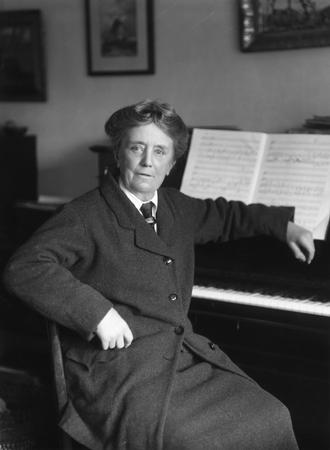
Smyth is barely know today.   She was a personal friend of Brahms and Tschaikovsky, among others, and knew Mahler well too.   An advocate of women’s rights, she marched with the suffragettes and enjoyed an amusingly varied sex life including affairs with the wife of the Archbishop of Canterbury and the wife of Queen Victoria’s private secretary.   As described by Wilson she was a woman I would have much enjoyed knowing.

“The Wreckers” features strong melodic lines and is essentially neo-Romantic.   Smyth really knew how to orchestrate and only her gender prevented her from being widely recognized during her lifetime.   Actually, her music slipped below the radar screen after her death and only now is slowly being rediscovered.

A very satisfying launch to the season.

-Ralph Micahel Stein

Share
Posted in Bloggenpheffer, Firsts | Comments Off on American Symphony Orchestra Performs Opera By Ethel Smyth