University of South Carolina School of Law Sued By The Christian Legal Society

Their Complaint is here. The letter the organization says it sent to the University President is here. (NB: both links are to CLS sites).

Application card credit online secured
Instant fleet 0 apr credit card application
Set up a VPN
Auto loan rate
Improving credit scores
Providian credit card application
Purchase auto insurance online
Free instant credit report with no credit card
Instant credit card approval applications
Free instant online credit report
Uk online credit card application
Linksys VPN
Sprint Ringtones
Average credit card debt in america
Capital one credit card application in canada
Automobile refinance
Zyrtec
Dave Hollister Ringtones
Cleaning up credit report
Auto warranty
Instant approval credit cards bad credit
Card credit debt grant help pay
America credit card debt statistics
Verizon Wireless Ringtones
Increasing credit scores
Credit card application immediate online approval
Credit cards with no apr
How to raise my credit score
Cialis
Lipitor
Download Ringtones
Credit score interest rate
Nexium
Fixed low apr credit cards
Get a free credit report
Unsecured credit cards low apr interest annual fee
Elysium Ringtones
Equity home loans
Juniper credit card application
Tampa home equity loan
Credit card application bad credit
Fair credit reporting act of 1970
Free Ringtones
Insurance long term care
Warranty auto
Life insurance broker
Norvasc
Debt consolidation firm
0 apr balance transfer over 70 credit cards
Credit score definition
How to get free credit reports
Credit card application high credit line immediate approval
Secured credit cards low apr credit card balance transfer
Zovirax
Free Verizon Ringtones
Ultram
Automobile refinance
Chevron credit card application
Low interest credit cards with instant approval
Consolidate student loan debt
Beatles Ringtones
Low apr student credit cards
Free debt settlement
Lortab
Transunion credit reports
Tylenol
Insurance long term care
Paydayloan
Instant approval credit cards for
Zovirax
Check credit reports
Levitra
Reliable debt settlement
Credit credit card applications
Free Real Ringtones
0 apr on balance transfer credit cards
Elysium Ringtones

Share
Posted in Academia, Feminism and Law, South Carolina | Comments Off on University of South Carolina School of Law Sued By The Christian Legal Society

Lecture by Prof. Ben Barres on “the obstacles faced by women in academic science and what individuals and institutions can do to increase opportunities in the sciences for women.”

Viewable (with RealPlayer) here. From the related website:

Professor Barres brings a unique perspective to this discussion: Professor Barres is transgender, and has experienced life as both a female and as a male scientist. His seminal article in the Journal Nature,”Does gender matter?”posits the challenge:”To paraphrase Martin Luther King, a first-class scientific enterprise cannot be built upon a foundation of second-class citizens. If women and minorities are to achieve their full potential, all of us need to be far more proactive. So what can be done?”

Ben Barres, MD, PhD is a Professor of Neurobiology, Developmental Biology, and Neurology at Stanford University. Dr. Barres earned a PhD in Neurobiology from Harvard, an MD from Dartmouth, and a BS in Biology from MIT. He is Associate Chair of Neurobiology at Stanford Medical School.

Share
Posted in Academia, Feminism and Technology | Comments Off on Lecture by Prof. Ben Barres on “the obstacles faced by women in academic science and what individuals and institutions can do to increase opportunities in the sciences for women.”

Symposium on Noëlle McAfee’s “Two Feminisms”

McAfee’s article is accessible here, via the Journal of Speculative Philosophy, Vol. 19, No. 2, 2005. McAfee writes at her blog:

An article of mine that I wrote a few years ago,”Two Feminisms,”found a new life as the subject of the fall symposium of the online journal, Symposia on Gender, Race, and Philosophy. Every season the editors pick an article for a symposium and also four scholars to critique it. Then the author has an opportunity to reply; the reply along with the critiques are posted; and the symposium is open for public commentary. My four interlocutors:Amy Allen, Nancy Bauer, Scott Pratt, and Linda Zerilli:had quite varied responses to the paper, all of which prompted me to put the piece in a broader frame.”Having read my interlocutors, it now occurs to me that …’Two Feminisms’ isn’t about two distinct groups of feminist scholars; it’s about two different conceptions of power and politics.”In the original article and the response, I argue for a model of politics and change that is deliberative in the Deweyan (not Habermasian) sense, a model where change need not come from battling the other but from working on changing the ways in which the larger sociosymbolic system situates us. The deep problem that accompanies injustice is the ways”the system,”and not just segments of society, puts us in”our place.”By moving the focus from primarily particular bad actors to the larger sociosymbolic sphere, I’ve touched some nerves. But this is a discussion worth having.

Symposium Commentaries (click on names to read essays):

Amy R. Allen (Dartmouth College)
Nancy Bauer (Tufts University)
Scott L. Pratt (University of Oregon)
Linda M. G. Zerilli (Northwestern University)

Reply by Noëlle McAfee (George Mason University)

Share
Posted in Feminism and Culture, Feminist Blogs Of Interest, Feminists in Academia | Comments Off on Symposium on Noëlle McAfee’s “Two Feminisms”

Data On Women and Men in Academia

1. Extensive annotated bibliography by Virginia Valian here. (See also Valian’s Equity Materials).
2. Report on “Women, Work and the Academy” by Alison Wylie, Janet R. Jakobsen and Gisela Fosado here.

Share
Posted in Academia | Comments Off on Data On Women and Men in Academia

A New Place To Buy Knock-offs?

Susan Scafidi launched her eponymous boutique on April 1st!

Share
Posted in Bloggenpheffer | Comments Off on A New Place To Buy Knock-offs?

“Dean Kagan Hires Every Law Professor in the Country”

From the April 1st edition of Harvard Law School’s The Record:

Harvard Law School’s communications office announced today that HLS has hired every law professor in the country, solidifying its position as the preeminent law school in America.

Dean Elena Kagan said that she got the idea from recent additions to the faculty. “As soon as we’d hire one professor from, say, Columbia or Chicago,” said Kagan, “he or she would suggest another prize we should grab. We hired two, then three, then finally realized we were only delaying the inevitable.”

“Plus,” added Kagan, “our U.S. News ranking was being held back by our student-teacher ratio.” Harvard’s student-teacher ratio, formerly 11:1, currently stands at 1:17. …

Via Brian Leiter.

Share
Posted in Bloggenpheffer | Comments Off on “Dean Kagan Hires Every Law Professor in the Country”

U.S. Funded Health Search Engine Blocks ‘Abortion’ – Now Unblocked

Wired story about blocking here. Lifting of the blockade announced here by the Dean, Johns Hopkins Bloomberg School of Public Health. Via the Relevant This Week Froomkin.

Update: NYT account here.

Share
Posted in Academia, Reproductive Rights | Comments Off on U.S. Funded Health Search Engine Blocks ‘Abortion’ – Now Unblocked

CFP: “Girls’ Culture & Girls’ Studies: Surviving, Reviving, Celebrating Girlhood”

From the FLP mailbox, this invitation for proposals on interdisciplinary scholarly and creative work to be presented at the 18th Annual Women’s Studies Conference at Southern Connecticut State University, October 17-18, 2008:

The 18th Annual Women’s Studies Conference at Southern Connecticut State University explores girlhood. What does it mean to be a girl? Who defines girlhood in an age when puberty and sexualization are happening at younger ages? How do girls assert their own identity in an increasingly medicated and consumerist culture which targets girls as a prime audience? Why are U.S. girls preoccupied with perfection? What challenges do girls across races, classes, religions, nations, and cultures face in an ever more globalized world? What is the relationship between girls and feminism? What effect can feminism have on constructions of boyhood and masculinity and how in turn can this affect girls? In the 18th annual SCSU Women’s Studies conference, we will take a close look at girls’ culture and girls’ studies, among the most vibrant areas in women’s studies. The Conference Committee invites individuals, groups, scholars, feminists, activists, girls and all to submit proposals that address topics related to all aspects of girlhood.

More information is available here.

When I read this call for participation, I couldn’t help but think of Jennifer Baumgardner and Amy Richards’ trenchant critique of “girls’ empowerment” programs:

If you go back to the genesis … you’ll probably find a woman who is revisiting the ghosts of her childhood. This movement is not just led by adult women…it is, in many ways, for adult women. Tangled in the Second Wave’s dedication to the girls’ movement..is the harsh fact that the shelf life of older women is short, many years shorter than that of men. Feminist women, therefore, may be masking their ambitions – which are considered unseemly or aggressive or threatening by a gynephobic society – by filtering them through girls. They also employ this tactic as an excuse to overlook the young women who are making strides right beside them.

(Manifesta, 185-186; emphasis in the original). Baumgardner and Richards were not describing “Girls’ Studies” per se, but I wonder if their critiques would apply equally to an academic (semi-academic?) conference with the subtitle “Surviving, Reviving, Celebrating Girlhood.” The invitation extends to “girls and all,” but how many girls are going to go to the SCSU Women’s Studies Conference? October 17 is a school day after all. And if we blame “Girls’ Studies” on second-wave feminists, then what explains enrollment in classes that makes the field supposedly “one of the most vibrant areas in women’s studies”? Perhaps college-age women also “mask[] their ambitions” with the label. A student of “Girls’ Studies” seems far less threatening (read: less likely to be dismissed as a lesbian) than a “Women’s Studies” major. Better to study those who have no body hair than to consort with those whom might braid theirs? My guess this is far more complicated than the “Second Wave vs. Third Wave” refrain suggests.

-Bridget Crawford

Share
Posted in Call for Papers or Participation, Upcoming Conferences | Comments Off on CFP: “Girls’ Culture & Girls’ Studies: Surviving, Reviving, Celebrating Girlhood”

Appel on “The Endurance of Biological Connection: Heteronormativity, Same-Sex Parenting and the Lessons of Adoption”

Annette Ruth Appel (UNLV) has posted to ssrn her article, “The Endurance of Biological Connection: Heteronormativity, Same-Sex Parenting and the Lessons of Adoption.” Here is the abstract.

This paper traces the intersecting and diverging paths of legal norms regarding adoption and the legal recognition of same sex parents. It compares adoption law’s movement from replicating the modern family by ignoring biology to its current embrace of biology to a similar movement among lesbian and gay families. Many of these families are replicating modern family forms, but are also heeding lessons about the endurance of biology; these post modern lesbian and gay families are acknowledging and even embracing their children’s biological families. The paper first reveals the tenacity of biological connection and its deep and wide significance in United States culture, history, and law. The next section explores lesbian and gay families with children, noting ways these families reflect heteronormativity through two, rather than plural, parent families and yet still value and honor biological connections by including reproductive partners, such as sperm donors and surrogates, into their family systems. The article concludes with lessons open-adoption law and practice might offer lesbian and gay families with children, particularly regarding the possible benefits of developing legal schemes regarding these family systems.”

The full article is available here.

-Bridget Crawford

Share
Posted in Feminist Legal Scholarship, LGBT Rights | Comments Off on Appel on “The Endurance of Biological Connection: Heteronormativity, Same-Sex Parenting and the Lessons of Adoption”

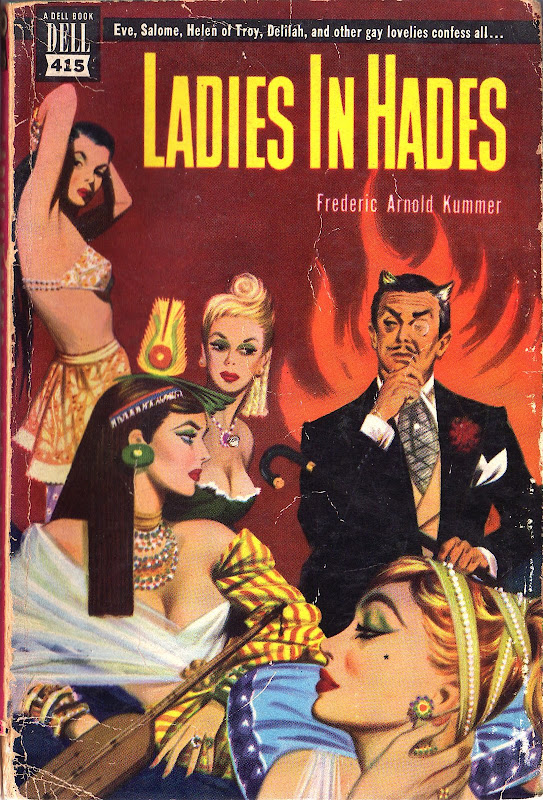
‘Ladies In Hades’ by Frederic Arnold Kummer (1928)

Share
Posted in Bloggenpheffer | Comments Off on ‘Ladies In Hades’ by Frederic Arnold Kummer (1928)

Robin Fretwell Wilson, “Keeping Women in Business (and Family)”

Abstract:
Work and family have become either/or propositions for a growing segment of young professionals in business, law, and medicine. A well documented opt-out revolution is underway, in which women professionals are leaving the workplace in droves. Less appreciated is the converse phenomenon: huge numbers of female, and male, professionals who remain in the workplace but opt out of family. These men and women forego parenting and stable, long-term relationships in surprisingly high numbers, believing they cannot have both.

This Chapter documents the extent of this break from family for professional men and women. Using the 2003 National Survey of College Graduates, this Chapter shows that among professionals, long-term adult relationships often take a beating, but that women outstrip men in the number of failing personal relationships. Women with MBAs are divorced or separated more often than college graduates and they split up over twice as often as men with the same degree. Women with JDs and MDs are also more likely to divorce or separate than their male counterparts in the same profession. The complete break from marriage tells an even starker story. 21% of women with JDs and 17% of women with MBAs have never married, compared to 14% of women college graduates. Importantly, never married women with MBAs outnumber their male counterparts almost three to one, a gap that closes only somewhat for doctors and lawyers.

Most examinations of the opt-out revolution emphasize almost exclusively what employers can and should do to support family. This Chapter starts closer to home with graduate educators. In many ways, young professionals learn to treat work and family as either/or choices at the very beginning of their graduate professional educations. The intense time demands and pressures of graduate professional education teach students early on to place professional obligations over the personal at every turn. Far from being solely a problem for employers to remedy, graduate professional schools themselves must take an active role.

This Chapter will explore what graduate professional programs can do to change the calculus that young professionals engage in when deciding whether to combine family and work. It argues that professional schools can change the culture of graduate education and thus the expectations of young professionals with a number of straight-forward, concrete measures. Graduate educators can support family by modeling good behavior in our own institutions, decreasing the admission age for women, giving preference in admissions to applicants with children, providing financial support for student-parents in the form of scholarships and better loan terms, establishing alumni mentoring networks, and outlining for students the real costs of various practice settings for forming and maintaining families. Once armed with stronger expectations that they can have both, these young professionals will be important agents for transforming the workplace from the inside out.

Downloadable here. This scholarly work was discussed by the Wall Street Journal in this online article, which reported:

Women with M.B.A.s are twice as likely to get divorced or separated as their male counterparts. The picture isn’t much rosier for women with law or medical degrees.

That is the finding in a soon-to-be-published study by Washington & Lee University School of Law Prof. Robin Fretwell Wilson. Using a National Science Foundation survey of more than 100,000 professionals, Prof. Wilson analyzed data on newly minted professionals in business, law and medicine. Her conclusion: For women, a professional degree is often hazardous to marital health. …

… What Prof. Wilson’s study highlights is the large number of professionals — particularly women — who remain in the workplace but “opt out” of having families.

Women with M.B.A.s described themselves as divorced or separated more often than women with only bachelor’s degrees (12% of female M.B.A.s compared with 11% of women with only bachelor’s degrees) and more than twice as often as men with M.B.A.s (5% of whom reported being divorced or separated), according to Prof. Wilson’s study. The study will be published next week by the Witherspoon Institute as a chapter in a book to which Prof. Wilson contributed, “Rethinking Business Management.”

According to Prof. Wilson’s study, women with law or medical degrees divorce less often than those with only bachelor’s degrees, but are still more likely to divorce or separate than their male counterparts (10% of women with law degrees and 9% of women with medical degrees, compared with 7% of male lawyers and 5.1% of male doctors).

Prof. Wilson also found that female professionals abstain from marriage at double and sometimes nearly triple the rate of men. …

Robin used to be on the South Carolina law faculty and we really miss her.

–Ann Bartow

Share
Posted in Academia, Legal Profession, Recommended Books | Comments Off on Robin Fretwell Wilson, “Keeping Women in Business (and Family)”

Yesterday, by more than a 2-1 margin, Columbia SC voters approved a proposal to allow sales of beer and wine : but not liquor : on Sundays.

Story here. Hope this doesn’t lead to dancing! Slowly but surely McGowan v. Maryland, in which the Supreme Court held that state “blue laws” which prohibited specific activities on Sundays or limited them to certain hours, places or conditions did not violate the Free Exercise and Religious Establishment clauses of the First Amendment, is unraveling. And by “slowly” I mean, yeesh, that case was decided 46 years ago.

Share
Posted in Feminism and Law, South Carolina | Comments Off on Yesterday, by more than a 2-1 margin, Columbia SC voters approved a proposal to allow sales of beer and wine : but not liquor : on Sundays.

Newsweek/Surrogacy II

Yesterday I noted the current Newsweek cover story on surrogacy. Here’s a bit more to think about in that regard. I’m prepared to assume that the practice of surrogacy is useful. (Even if I weren’t, I’d have to acknowledge it is here to stay. It may be banned or restricted in some states/countries, but it will be available in plenty of others.) The question then for me is what’s the best set of rules for surrogacy. Of course, “best” will depend on your point of view. I want to try to ask the proverbial “woman question” and answer this as a feminist. The Newsweek article invites us to focus on the surrogate’s experience as well as the relationship between the contracting couple and the surrogate. This seems to me to be critical, especially as the surrogate will always be a woman and, as I’m partway through demonstrating elsewhere on the blog, the issues for a woman in the contracting couple are also distinctive.More… It’s interesting to compare the experience in the UK with that here in the US. (I don’t profess real expertise on this, just the gathered impressions from what I’ve read. If there is a real analytical work on this, I’d love to hear about it.) Formally the law is quite different. In the UK surrogacy is not a for-profit enterprise, the surrogate cannot be paid, and the contract is not enforceable. In the US–or at least in the featured states in the US–it is for profit, surrogates are paid and the contracts are enforceable. I’ve already argued that these things are not chance alignments–surrogacy can only exist as a profitable industry if surrogates can be forced to turn over the children. It’s interesting to contrast the accounts of surrogacy (from the surrogate’s viewpoint) in the UK and in the featured US states. For starters, note that the surrogates in the UK do receive money for “expenses” and that it seems to be roughly on the same scale as the money received here. So from a narrow economic view, the two systems are more similar than they appear. But, since the women in the UK have the right to change their minds, their willingness to turn over their children to the intended parents is crucial. Unsurprisingly, this willingness is fostered by a positive relationship between the intending parents and the surrogate mother. In other words, the intending couple have every reason to treat the surrogate with dignity, respect, and good will. And the system usually works–the instances in which the surrogates women change their minds appear to be few. It’s easy to see that the dynamic in the US could well be quite different, though this is not to say it always will be. If the contracting couple knows that the surrogate can be forced to turn over the child, they may choose to assert their authority in any number of ways. Indeed, to the extent surrogacy is likened to baby-sitting, they might tend to treat her as you would a babysitter. On this point, I’d say there’s ample reason to prefer the system in the UK. It appears to allow surrogacy without inviting the more disturbing aspects of surrogacy. It respects the dignity of the women who are surrogates and recognizes their unique role. There’s another important point, of course. The real money in the US isn’t made by the surrogates themselves–it is made by the surrogacy centers that facilitate surrogacy. That is what truly makes it into a for-profit enterprise.

Julie Shapiro–cross posted to Related Topics

Share
Posted in Feminism and Law, Feminism and Technology | Comments Off on Newsweek/Surrogacy II

Just how many women have to be raped before the military DOES SOMETHING about it?

Here’s just the latest  depressing assessment from my virtual colleague Dan Filler over at  The Faculty Lounge:  

040609_harman_hmed_9ah2Representative Jane Harman has a disturbing post up at Huffington (which is also an LA Times op-ed) discussing the frequency of   rape in the military – and particularly the extent that woman soldiers are sexually assaulted.   Everyone knows I’m a crime data skeptic.   Still, I was particularly troubled by some Department of Defense stats she cites for 2007.   Here’s a snapshot:

Only 181 out of 2,212 subjects investigated for sexual assault in 2007, including 1,259 reports of rape, were referred to courts-martial…. Another 218 were handled via nonpunitive administrative action or discharge, and 201 subjects were disciplined through “nonjudicial punishment,” which means they may have been confined to quarters, assigned extra duty or received a similar slap on the wrist. In nearly half of the cases investigated, the chain of command took no action; more than a third of the time, that was because of “insufficient evidence.”   This is in stark contrast to the civilian trend of prosecuting sexual assault. In California, for example, 44% of reported rapes result in arrests, and 64% of those who are arrested are prosecuted, according to the California Department of Justice.

The Huffington Post’s provocative homepage teaser for the post – women in the military are more likely to be raped by a fellow soldier than killed by enemy fire – turns out to be a wild understatement.   For whatever reasons – everything from institutional culture around gender and sex to a healthy does of troop omerta – the military seems unable to safely support a co-ed force.   Moreover, if Harman’s analysis is anything close to right, we have a whole other cohort of injured soldiers coming home – and one that I fear nobody in Washington, at the VA, or pretty much anywhere else, is taking seriously.  

Kathleen A. Bergin    

Share
Posted in Acts of Violence | Comments Off on Just how many women have to be raped before the military DOES SOMETHING about it?

“Ooh Girl!”

Best R&B song ever. Maybe not safe for work, depending on where you work.

Share
Posted in Bloggenpheffer, Sociolinguistics | Comments Off on “Ooh Girl!”

Feminist Jurisprudence Day at Hamline, April 11, 2008!

Hamline University Klas Center
St. Paul, Minnesota

A day of dialogue on gender and the state.
Students, legal practitioners, and community advocates encouraged to attend.


Our list of panelists continues to grow. See the list below for details.

Morning Panels
9:00-10:00 am: Women and Trafficking in Minnesota
10:10-11:10 am: Women Offenders in Minnesota

11:30-12:30 pm: Featured Keynote Speaker
Professor Ahmed E. Souaiaia
Author of “Contesting Justice: Women, Islam, Law, and Society”, Professor of Arabic, Islamic and international studies, University of Iowa.

Lunch will be provided for registrants. Click Here to Register!

Afternoon Panels
12:40-1:40 pm: Sexual Orientation and the State
1:50-2:50 pm: Reproductive Healthcare and the State


3:00-5:00 Law Students for Reproductive Justice Spring Social
Hamline Law Faculty Study
Join law students, attorneys and the community to unwind, eat, have a glass of wine, and meet our fellow participants.

Continuing Legal Education credits have been applied for.
Our CLE event code is 117983.

Click Here to Register!

More information here.

Share
Posted in Academia, Law Schools, Law Teaching, Legal Profession, Upcoming Conferences, Upcoming Lectures | Comments Off on Feminist Jurisprudence Day at Hamline, April 11, 2008!

April Fool’s Day Hoaxes

100 of ’em, here.

Share
Posted in Bloggenpheffer | Comments Off on April Fool’s Day Hoaxes

How To Be The Best…

If you are a boy, this book will teach you how to:
â–º Fight off a crocodile
â–º Rip a phonebook in half
â–º Escape quicksand
â–º Speak in code

But if you are a girl, surely you’d prefer to:
â–º Act like a celebrity
â–º Make your own bubble bath
â–º Give yourself a perfect manicure
â–º Knit with your fingers

Via IntLawGrrls.

Share
Posted in Feminism and Culture | Comments Off on How To Be The Best…

Toilet Signs

A whole blog full! Some subtle, some not so much…

See also.

Share
Posted in Bloggenpheffer, Feminism and Culture | Comments Off on Toilet Signs

Still More Misogyny

This time from spoiled rich kids at a private high school in NYC. In about five years, give or take, some of them will be enrolling in law schools, but hopefully not mine. Via Jezebel.

–Ann Bartow

Share
Posted in Feminism and Culture, Feminism and Technology, Sociolinguistics | Comments Off on Still More Misogyny

Need a Daily Dose of Misogyny?

Nicole Black notes that Volokh Conspiracy readers have been dumping all over Dahlia Lithwick. She writes:

Volokh Conspiracy readers can’t help themselves.   When a women lawyer is as successful at what she does as Dahlia Lithwick, they simply have to characterize her as:   lacking objectivity, emotional, unqualified, unfit, laughable, illogical, snarky, bitter, mean-spirited, lacking common sense, dishonest, a useless hack, unimportant, unintelligent, “you’re out, honey”, ineffective, unpersuasive, screeching, squealing, giggling schoolgirl, clueless, “gossip columnist tool”, a bad lawyer, :   Lithwick on Heller and Oh Those Hypocritical Conservative Justices.

Share
Posted in Feminist Blogs Of Interest, Sexism in the Media | Comments Off on Need a Daily Dose of Misogyny?

“The Cumberland County Courthouse lawn in Crossville, Tennessee now features an enormous statue of the Flying Spaghetti Monster.”

More information here.

Share
Posted in Feminism and Politics | Comments Off on “The Cumberland County Courthouse lawn in Crossville, Tennessee now features an enormous statue of the Flying Spaghetti Monster.”

Surrogacy on the Cover of Newsweek

In yet another sign that there’s a resurgence of interest in this topic, surrogacy is the cover story in this week’s Newsweek magazine. Interestingly, the focus is on the women who are surrogates. I think this consistent with recent press coverage, but quite different from when the main news was the wonders of technology or ART more generally. It deepens my conviction that it is a good cultural moment to be thinking about these things.

There’s quite a bit to say about this article, but I wanted to offer a brief take on how it is set up. The authors describe surrogacy as “an act of love but also a financial transaction.” This suggests is an interesting way to categorize surrogacy transactions. At one end of the spectrum you might place the ones in India I’ve previously discussed. They fall pretty firmly into the “financial transaction” realm. (Remember that in some the parties never meet. And no one portrayed the Indian women as engaging in acts of love.)

By contrast, and at the other end of the spectrum, surrogacy in Britain is (at least formally) not a financial transaction at all. Surrogates cannot be paid for their services. It’s considered to be altruistic or compassionate. Clearly on the “labor of love” side of the balance?

As far as I can tell, all the cases discussed in Newsweek are commercial surrogacy–the surrogates are in fact paid. Indeed, there’s only fleeting recognition that someone might actually do this absent the money. (I think the listing of places where surrogacy is permitted is deceptive in this regard–it is really a list of where surrogacy contracts will be enforced and where surrogates can be paid.)

What may be most interesting is the initial insistence that, despite the payment, these are not purely commercial transactions–a sale of services or worse yet, goods. Perhaps given the prevalence of a highly romanticized notion of pregnancy these days, it’s impossible to reduce pregnancy to a service. But isn’t it a bit telling that there aren’t a lot of wealthy surrogates? (The article notes that an increasing number of surrogates are military wives, which speaks to the poor compensation provided to service members.) In any event, it seems to reflect some desire to place the US in the middle of the surrogacy spectrum.

I’m happy to agree that portraying surrogacy as a simple sale of services misses a great deal. This article is actually very rich in detail, in providing a more detailed and nuanced portrait of surrogates, considering a range of circumstances and experiences.

–Julie Shapiro (cross-posted to Related Topics)

Share
Posted in Feminism and Law, Feminism and Technology | Comments Off on Surrogacy on the Cover of Newsweek

“Harry Potter: Feminist Friend or Foe?”

It was only a matter of time until a book like Harry Potter: Feminist Friend or Foe?  hit the presses.   I have an affinity for feminist perspectives and  a tolerance for “Law &” just about anything.   I liked the Harry Potter series (although I think it jumped the shark in the Half-Blood Prince), too.   But for some reason, this  book doesn’t interest me at all.   Maybe I’m too 21st-century (dare I say “third-wave”?) to think that “friend” vs. “foe” is so easy to distinguish.  

Harry Potter, as a character or as a phenomenon, doesn’t concern me too much.    He/it is  just another springboard for interesting conversations, not an ideology that I have to adopt or even an “influence” to be avoided.   Ditto for Deenie, Forever and all of the other books my school librarians never wanted kids to read.

-Bridget Crawford  

Share
Posted in Feminism and Culture | Comments Off on “Harry Potter: Feminist Friend or Foe?”

Civil Unions and State Taxes

A story in the Hartford Courant last week highlights the burdens faced by same-sex couples in states that legally recognize same-sex relationships when they go to file their state tax returns.

But, first, a little background: Because many states use the federal income tax as a base for their own income taxes and the federal government does not recognize same-sex relationships, same-sex couples in legally recognized relationships cannot simply use their federal returns as a basis for their state filings (as different-sex married couples can). As a practical matter, then, this usually means that the same-sex couple has to prepare two separate”single”federal returns to  file with the federal government and then a mock”joint”federal return to use as a basis for completing their joint state return. (For more on this problem and the even worse problem of what happens to couples when they move from one state to another, check out this note by one of my students: Catherine Martin Christopher, Note, Will Filing Status Be Portable? Tax Implications of Interstate Recognition of Same-Sex Marriage, 4 Pitt. Tax Rev. 137 (2007).)

Now, back to the story: A Connecticut couple that had entered into a civil union was completing their tax returns online using the H&R Block web site when the following message popped up: “We don’t support Connecticut Civil Union returns.” At the most immediate level, H&R Block could have put a bit more thought into how best to phrase the message that this was a software issue. After all, the story implies that the Connecticut couple initially took the statement to represent H&R Block’s position on the propriety of legally recognizing same-sex relationships in Connecticut). More troubling, however, is the fact that the couple was told by H&R Block that it was willing to prepare the return in one of its offices—but at a price of about $200, which is $155 more than the online price for preparing returns.

The ACLU has now stepped into the matter, asking H&R Block to cease discriminating against civil union couples—in violation of Connecticut’s prohibition against denying full and equal accommodation on the basis of sexual orientation or civil union status. (In the interest of full disclosure: I am on the Board of Directors of both the ACLU of Pennsylvania and its Pittsburgh Chapter—and my involvement in the organization is in large part motivated by the great work, just like this, that the organization does on behalf of LGBT individuals.) H&R Block is now studying how it can provide online support for civil union couples. Oddly enough, H&R Block has managed to accommodate Massachusetts couples that have entered into same-sex marriages, which should raise similar issues. But this just goes to underscore the point that civil unions are not the same as marriage, no matter what the law says. (For more on this, see this story in the New York Times and this report from the New Jersey Civil Union Review Commission.) The story notes that TurboTax supports civil union returns and actually advises clients to buy its software rather than complete the return online using TurboTax, because it comes out cheaper for the client.

-Anthony C. Infanti

Share
Posted in Feminism and Law, LGBT Rights, Women and Economics | Comments Off on Civil Unions and State Taxes

If You Live In South Carolina, Get A Passport And Carry It Whenever You Travel, Even Domestically.

Why? Because of this:

Gov. Mark Sanford said today that he will not comply with the federal Department of Homeland Security’s standards for state-issued driver’s licenses and IDs, meaning S.C. residents could be subjected to extra security screenings when boarding airplanes or entering federal buildings.

Using a passport rather than an SC Driver’s License will (hopefully) solve this problem.

Update: Sanford’s objections to compliance are articulated here.

–Ann Bartow

Share
Posted in South Carolina | 11 Comments

“Nipple Rings, Respect and the Undertreatment of Women’s Pain”

Really interesting post by this name by Jennifer Bard at the Women’s Bioethics Project blog.

Share
Posted in Feminism and Law, Feminism and Politics, Feminism and Technology, Feminist Blogs Of Interest, Women's Health | Comments Off on “Nipple Rings, Respect and the Undertreatment of Women’s Pain”

Another Excuse for Non-Reciprocal Oral?

According to this Time article, oral sex can add to HPV-associated cancer risk in men.

Oral sex can get most men’s attention. The topic becomes considerably more relevant, however, when coupled with a new study linking the human papillomavirus (HPV) to an increased risk of a kind of oral cancer more often seen in men.

The study, which appears in this week’s New England Journal of Medicine (NEJM), shows that men and women who reported having six or more oral-sex partners during their lifetime had a nearly ninefold increased risk of developing cancer of the tonsils or at the base of the tongue. Of the 300 study participants, those infected with HPV were also 32 times more likely to develop this type of oral cancer than those who did not have the virus. These findings dwarf the increased risk of developing this so-called oropharyngeal cancer associated with the two major risk factors: smoking (3 times greater) or drinking (2.5 times greater). HPV infection drives cancerous growth, as it is widely understood to do in the cervix. But unlike cervical cancer, this type of oral cancer is more prevalent in men.

I can hear the excuses already.

-Bridget Crawford

Share
Posted in Women's Health | Comments Off on Another Excuse for Non-Reciprocal Oral?

Strangelets on the Front Page

I can’t help but think of author Dan Brown when I hear the acronym “CERN.” The Swiss science institute has been sued in federal court in Hawaii:

[T]wo men pursuing a lawsuit in federal court in Hawaii . . . think a giant particle accelerator that will begin smashing protons together outside Geneva this summer might produce a black hole or something else that will spell the end of the Earth : and maybe the universe. * * * Walter L. Wagner and Luis Sancho contend that scientists at the European Center for Nuclear Research, or CERN, have played down the chances that the collider could produce, among other horrors, a tiny black hole, which, they say, could eat the Earth. Or it could spit out something called a”strangelet”that would convert our planet to a shrunken dense dead lump of something called”strange matter.”Their suit also says CERN has failed to provide an environmental impact statement as required under the National Environmental Policy Act.

This was front page coverage (here) in the NY Times. We will be waiting a long time for front page coverage of why the law has not yet realized its promise of equality for women and men. And rigorous discourse about race and rights. These issues don’t make as good copy as a black hole gobbling the earth.

-Bridget Crawford

Share
Posted in Feminism and the Environment, Sexism in the Media | Comments Off on Strangelets on the Front Page

District Court Rules State “Right of Publicity” and “False Designation of Origin” claims are NOT barred by Section 230 of the Communications Decency Act

This decision provides a mechanism for the victim of social networking bad actors to pursue a claim for damages against the site hosting the damaging material. A media account of the suit, captioned Jane Doe v. Friendfinder Network, Inc., explains:

A woman who lives somewhere near Dartmouth College is suing an online sex site, claiming it identified her in her area even though a nude photograph purporting to be her was not.

The woman, suing under the pseudonym “Jane Doe,” says her bogus profile had been on the site for more than a year when someone in her circle of friends told her they had believed it was her and had been discussing it.

The profile on [Adult Friend Finder dot com], which bills itself as the world’s largest community for sex and swingers, said she was seeking “men or women for erotic chat/e-mail/phone fantasies and discreet relationship.”

The profile was of a 40-year-old in the Upper Connecticut River Valley area who had recently separately from her husband, according to the U.S. District Court lawsuit against Friendfinder Network Inc. and Various Inc., an affiliated company.

The woman said all she knows about the creator of the bogus “petra03755” profile – created in June 2005 – is he or she did it using the computer network at Dartmouth College in Hanover, whose zip code is 03755.

A federal judge this week threw out some of the woman’s claims, saying the companies are protected by a 12-year-old federal law that protects Internet service providers and interactive sites from liability for false postings by others. U.S. District Judge Joseph Laplante’s refusal to dismiss all the claims under the Communications Decency Act was an unusual first-round victory for a plaintiff. …

The judge explicitly criticized and rejected the Ninth Circuit’s ruling in Perfect 10 v. CC Bill (see also), writing:

Thus, even if it were free to disregard the plain language of § 230(e)(2), this court cannot accept the defendants’ claim at oral argument that allowing state-law intellectual property claims to survive the CDA would have a “devastating” impact on the internet. Despite the general consensus before the Perfect 10 decision that the CDA did not shield service providers from state intellectual property law, both the internet and so-called “e-commerce” remain alive and well, and show no signs of imminent collapse.

Via Anthony Falzone. When I find a direct link to the opinion I’ll post one.

–Ann Bartow

Update: Thanks to the Stanford Center for Internet & Society, the opinion is available here.

Share
Posted in Feminism and Law, Feminism and Technology | Comments Off on District Court Rules State “Right of Publicity” and “False Designation of Origin” claims are NOT barred by Section 230 of the Communications Decency Act

“The pop star also held the 3-month-old daughter of a 22-year-old woman who was sold by her father to a brothel and is now HIV-positive. The woman broke down in tears as she urged Martin to keep fighting against human trafficking.”

That’s an excerpt from this article.

Share
Posted in Acts of Violence, Feminism and Law, Sisters In Other Nations | Comments Off on “The pop star also held the 3-month-old daughter of a 22-year-old woman who was sold by her father to a brothel and is now HIV-positive. The woman broke down in tears as she urged Martin to keep fighting against human trafficking.”

Knit Heart

From here.

Share
Posted in Bloggenpheffer | Comments Off on Knit Heart

Live Blog Report: Law, Culture and Humanities

I am at the Law, Culture, and the Humanities conference this weekend. The conference is being co-sponsored by UC-Berkeley and San Francisco State University, and it is being held at Boalt Hall (i.e., what is now being referred to as the”UC-Berkeley School of Law”).

This morning I attended a very interesting session titled”Social Justice Feminism: Words, Movements, Theory, and Practice.”Feminist Law Profs Verna Williams and Kristin Kalsem (both of the University of Cincinnati:notwithstanding SSRN’s insistence that Kristin is”unaffiliated”) presented a paper that they are working on together. The paper is titled”Social Justice Feminism: History and Principles”: an abstract and a copy of the paper can be viewed/downloaded from SSRN here. In their presentation, they described the principles of social justice feminism and its methodologies, using the U.S. Supreme Court’s generally overlooked decision in Long Island Care at Home v. Coke as an example. The presentation, which included video clips from the 1977 National Women’s Conference, was quite interesting, and the paper promises to be very interesting.

After this first session, I was on a panel with Bennett Capers (Hofstra), who presented a paper titled”Cross-Dressing and the Criminal”(available here). This presentation was fascinating because Bennett didn’t talk about the criminalization of cross-dressing, but about how cross-dressing can be used as a metaphor in criminal law. He suggested that judges, prosecutors, and jury members question the bases for their decisions by imagining whether they would come to the same decision were the defendant of a different race, gender, sexual orientation, etc. One of my other co-panelists, Anne Bloom (McGeorge) had a great paper titled”The Regulation of Sexual Identity in Tort Law,”which examines the role of tort law in enforcing and reproducing cultural/legal norms that determine sexual identity. In her talk, Anne had some quite interesting things to say about this issue in the area of products liability and, particularly, as it relates to breast implant litigation. My last co-panelist was Hadar Aviram (Hastings), who presented a paper with the catchy title”Geeks, Goddesses, Leather and Heinlein: Political Mobilization and the Cultural Locus of the Polyamorous Community in the San Francisco Bay Area.”She described the results of her interviews with members of that community and some of the conclusions that she drew from her research.

In the afternoon, I made it to the panel where Feminist Law Prof Darren Rosenblum (Pace) was presenting his paper titled”Unsexing CEDAW.”His paper, which argues that the Convention for the Elimination of All Forms of Discrimination Against Women should not focus on”women”as such and treat them as a discrete and insular minority, but should instead focus on gender and cover both men and women, generated quite a bit of discussion in the room.

I’ll try to blog from the conference again tomorrow.

-Anthony C. Infanti

Share
Posted in Feminism and Law, Feminist Legal Scholarship | Comments Off on Live Blog Report: Law, Culture and Humanities

Third Carnival Against Pornography and Prostitution

Up at the Burning Times.

Share
Posted in Carnival time! | Comments Off on Third Carnival Against Pornography and Prostitution

“Equality Now welcomes the release of Mokarrameh Ebrahimi from prison in Iran following the suspension of her stoning sentence.”

From the FLP Mailbox:

“On 18 March 2008, the Judicial Commission for Amnesty in Iran ordered the release from prison of Mokarrameh Ebrahimi, a woman sentenced to death for adultery. Both Mokarrameh and her partner Jafar Kiani were originally scheduled to be stoned to death on 21 June 2007 for adultery. Equality Now issued an urgent appeal to stop the stonings. International advocacy appeared to have an effect as their sentences were suspended in the eleventh hour by a written order of the head of the judiciary in Tehran . Two weeks following the order, however, Iranian judiciary spokesperson Alireza Jamshidi announced in Tehran that Kiani’s sentence of stoning had been carried out on 5 July 2007. There were fears that the same fate would befall Mokarrameh. Until her recent amnesty she remained in prison on charges of adultery where she had spent a number of years along with her son who was born in prison.

Equality Now would like to thank all of our Women’s Action Network members who took action on behalf of Mokarrameh. In spite of a moratorium on stoning issued in 2002 by Ayatollah Shahroudi, head of the Iranian judiciary, judges continue to hand down stoning sentences, in particular and disproportionately to women, for adultery. Equality Now continues to campaign for the commutation of all sentences of death by stoning and for the removal of all laws that discriminate against women, including those relating to fornication and adultery.

“We remain concerned for Zohreh and Azar Kabiri and Kobra Najjar, among others, who have been sentenced to stoning. Please contact Iran’s Head of Judiciary Ayatollah Shahroudi urging him to release Kobra Najjar with immediate effect (see this website). Please do the same for Zohreh and Azar Kabiri (see this website) and for all others sentenced to this cruel and inhuman punishment. Iran must comply with its obligations under the International Covenant on Civil and Political Rights (ICCPR) and ban the practice of stoning, as well as recognize that adultery is a private act that should not incur criminal penalties.”

Share
Posted in Sisters In Other Nations | Comments Off on “Equality Now welcomes the release of Mokarrameh Ebrahimi from prison in Iran following the suspension of her stoning sentence.”

Moe at Jezebel asks: “How Many 8-Year-Olds Have To Get Bikini Waxes Before We All Agree The Terrorists Have Won?”

Here. Article about beauty treatments for children that it references, here.

Share
Posted in Feminism and Culture | Comments Off on Moe at Jezebel asks: “How Many 8-Year-Olds Have To Get Bikini Waxes Before We All Agree The Terrorists Have Won?”

You might want to remove your nipple jewelry before you travel by air.

Cronespeaks explains why.

Share
Posted in Women's Health | Comments Off on You might want to remove your nipple jewelry before you travel by air.

Michael J. Higdon, “Queer Teens and Legislative Bullies: The Cruel and Invidious Discrimination Behind Heterosexist Statutory Rape Laws”

Abstract:
Most states make an exception to their statutory rape laws for sexual acts involving an adolescent victim, who is below the age of consent, when the defendant is close in age to the victim (i.e., generally no older than three or four years). However, a few states explicitly limit such exceptions (commonly referred to as Romeo and Juliet exceptions) to only those situations involving teens who are of the opposite gender. Thus, adolescents in these states who have sex with someone below the age of consent, and who are also the same gender as the defendant, cannot avail themselves to the exception.

As a result, these teens are faced with felony convictions, large fines and mandatory sex offender registration – penalties that would not attach had the victim been the opposite gender. My article argues that such disparate treatment is not only cruel, but is also invidious discrimination that violates the Equal Protection Clause given that these laws serve primarily to stigmatize LGBT adolescents, a class of individuals that is already one of the most stigmatized and at-risk groups in American society.

Downloadable here. Via the Sexual Orientation and the Law Blog.

Share
Posted in Feminism and Law, LGBT Rights | Comments Off on Michael J. Higdon, “Queer Teens and Legislative Bullies: The Cruel and Invidious Discrimination Behind Heterosexist Statutory Rape Laws”

There are seventeen different types of lawyers…

…at least according to the Legal Underground.

Share
Posted in Legal Profession | Comments Off on There are seventeen different types of lawyers…

“Workplace bullies and the academy”

Historiann has an interesting post with this title here. She notes that “women victimizing women” surfaces as a problem. She also trenchantly observes that academics can work around bullies easier than people in other occupational environments, writing:

The only exception to this is if your bully happens to be someone of importance in your field–but this is probably unusual: by definition, people who are important in their field spend their time writing books, working with students, and hobnobbing at conferences with other people important in their field. In general, they don’t have the time, let alone the inclination, to try to mess with someone else’s career. In my experience, the bullies weren’t exactly the brightest bulbs in the chandelier, to put it charitably. They weren’t terribly productive scholars or successful teachers, which is probably why they felt so intimidated by smart young things who were clearly going places. So, they chose to make their post-tenure careers as hall monitors rather than as scholars. [Emphasis added.]

My own experiences with female bosses and “superiors” have been very positive. In my view most of the (small number of) women who entered law teaching in the 1970s did a fantastic job of bringing new women into the field, and mentoring them. That’s the main reason the number of women law professors increased as much as it did. Sure we have miles to go before we reach anything approaching parity in the profession, but it was primarily the efforts of women law professors that got a lot of us in the door, as well as through the tenure slog. To this day, when I need help or advice, the law profs I turn to and whom I most trust, as both friends and mentors, are mostly women. Law may be different than other fields in this regard. I’m glad it was for me, anyway.

Historiann’s conclusion that the worst bullies on a faculty tend to be the underachieving losers, however, sounds spot on to me.

–Ann Bartow

Share
Posted in Academia, Feminist Blogs Of Interest, Feminists in Academia | Comments Off on “Workplace bullies and the academy”

Another Travel Story, This One Involving a U.S. Attorney

Traveling to and from Columbia, SC by air often requires two planes. So I’ve spent a lot of “layover” time in airports. Because Fort Jackson, “the largest and most active Initial Entry Training Center in the United States” is located in Columbia, and because the Army flies new recruits in via commercial airlines, I’m used to having nervous young people waiting with me in airline terminals ask me if I live in Columbia, and when I answer affirmatively, ask me about the city and about Fort Jackson. Yesterday I got the same questions from an older man who was flying to Columbia from Wyoming, where he worked on rigs as an oil driller, to Columbia to attend his daughter’s graduation from Basic Training at Fort Jackson. He interrupted this chat to meet his sister’s plane, as she was flying in from Arkansas to attend the graduation as well. He returned with her, and the three of us had a really pleasant conversation about many things. Neither of them had a computer or knew how to use one, so I pulled out my laptop and helped them research hotel reservations and car rental information. They were extremely nice people. They offered to buy me coffee, but I declined and they went off in search of it, and I began checking my e-mail. One of my messages contained a link to the webcast of a law conference I had recently attended. I began listening to it. I didn’t have any headphones with me, so I tried to keep the volume low. But I have been suffering from a head cold that has been making my ears stuffy, so maybe it was louder than I think it was. I don’t know.

After a couple of minutes I asked the people sitting in my row of chairs if the webcast was disturbing them. They said no. Maybe they were just being polite. It didn’t occur to me to ask the people sitting behind me if the webcast was disturbing them. I wish it had. My friends from Wyoming and Arkansas returned with their coffee and sat next to me. We started chatting again and I left the webcast droning on in the background, unthinkingly. Suddenly a woman sitting behind me stood up and thumped me on the shoulder, hard. “EXCUSE ME!” she shouted, “ARE YOU GOING TO THE NAC?” The NAC (pronounced “knack”) is the National Advocacy Center, located in Columbia. A lot of government lawyers travel to Columbia to attend training sessions at the NAC.

“No,” I said. “WELL I AM THE U.S. ATTORNEY FOR THE ____ DISTRICT OF ______ AND THE LAW TAPES YOU ARE LISTENING TO ARE DISTURBING PEOPLE!” She did not leave blanks. She specified the district and the state. Loudly. Clearly I was supposed to be impressed and intimidated. I immediately shut off the webcast and apologized. This was not good enough.

“I WOULD NEVER ALLOW AN ATTORNEY WHO WORKED FOR ME TO LISTEN TO LAW TAPES IN A PUBLIC PLACE. I AM THE U.S. ATTORNEY FOR THE ____ DISTRICT OF ______ AND I THINK YOUR BEHAVIOR IS HIGHLY INAPPROPRIATE,” she continued. It dawned on me that she thought I had been listening to a deposition or some other confidential or at least quasi confidential legal proceeding. “The webcast was of a public lecture,” I explained, “given at a law school, to an audience of mostly academics and law students, but also open to the public. It didn’t contain anything confidential,” I said. I tried hard to sound polite, I really did.

“WELL IT WAS DISTURBING PEOPLE. TWO PEOPLE MOVED THEIR SEATS BECAUSE OF YOU, AND BECAUSE I AM THE U.S. ATTORNEY FOR THE ____ DISTRICT OF ______, I THOUGHT I OUGHT TO INTERVENE,” she boomed.

I apologized again, and my friends from Wyoming and Arkansas rather effusively thanked me for all the kindness I had shown them, I think to get the U.S. ATTORNEY FOR THE ____ DISTRICT OF ______ to back off, and it worked. Did I mention how nice those folks were? I couldn’t resist googling “U.S. ATTORNEY FOR THE ____ DISTRICT OF ______” and there she was. The hairstyle had changed somewhat but the face was the same. And I had to wonder: What kind of person decides she has to announce her job title, loudly and repeatedly, before asking a complete stranger to turn down the sound on her computer? Answer: A person who abuses her power. And guess what? A little more googling revealed that the U.S. ATTORNEY FOR THE ____ DISTRICT OF ______, a Bush appointee, has been accused of doing just that, in a political situation I was already aware of, and now will be following with even more interest.

–Ann Bartow

Share
Posted in Academia, South Carolina | Comments Off on Another Travel Story, This One Involving a U.S. Attorney

A Riff on Yale’s “Sex Week”

Here at the Nola Radfem Blog.

Share
Posted in Academia, Acts of Violence, Feminist Blogs Of Interest | Comments Off on A Riff on Yale’s “Sex Week”

Feminist Law Prof Beverly Moran Named ACE Fellow

Congratulations to Feminist Law Prof Beverly Moran (Vanderbilt), who has been named as a Fellow of the American Council on Education for the 2008-2009 academic year. The Fellows Program is “the nation’s premier higher education leadership development program in preparing senior leaders to serve American colleges and universities.” Vanderbilt’s press release is here.

Professor Moran’s article with William Whitford, A Black Critique of the Internal Revenue Code, 4 Wisconsin Law Review 751 (1996), rocked my world when I read it more than 10 years ago, and I see something new every time I read it again.

-Bridget Crawford

Share
Posted in Chutes and Ladders, Feminists in Academia | Comments Off on Feminist Law Prof Beverly Moran Named ACE Fellow

“Feminism … does appear to afford women a more inclusive perception of who is physically attractive.”

No kidding.

Share
Posted in Feminism and Culture | Comments Off on “Feminism … does appear to afford women a more inclusive perception of who is physically attractive.”

Well of course they are scissors!

Here. Via bobc.

Share
Posted in Bloggenpheffer, Uncategorized | Comments Off on Well of course they are scissors!

New major study on gender and the pay gap between faculty women and men.

Historiann has the depressing details.

Share
Posted in Academia, Women and Economics | Comments Off on New major study on gender and the pay gap between faculty women and men.

5th Annual Symposium on IP/Gender: Mapping the Connections, in DC on April 4th

On April 4, 2008, American University Washington College of Law will host its 5th Annual symposium on IP/Gender: Mapping the Connections. The symposium will take place at the WCL campus, 4801 Massachusetts Ave NW , room 528, 10am-4pm. Lunch will be served to all registered participants.In the Spring of 2004, the WCL Program on Information Justice and Intellectual Property, Women and the Law Program and Journal of Gender, Social Policy and the Law sponsored the initial effort to bring scholars together to focus interdisciplinary attention on the interplay between intellectual property and gender. In that first year, a group of scholars who study intellectual property law or feminist theory, most of whom had not previously analyzed the connections between their disciplines, began a process of mapping the contours of a path of exploration. The workshop primarily occurred behind closed doors and operated as an intense brainstorming session abut what future work in this area might become.

The following year, we built on the discussions from that first workshop by holding a public program highlighting the work of two scholars writing in this emerging area, Ann Bartow and Sonia Katyal. These two scholars published their work in the American University Journal of Gender, Social Policy, and the Law, which has remained a steady partner of the symposium in the years since. In 2006 and 2007, the symposium expanded into full-day workshops with multiple presentations by scholars applying feminist theory insights to the full range of intellectual property doctrines and policies. Scholars have used the forum to develop ideas on the impact on intellectual property on gender-related imbalances in wealth, cultural access, political power, and social control; to explore relations between creative production and gender; to analyze the effects of stereotyping and feminization and masculinization of intellectual property stakeholders; to uncover the gendered development of IP doctrines and doctrinal categories; and to apply feminist jurisprudential insights to the teaching and practicing of intellectual property law. This year, the IP/Gender: Mapping the Connections Symposium will be the grandest yet, featuring fifteen presenters or commenters from two continents, open to the public and webcast live here. The full schedule of panels, links to past articles and other information can be found here.

–Vicki Phillips

Share
Posted in Feminism and Law, Upcoming Conferences | Comments Off on 5th Annual Symposium on IP/Gender: Mapping the Connections, in DC on April 4th

Gender and Surrogacy, 1

[I cross post from my blog, Related Topics, from time to time.   I haven’t done that in a while, but I’m working my way round to a topic that might be of interest.   Here’s the latest post.]

I’ve been skirting this topic for a time, in part because there is so much to say it is hard to know how to begin. Plus, so much excellent analysis is already out there. Nevertheless, here goes. This takes me back to my recent thread on surrogacy. (I know there have been a lot of “current events” type items recently–it’s just the way the world is.)

Some time ago I wrote about an obvious asymmetry. Women and men are differentially situated with regard to the process by which babies are born. Pregnancy, as a uniquely female experience (though not a universal one), must be accounted for even though it should not be over-emphasized. (Pregnancy does not make women uniquely qualified to be parents. Women are not better parents because (most) women can become pregnant.) So how does this matter in surrogacy? Several ways.

The seller (or vendor?) in surrogacy is always female. Obvious, right? And, as I’ve noted before, for commercial surrogacy to be viable, the woman who gives birth cannot be considered a parent. Thus, commercial surrogacy requires pregnancy (that uniquely female experience) to be disconnected from parenthood. I’ve made much the same point before, but it’s helpful sometimes to say the same thing in different ways and in different contexts. Commercial surrogacy ought to be of particular concern to women/feminists because it requires devaluing something that only women can do.

There’s a flip side to this, of course. Once you disconnect pregnancy from parenthood it becomes a service that can be bought and sold. Thus, women now are able to receive payment for this uniquely female ability. In other words, you could view commercial surrogacy as freeing women to make the most of their unique capabilities. Otherwise you leave women in a position where they can give their services away (as in altruistic or compassionate surrogacy) but cannot sell them.

This isn’t a new debate. It’s part of a larger debate over commodification–what can be bought and sold. Perhaps everything should be up for purchase. But it is hard to read the recent stories on outsourced surrogacy and not conclude that there is a dark side to the pro-commodification argument. There’s an inevitability to the race to the bottom–women who will bear your child for less, because they live in impoverished circumstances or in cultures where women’s employment options are restricted. While I might well understand the individual choices particular women in particular circumstances are making, it’s harder and harder to condone a system that creates those circumstances.

But my purpose here is not to resolve the broad debate about commodification. I just want to raise and frame the ways in which sex difference plays itself out in surrogacy.

You’ll notice I included “1” in the title of this post. That’s because it is clear there is much more to say. Point 1 is that the seller/vendor is always female and she is always selling something that only women can offer.

–Julie Shapiro (cross posted to Related Topics)

Share
Posted in Uncategorized | Comments Off on Gender and Surrogacy, 1

Toward “a more systematic exercise regimen for the professoriat…”

Check out the intellectual exercises listed in this post at The Little Professor.

Share
Posted in Bloggenpheffer | Comments Off on Toward “a more systematic exercise regimen for the professoriat…”

Verna L. Williams and Kristin Kalsem, “Social Justice Feminism”

Abstract:
For the past three years, women leaders from national groups, grassroots organizations, academia and beyond have gathered to address dissonance in the women’s movement, particularly dissatisfaction with the movement’s emphasis on women privileged on account of their race, class, or sexuality. At these meetings of the New Women’s Movement Initiative (NWMI), advocates who no longer want to do feminism have articulated a desire for social justice feminism. This article analyzes what such a shift might mean for feminist practice and legal theory.

Drawing on history, specifically the work of the women behind the Brandeis brief in the Muller v. Oregon workers’ hours’ restriction case and the National Women’s Conference of 1977, this article takes initial steps at broadly defining social justice feminism as that which is productive, constructive, and healing. Moving from practice to theory, it suggests a new way of articulating and understanding the feminist work that is being done in this current stage of feminist jurisprudence, after the path-breaking interventions of anti-essentialism and intersectionality. This article also sets forth certain methodological tools for doing social justice feminism and then uses them to examine the recent Supreme Court case, Long Island Care at Home v. Coke, a case upholding the lack of wage protections for certain domestic workers.

With this article, we hope to advance the conversation that has already begun, both in the world of practice as evidenced by the work of the NWMI, as well as the world of feminist legal theory. Social justice brings to feminism a particular emphasis on fairness and transformation; it is a modification that signals change. At this critical time, with efforts to exacerbate the divides of race and gender, social justice feminism provides a new paradigm for talking about and examining these and other issues that threaten movements dedicated to dismantling oppression and bettering people’s lives.

Downloadable here!

Share
Posted in Feminism and Law, Feminist Legal History, Feminist Legal Scholarship | Comments Off on Verna L. Williams and Kristin Kalsem, “Social Justice Feminism”