
Via.

Last October it was reported that a first effort to get Newcomb College reopened failed:
A state appeals court today narrowly turned down an attempt to resurrect Newcomb College, ruling that the plaintiffs had no right to file suit.
By a 2-1 vote, the judges sent the suit back to Civil District Court Judge Rosemary Ledet, telling her to dismiss it.
Ledet had ruled against the plaintiffs last year. The case was argued before Judges Charles Jones, Patricia Murray and Max Tobias. Tobias dissented, stating his reasons in a document that was one page longer than the opinion.
Newcomb College was established in 1886 by Josephine Louise Newcomb as a memorial to her daughter, Harriott Sophie Newcomb. It was the first degree-granting college for women within an established university in the United States. Her total gifts would amount to about $50 million today.
The college was closed July 1, 2006, as part of Tulane President Scott Cowen’s post-Hurricane Katrina restructuring.
The plaintiffs — two of Josephine Louise Newcomb’s great-great-nieces, who live in the Carolinas — argued that Tulane thwarted their relative’s intent by closing the college.
Tulane disagreed, citing a letter in which the college’s benefactor wrote that she was giving her money to the university “with entire confidence in your fidelity and wisdom.”
The New Orleans Times-Picayune reports on a second suit here. The AP reported:
A great-great-great-niece of the founder of one of the nation’s oldest degree-granting colleges for women filed a new challenge Wednesday to Tulane University’s merger of H. Sophie Newcomb Memorial College with its six other undergraduate colleges.
Susan Henderson Montgomery of Franklin, Mass., argues she has the legal right to file a challenge under an opinion handed down in July by the Louisiana Supreme Court.
The university merged all its undergraduate colleges into Newcomb-Tulane College about two years ago, as part of a reorganization after Hurricane Katrina. The university also cut 27 of its 45 doctoral programs, suspended eight athletic teams and laid off about 230 faculty members, mostly from the medical school.
Challenges have contended the merger was a way for the university to use Newcomb’s $41 million endowment for other purposes.
Two great-great-nieces of Josephine Newcomb, who founded the college as a memorial to her daughter, lost an attempt to keep Newcomb open but won a state Supreme Court ruling that “would-be heirs” may sue to enforce conditions of a will.
The 5-2 decision said Parma Howard of Greenville, N.C., and Jane Smith of Columbia, S.C., had to prove they were not just relatives, but heirs.
Howard and Smith weren’t “successors” under Louisiana law because their great-grandmother left everything she had to her fourth husband, said John Shreves, the lawyer representing Montgomery.
He said Montgomery meets the opinion’s definition of a successor because she is in a direct line of inheritance as well as blood.
The petition asks the Orleans Parish Civil District Court to rule that Montgomery can challenge Tulane’s actions, that Newcomb wanted the money left to Tulane used only for the women’s college, and to order it reopened. …
Via Al Brophy.
–Ann Bartow
Flea, who blogs here, published her interview with pornography producer and performer Nina Hartley here. Click the aforesaid link if you are interested in reading it, don’t if you aren’t.
ETA: Not intended as an endorsement of Hartley, who fails other women badly by not, at a minimum, staunchly promoting condom use in the porn industry.
Daniel J. Solove, Do Social Networks Bring the End of Privacy?
Whitfield Diffie and Susan Landau, Internet Eavesdropping: A Brave New World of Wiretapping
Steven Ashley, Digital Surveillance: Tools of the Spy Trade
Katherine Albrecht, How RFID Tags Could Be Used to Track Unsuspecting People
Anil K. Jain and Sharath Pankanti, Beyond Fingerprinting: Is Biometrics the Best Bet for Fighting Identity Theft?
Mark A. Rothstein, Tougher Laws Needed to Protect Your Genetic Privacy
Simson L. Garfinkel, Data Fusion: The Ups and Downs of All-Encompassing Digital Profiles
Peter Brown, Privacy in an Age of Terabytes and Terror
Esther Dyson, How Loss of Privacy May Mean Loss of Security
Anna Lysyanskaya, Cryptography: How to Keep Your Secrets Safe
The abstract:
Lower federal courts often fail to provide plaintiffs in sexual harassment cases the relief intended by Title VII of the Civil Rights Act of 1964 and mandated by the Supreme Court when it recognized the cause of action twenty years ago. There is little doubt that sexual harassment in the workplace persists. However, lower courts misapply or ignore Supreme Court reasoning that would result in fairer and more consistent dispositions in hostile work environment sexual harassment cases. This article draws directly on reasoning from the Supreme Court cases to explain the sources of the confusion in the lower courts and offers jury instructions and guidelines to judges that reflect what the Supreme Court intended.
A female deputy sheriff alleged that, in violation of Title VII of the Civil Rights Act of 1964, she was sexually harassed by another officer in the County Sheriff’s Department where they worked.1 The co-worker’s harassing behavior included, among other acts, his comment to the deputy that “you can just walk into the room and I get an erection;” his calling the deputy a “frigid bitch” on two occasions, once when he tried to kiss her after a department Christmas party, and another time when she refused to join him in a hot tub at a hotel where they both were attending a conference; his telling her that “her ass sure does look fine;” and his descriptions to her and others of a golf tournament where the caddies were strippers and they were directed “to place golf balls into their vaginas and to squirt them onto the green.”2
The federal district court granted summary judgment for the defendants. In 2006, the Court of Appeals for the Eleventh Circuit affirmed the lower court’s [*pg 248] decision, stating that the conduct was not sufficiently severe or pervasive to constitute actionable sexual harassment.3
Read the article here.
From the Feminist Daily News:
A new report analyzes the impact media has in framing the current affirmative action debates and generally concludes that media portrayals are often biased and misinformed. The report was released by The Opportunity Agenda and is entitled “Affirmative Action in the Public Discourse: Media Content and Opinion Analysis”.
Among other findings, the report shows “that the media has skillfully crafted affirmative action messages that imply these programs are no longer useful”, “that media pieces consistently fail to acknowledge the consequences and negative effects a ban on affirmative action would have on people of color”, and that “current media framing makes a ban on affirmative action seem not only inconsequential, but inevitable.” Public opinion as measured by various sources indicates that though many Americans are ambivalent about affirmative action, very few believe such programs should be discontinued at this point.
In the November elections, statutes that would effectively ban affirmative action programs to affirmatively counter discrimination on the basis of race, sex, and ethnicity will be on the ballot in Arizona, Colorado, and Nebraska. Anti-affirmative action measures were proposed but will not be on the ballot in Oklahoma and Missouri. The recommendations of the report aim to “create a big enough groundswell of opposition to defeat the initiatives” by showing that “discrimination still exists”, “affirmative action policies are not divisive”, and that “policies that take account of race are still necessary.” Unfortunately, the report focuses mostly on issues of race. If passed, these state bans will also impact women negatively, particularly in relation to public education, public employment, and public contracting.
ETA: The penultimate and final sentences are kind of clunky, and wrong. It’s unfortunate that there isn’t a section of the report that focuses on gender in addition to race, is the hopeful interpretation of what was meant here. As written, it makes it sound like all women are white, or something. Blech. The report itself seems useful, though.
–Ann Bartow
Roy Den Hollander is a Manhattan lawyer and a self-described antifeminist. Over the past year, he has sued Manhattan nightclubs for favoring women by offering ladies’ night discounts and has sued the federal government over a law that protects women from violence.
And now Columbia University has come within his sights. On Monday, he filed a lawsuit in United States District Court in Manhattan against Columbia for offering women’s studies courses, which Mr. Den Hollander sees as discriminatory toward men. His class-action suit accuses Columbia of using government aid to preach a”religionist belief system called feminism.”
Read the rest here, if you have any interest. You can learn more about Roy Den Hollander here. Via Jezebel, where there is a related expletive filled impression piece.
–Ann Bartow
I am re-posting the entire article because of its terminal sentence:
Beneath the anonymity of the sky-blue burqa, Saliha’s slender frame and voice betray her young age.Asked why she was serving seven years in jail alongside hardened insurgents and criminals, the 15-year-old giggled and buried her head in her friend’s shoulder.
“She is shy,” apologised fellow inmate Zirdana, explaining that the teenager had been married at a young age to an abusive husband and ran away with a boy from her neighbourhood.
Asked whether she had loved the boy, Saliha squirmed with childish embarrassment as her friend replied: “Yes.”
Ostracised from her family and village, Saliha was convicted of escaping from home and illegal sexual relations. The first carries a maximum penalty of 10 years, the second 20. These are two of the most common accusations facing female prisoners in Afghanistan.
Two-thirds of the women in Lashkar Gah’s medieval-looking jail have been convicted of illegal sexual relations, but most are simply rape victims – mirroring the situation nationwide. The system does not distinguish between those who have been attacked and those who have chosen to run off with a man.
Sitting among the plastic flowers around his desk, where an optimistic United Nations scales of justice poster competed for space with images of Afghanistan’s President, Hamid Karzai, Colonel Ghulam Ali, a high-ranking regional security officer, explained sternly that he supported the authorities’ right to convict victims of rape. “In Afghanistan whether it is forced or not forced it is a crime because the Islamic rules say that it is,” he claimed. “I think it is good. There are many diseases that can be created in today’s world, such as HIV, through illegal sexual relations.”
But there are signs of progress. A female shura, or consultative council, was established in Helmand province last week to try to combat the injustice of treating an abused woman as a criminal, and not a victim. British officers and Afghan government officials from the province’s reconstruction team are also overseeing a project to build humane accommodation for the 400 male and female prisoners.
Inside the fortified compound of the prison in Lashkar Gah, Helmand’s capital, the 330 male prisoners laze about in the shade of their straw huts. The prison security was was recently upgraded with new razor wire and guard posts following the attack on Kandahar’s prison in which more than a 1,000 inmates escaped, including 400 Taliban. Past the main gate, inmates – whether on remand and awaiting trial or convicts – are incarcerated alongside 50 insurgents.
In a separate area are the female “criminals” – the youngest is just 13 years old – along with their small children, who must stay with their mothers if no one else will claim them. Their only luxury is a carpet, two blankets, basic cooking facilities and two daily deliveries of bread. They have neither medical care nor, as Colonel Ali acknowledged, “basic human facilities”, such as washing areas, electricity and drinking water. All this he hopes will be rectified when the new building his finished.
Pushing her five-year-old son’s arm forward imploringly, Zirdana, 25, pointed to the festering wound buzzing with flies. The little boy was just two months old when his mother was convicted of murdering her husband, his father. Zirdana had been handed over to him at the age of seven, as part payment in a financial dispute. She gave birth to the first of her children when she was 11 and was pregnant with her fourth when her husband disappeared and she was accused of killing him. Her three older children were taken from her by her brother-in-law. “When I first came to jail I cried so much blood was coming out of my mouth. My husband’s brother told me he would give my children back when I came out of jail but he has become a Talib. Nobody comes to see us in jail. There are a lot of diseases,” she said.
Next to her, Dorkhani, 55, sobbed so much that the glint of her tears shone through the mesh of her burqa. Married for four decades to a relatively wealthy man from Nowzad, the couple had fled to Lashkar Gah after a family dispute. When he returned to Nowzad, to try and reclaim his money, he disappeared. “The ones who killed my husband, they have money and they threw me in jail. I am 100 per cent innocent. I have no one, no brother to look after me,” she said, explaining that those with cash could buy their freedom.
Last week, in Helmand, the new Women and Children’s Justice Shura met and voted in its constitution with the help of advisers from the Afghan Human Rights Committee and support from the Women’s Affairs Department, as well as a government legal adviser.
The shura, made up of 20 influential women, mostly teachers, hopes to tackle the inequality of the system by first ensuring that women in the province become aware of their basic right: not to have to endure abuse.
Earlier this year a report by Womankind, Taking Stock: Afghan Women and Girls Seven Years On, revealed that violent attacks against women, usually in a domestic setting, are at epidemic proportions – 87 per cent of women complain of such abuse, and half of it is sexual. More than 60 per cent of marriages are forced and, despite laws banning the practice, 57 per cent of brides are under 16. Many of these girls are offered as restitution for a crime or as debt settlement. Afghanistan is the only country in the world with a higher suicide rate among women than men.
In the UK, the MP Malcolm Bruce, chairman of the House of Commons International Development Committee, warned: “There is a dangerous tendency to accept in Afghanistan practices which would not be countenanced elsewhere, because of ‘cultural’ differences and local traditions.”
The shura is hoping to provide a place where women can report abuse and create a separate centre for women and girls incarcerated for running away. It would be a compromise of custody without the stigma of being thrown in jail.
“They are very aware of the inequality in the system,” said Royal Navy Lieutenant Rebecca Parnell, a member of the Cimic, or civil-military co-operation, team. “The most refreshing thing is that there are plans coming from the Department of Women’s Affairs. It is not just us pushing our ideas on to them.” The military aid team has programmes for monthly health checks and trauma counselling in the prison as well as vocational training in carpet weaving, tailoring, literacy and basic health education.
As she was led away to her jail cell yesterday, Dorkhani lifted her burqa to reveal a sun-battered face streaked with tears and pleading eyes: “Please, please take our words somewhere where people will be kind and help us.”
Abstract:
In today’s law schools, article placement is a significant consideration in hiring, promotion, tenure, and lateral mobility. This article analyzes authorship by gender and home school “privilege” in 15 law reviews (the “top ten”) over a three year period. It compares these data with the gender composition of the professoriate and of the 15 law schools’ faculties, using Association of American Law Schools and American Bar Association statistics. The mean percentage of articles authored by one or more women (and no men) is 20.3. Nationally, women comprise 31% of the tenured/tenure-track professoriate and 28.3% at the 15 schools. At the associate and assistant professor levels, the national figures are 46.8% and 53.9% respectively. As to privilege, 45% of authors come from US News top ten schools, 61% from the top 25, and 70% from the top 50, cumulatively.
The article considers a number of possible explanations for the gender disparity, including: years and subject matter of teaching; affirmative action; institutional and family commitments; and social science theories. At least as to the quantifiable hypotheses, none fully explains the disparity. The article concludes with the suggestion that editorial boards examine their selection processes for unconscious bias with regard to gender and conscious bias with regard to privilege and that they consider adopting true anonymous submissions. It also argues that some number of women academics have not perfected the “audacity” factor that may contribute to article placement in elite journals. Although the gender gap in hiring and promotion has largely been resolved, the top of the legal academic ladder will elude women until the gender disparity in publications is overcome.
Downloadable here. The grapevine suggests this article is going to be a hot topic, so be sure and actually read it for yourself, rather than accepting secondhand accounts of what it says.
We invite you to attend “Obama Phenomena: Facets of a Historic Campaign,” a one-day symposium at the University of Denver Sturm College of Law on Friday, August 29, 2008, the day after the Democratic National Convention. Randall Kennedy, the Michael R. Klein Professor of Law at Harvard Law School, will deliver the Luncheon Keynote Address.
Barack Obama and his campaign would be worthy of study if he were merely the first African American major-party presidential nominee. Yet Obama is more than a history-making candidate; he and his campaign are a cultural phenomenon on many levels. This conference brings together a diverse, inter-generational group of scholars who will examine the meaning of Obama’s candidacy on aspects ranging from race, gender, religion and difference in contemporary politics, to the changing nature of campaign organizing, to Obama’s potential impact on affirmative action law, election law, and U.S. foreign policy.
The following scholars are participating as panelists/moderators at this exciting conference during a truly historic time: Raquel Aldana (UNLV), Keith Aoki (UC-Davis), Rachel Arnow-Richman (Denver), Monica Bell (Yale ’09), Jane Caputi (Florida Atlantic, Women’s Studies and Communications), Robert Chang, (Seattle), Guy-Uriel Charles (Minnesota), Jeffrey Chemerinsky (Duke ’09), Delmarie Cobb (The Publicity Works), Charlton Copeland (Miami), Roberto Corrada (Denver), Nancy Ehrenreich (Denver), Robert Hardaway (Denver), Craig Jackson (Texas Southern), Keynote Speaker, Randall Kennedy (Harvard), Jacqueline Lipton (Case Western), Scott Moss (Colorado), Camille Nelson (St. Louis), Reggie Oh (Cleveland State), Ann O’Leary (Berkeley Center on Health, Economic & Family Security), Angela Onwuachi-Willig (Iowa), Jeffrey Pokorak (Suffolk), john a. powell (Ohio State), Nancy Reichman (Denver, Sociology), Susan Schulten (Denver, History), and Verna Williams (Cincinnati).
Essays from the symposium will be published in a special issue of the Denver University Law Review. For additional information, please visit this link or contact Frank Rudy Cooper at fcooper@suffolk.edu and 617-573-8530 or Catherine Smith at csmith@law.du.edu and 303-871-6180.

NB from Ann: Can’t resist adding that the above referenced Prof. Catherine Smith is a fabulous and brilliant graduate of the University of South Carolina School of Law!
The ABA Commission on Women in the Profession has announced its Video/Essay Competition on the topic, “Gender Diversity: Have we solved the problem? If not, where do we go from here?” The competition is open to law students and “young lawyers” (defined as “lawyers under 36 years old or admitted to practice for less than 5 years”).
More details are available here. The deadline is December 31, 2008.
Will there be a Masters Division? I guess I’m out. But I think it is a weird question anyway. It puzzles me in four respects.
First, taking the question on its own terms, to what problem does the ABA Commission refer? Certainly the legal profession does not have a problem of “gender diversity” per se, but rather a lack of gender diversity.
Second, what is “gender diversity”? Is it male/female balance? Parity? Is it equality? Is it male/female proportionality? At all levels or in leadership professions? Could the ABA possibly be asking a more nuanced question about the lack of diversity in gender identities? Ok, I’m dreaming.
Third, regardless of how we define “gender diversity,” what is the “problem” that feminists seek to remedy? Formal quality, proportionality, strength in numbers do not necessarily translate into substantively equal opportunities for women and men.
Finally, the ABA question (“[h]ave we solved the problem”) suggests there is only one “problem.” Head counts are crude measuring devices that signal a mulitiplicity of “problems.” Boosting head counts is a necessary, but perhaps not sufficient, step in solving them.
-Bridget Crawford


Olympic Gold Medalist in the Discus!
… Stephanie Brown Trafton took her place at the head of the American team with a surprising gold medal in the discus, the first by an American woman since 1932 and the only medal of any color since 1984. Hers was a dream spawned when she was 4 years old and watching the 1984 Los Angeles Olympics at her home in Arroyo Grande, Calif. Back then, she wanted to be a gymnast.
Now 6-foot-4 and 225 pounds at age 28, Brown Trafton has found a more fitting route to Olympic glory.
“I want to meet Mary Lou Retton, so please, someone hook me up,”Brown Trafton said.”She was my idol. I had a leotard like hers but I got too big to be a gymnast.”…
“I hope this gives all the kids in high school and college the confidence that they can medal in the Olympics,”Brown Trafton said.”Myself, I have a great physique to be a thrower, long and lean. I’m going to get stronger and hopefully I’ll stay injury free.”
Brown Trafton is a bit of a throwback to the Olympics of old. For one, she has a job, working as a project manager for Sycamore Environmental Consulting in Sacramento. She trains in almost complete anonymity….
I think the training in anonymity thing is probably over now! Congrats to Stephanie Brown Taylor.
–Ann Bartow
The California Supreme Court just came down with its decision in this case. This is the case of Guadalupe Benitez, a lesbian woman who, with her partner, decided to get pregnant. After a few failed tries at self-insemination, Benitez visited North Coast Women’s Care Medical Group, whose physicians advised that intrauterine insemination might be necessary for her to become pregnant, but ultimately refused to perform the procedure on religious grounds. Benitez filed suit against the physicians on a number of grounds, including violation of California’s public accommodations law, which requires nondiscrimination on the basis of sexual orientation in business establishments. In their answer, the doctors who treated Benitez asserted that application of the public accommodations law to them would violate their right to free exercise of religion under the federal and state constitutions. In the opinion issued today, the California Supreme Court decided that application of the public accommodations law’s prohibition against discrimination on the basis of sexual orientation to the physicians would not violate their right to free exercise of religion. Accordingly, the California Supreme Court upheld the trial court’s grant of summary judgment to Benitez on this particular defense.
This is a notable victory; however, there are still outstanding issues to be decided in the case.
-Tony Infanti
This just in from the AALS:
The AALS 2009 Annual Meeting will take place January 6-10, 2009, in San Diego, California. Several years ago the Association booked rooms at the San Diego Marriott and the Manchester Grand Hyatt. In the last few weeks there have been suggestions that the Association should boycott the Hyatt because its owner has contributed money to a ballot initiative designed to overturn the California Supreme Court’s May decision in favor of same-sex marriage. In addressing this issue, the Executive Committee has sought to ensure that the Annual Meeting serves the needs of all participants to the maximum extent possible given our contractual obligations to the hotels.
Law schools and other organizations hosting meetings and receptions will be contacted soon by an AALS meetings manager regarding the location of their events. Faculty and staff at law schools will soon receive housing information and you will be able to choose your individual hotel room on a first-come, first-served basis in accordance with the usual housing procedures.
I think the AALS Executive Committee crypto-speak translates as “We’ve moved our events, and law schools and other organizations planning receptions, etc. will be given the option to do so.” I cannot say the AALS’s decision surprises me. Reasonable people (see here and here) disagree about the wisdom of boycotting events at the Hyatt. What does surprise me, though, is that the Executive Committee completely punted on the labor issue.
UPDATE: As Dan Rodriguez points out in his comment at Prawfsblawg, the Hyatt and the Marriott are owned by the same person. Didn’t the AALS cancel a meeting in San Francisco a few years ago because of a labor strike? What makes this situation different?
SECOND UPDATE: Paul Caron at the Tax Prof Blog has more information here about Mr. Manchester’s ownership of the hotels. This is starting to seem like the old Abbott and Costello routine, “Who’s on First?”
-Bridget Crawford
Too common for much press coverage apparently, but there was this:
Authorities: Kidnapped girl rescued at motel
ABSECON — Police arrested a Vineland man and three other people after a Massachusetts girl called her mother to report she was being held against her will at a White Horse Pike motel.The mother notified Absecon police, who responded late Tuesday night to the Super Lodge Motel room where the girl was staying. She told police she had been threatened with a stun gun, forced to stay in various motels for at least a week and forced to work as a prostitute in the Atlantic City area.
Police said the four captors returned to the motel shortly after officers arrived and were arrested.
Police charged Javon R. Gordon, 26, of Vineland with unlawful possession of a stun gun. He was held in Atlantic County Jail.
Colleen M. Stapleton, 18, of Somers Point, was charged with promoting prostitution and endangering the welfare of a child. A Pompano, Fla., man was arrested for being a fugitive from justice, and a Philadelphia man was arrested on outstanding traffic warrants.
The investigation was continuing, police said.
The victim was treated at a local hospital and on her way back to Massachusetts, police said. Authorities did not specify where the alleged kidnapping began or the victim’s exact age, except that she was under 18.
Had she been 18 or over would she have been assisted, or arrested? Please, if you have any decency in your soul, support passage of the Trafficking Victims Protection Act.
–Ann Bartow
From the FLP Mailbox, this CFP for a conference on “Feminism in Practice” to be held at Lehigh University (PA) on November 15, 2008:
The 2008 Feminism in Practice Conference, hosted by Lehigh University’s Women’s Center and Office of Graduate Student Life, invites submissions for roundtable discussions, panels, research and/ or poster presentations, and scholarly papers.
The purpose of this conference is to bring together activists,academics, graduate students, community professionals, and other interested parties to discuss feminist practices in their work and
daily lives. Submissions for this interdisciplinary conference may be practically or theoretically oriented.
Suggested topics include but are not limited to:
Please visit the conference website for other information: http://www.lehigh.edu/~infemcon/. Please submit proposals of no more than 500 words to infemcon@lehigh.edu by August 30, 2008.
-Bridget Crawford


Oldest Olympic Marathon Gold Medal Winner Ever!
Funniest comment from a member of my family as I sat on the edge of my seat and cheered her on: “Mom, don’t worry, no matter what a woman is going to win.”
–Ann Bartow
ETA: Minor cranky point: The Romanian flag is sorta boring:

As the fall 2008 school semester begins with much of the country hoping for change early next year it seems that some things have not changed:
Inside Higher Education (August 15, 2008): If One Professor Gropes, Does Everyone Need Training?
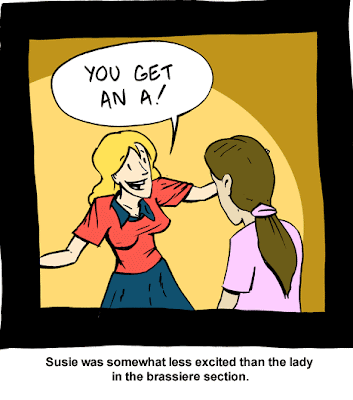
That what Arthur H. Miller is accused of doing would constitute sexual harassment is, one would hope, obvious to anyone who works in higher education. The political science professor at the University of Iowa was arrested last week on bribery charges arising out of accusations by female students that he told them he would give them higher grades if they let him fondle their breasts. In one case, he is alleged to have grabbed and sucked on a student’s breast and then sent her an e-mail telling her that she had earned an A+. … Sally Mason, Iowa’s president, announced on Tuesday that she plans to extend the university’s sexual harassment training : currently required only for those with supervisory roles : to all professors and other employees.
Many experts on sexual harassment say that Mason’s action is the right thing to do : and would be even if the Miller case hadn’t come along. …
But others question whether requiring all professors to go through training is necessary or appropriate. … “It’s ludicrous to think that the faculty member who was arrested was unaware that it was morally offensive to offer higher grades to several of his students if he could grope them,”Peter Wood, executive director of the National Association of Scholars, said.”I don’t believe there is a single faculty member who is unaware of the university’s sexual harassment policy. The fact that harassment took place did not happen because of the lack of awareness of the university’s policies.”
(hat tip to Paul Caron and TaxProfBlog and see also.)
–Francine J. Lipman
The APA convention meeting this week in Boston is hearing two internal reports with important public policy dimensions.
The report of the Task Force on Mental Health and Abortion concludes that no evidence supports the claim that an induced abortion causes mental health problems for adult women. The Task Force reviewed all empirical studies in peer-reviewed journals since 1989. For women who had a single elective abortion, the study found no mental health effects attributable to the abortion; for women who had multiple abortions, the evidence was more uncertain.
This report should help opponents of the ballot initiative in South Dakota, which seeks to all but eliminate abortions in that state by using a “woman protective” argument. (Background in my previous post.)
The Task Force on Gender Identity and Gender Variance also presented a report to the convention. The report encourages support for anti-discrimination protections, more research on these issues, and the development of practice guidelines. Votes by the Council of Representatives will occur Sunday, and the Council is expected to adopt a resolution endorsing anti-discrimination laws protecting transgender people.
Nan Hunter, cross-posted at hunter of justice

Olivia Gardner, a northern California teenager, was severely taunted and cyber-bullied by her classmates for more than two years. News of her bullying spread, eventually reaching two teenage girls from a neighboring town, sisters Emily and Sarah Buder. The girls were so moved by Olivia’s story that they initiated a letter-writing campaign to help lift her spirits. It was a tender gesture of solidarity that set off an overwhelming chain reaction of support, encouragement, and love.
In Letters to a Bullied Girl, Olivia and the Buder sisters share an inspiring selection of messages that arrived from across America:the personal, often painful remembrances of former targets, remorseful bullies, and sympathetic bystanders. Letters to a Bullied Girl examines our national bullying epidemic from a variety of angles and perspectives, and includes practical guidance from bullying expert Barbara Coloroso, author of The Bully, the Bullied, and the Bystander. Though addressed to Olivia, the letters speak to all young people who have been bullied, offer advice and hope to those who suffer, and provide a wake-up call to all who have ever been involved in bullying.
Via this HuffPo piece, where the authors write:
As the letters in this book prove, bullying has serious consequences. We can no longer turn away or sit idly by as our peers are bullied so severely and relentlessly that they are forced to withdraw, isolate themselves and even turn to suicide. Our book is dedicated to Corinne Sides, who committed suicide as a result of bullying, and there are pages of letters from others who attempted suicide to escape their bullies.
We decided to take matters into our own hands, and you too can be a part of this grass roots movement to erase bullying. We each must do our part to increase public awareness and understanding about the issue of bullying and bring comfort and healing to those enduring the lonely pains of being bullied.
Thanks to everyone who recommended this book!
ETA: To everyone who wrote to remind me that the master’s tools will never dismantle the master’s house, point taken.
–Ann Bartow
 Item LUS020
List price: $109.99
Our Price: $89.99
Smith Barney has agreed to pay $33 million to settle claims by three Northern California women that the brokerage giant favored men in pay, promotions and client assignments.U.S. District Judge Phyllis Hamilton of San Francisco approved the agreement Wednesday following lengthy negotiations between the Citigroup subsidiary and lawyers for the female brokers.
The nationwide settlement provides for payments to more than 2,400 current and past employees.
The three original Santa Rosa plaintiffs : Renee Fassbender-Amochaev, Deborah Orlando and Kathryn Varner : are slated to get $50,000 bonuses.
The suit alleged that male branch managers assigned most new clients to male brokers, who earned hundreds of thousands of dollars in commissions.
This mug? Would Richard Thaler and Cass Sunstein deem it an appropriate “choice architecture” type Nudge? Blogger Elle, Phd. is dubious about its efficacy, and I think her critique is a valid one.
–Ann Bartow

From Inside Higher Ed:
In The Black Academic’s Guide to Winning Tenure : Without Losing Your Soul (Lynne Rienner), Kerry Ann Rockquemore and Tracey Laszloffy offer both empathy and”to do”lists for African American scholars seeking tenure : as well as some advice on what not to do. The book speaks particularly to black scholars who may be the only non-white professor in a department, or who are in a very small minority. The authors are Kerry Ann Rockquemore and Tracey Laszloffy, who are the co-founders of BlackAcademic.com, a Web site that provides advice and forums. Rockquemore is an associate professor of sociology and African American studies and founder of the Under-Represented Faculty Mentoring Program at the University of Illinois at Chicago. Laszloffy is a coach and therapist for black and Latino faculty at predominantly white institutions….