James Grimmelmann, “Copyright, Technology, and Access to the Law”

An Opinionated Primer that provides an excellent overview of current copyright issues concerning access to laws for intelligent people who have inexplicably failed to devote their lives to the study of copyright law. Via Laboratorium, via Froomkin.

–Ann Bartow

Share
Posted in Academia, Feminism and Technology, Legal Profession | Comments Off on James Grimmelmann, “Copyright, Technology, and Access to the Law”

Mary Anne Case on “Feminist Fundamentalism”

From here:

At a time when so many different religious fundamentalisms are coming to the fore and demanding legal recognition, in this talk Prof. Case seeks to vindicate feminist fundamentalism, defined as an uncompromising commitment to the equality of the sexes as intense and at least as worthy of respect as, for example, a religiously or culturally based commitment to female subordination or fixed sex roles.

Watch the video here! Via Leiter.

Share
Posted in Feminism and Law, Feminist Legal Scholarship, Feminists in Academia | Comments Off on Mary Anne Case on “Feminist Fundamentalism”

Rainbow

At Elam Bend.

Share
Posted in Bloggenpheffer | Comments Off on Rainbow

Worst Thing I Saw Online Today.

This. I admit I wasn’t looking that hard.

–Ann Bartow

Share
Posted in Feminism and Politics, Race and Racism | Comments Off on Worst Thing I Saw Online Today.

Information Is Power

NARAL released a poll today showing that when women learn about Senator John McCain’s voting record on reproductive rights, he loses a significant number of independent and pro-choice-Republican supporters.   Pretty easy take-away for the Obama campaign on this one!

Using data from his firm’s survey of 1,788 likely women voters in states including Florida, Michigan, Ohio, and Pennsylvania, Quinlan says that Obama gained 13 points among pro-choice independent women and 9 points among pro-choice Republican women once they were presented with what the pollsters called “a balanced description of the candidates’ respective positions on choice.”

When women surveyed were simply asked for whom they would vote if the presidential election were held today, 47 percent named Obama and 45 percent McCain, Quinlan says. But after being read the description of the candidates’ positions, 53 percent said they would vote for Obama; 40 percent for McCain.

H/T: Reproductive Rights Prof Blog.

– David S. Cohen

Share
Posted in Reproductive Rights | Comments Off on Information Is Power

Susan Faludi, “Think the Gender War Is Over? Think Again”

This is an Op-Ed that was published in the NYT on June 15th, below is an excerpt:

In the campaign ahead, expect a fierce Republican effort to reinstate the nation’s guardian myth : by demonstrating how the other party’s candidate fails to fit the formula. Had Mrs. Clinton been the candidate, she would no doubt have faced more attacks for being too mannishly abrasive or, conversely, too emotional to play the manly role. But Mr. Obama should expect similar damned-if-you-do, damned-if-you-don’t gender assaults. He will be cast either as the epicene metrosexual who can’t protect the country or else as the modern heathen with a suspicious middle name.

The attacks are already under way, as is evident if one enters the words”Obama”and”effeminate”into a search engine. The effeminacy canard lurks in Mike Huckabee’s imaginings of Mr. Obama tripping off a chair and diving for the floor when confronted by a gunman, and in the words of Tucker Bounds, Mr. McCain’s campaign spokesman, who depicted Mr. Obama as”hysterical.”

News media blatherers and bloggers are taking up the theme. On MSNBC, Tucker Carlson called Mr. Obama”kind of a wuss”; Joe Scarborough, the morning TV talk show host, dubbed Mr. Obama’s bowling style”prissy”and declared,”Americans want their president, if it’s a man, to be a real man”; and Don Imus, the radio host, never one to be outdone in the sexual slur department, dubbed Mr. Obama a”sissy boy.”

Share
Posted in Feminism and Politics | Comments Off on Susan Faludi, “Think the Gender War Is Over? Think Again”

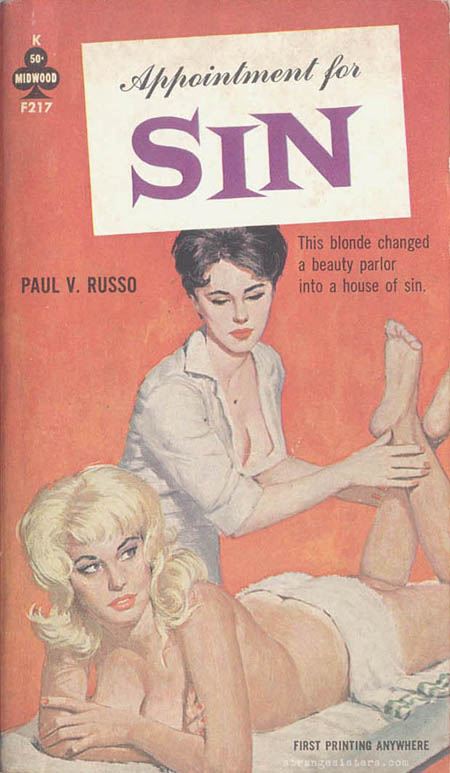
“Strange Sisters”

A website featuring lesbian paperback artwork from the 1950s and 1960s.

Share
Posted in Feminist Legal History, LGBT Rights | Comments Off on “Strange Sisters”

Information for Submitting Articles to Law Reviews and Journals

My colleague Allen Rostron and I have updated our charts about law review submissions/expedites and law review rankings from different sources for the summer and fall 2008 submission season. The first chart contains information about each journal’s preferences about methods for submitting articles (e.g., e-mail, ExpressO or regular mail), as well as special formatting requirements and how to request an expedited review. The second chart contains rankings information from U.S. News and World Report as well as data from Washington & Lee’s law review website. “Information for Submitting Articles to Law Reviews and Journals” is available here.

We hope you and your faculties find the information useful and welcome any feedback you might have.

–Nancy Levit

Share
Posted in Academia, Law Schools, Law Teaching | Comments Off on Information for Submitting Articles to Law Reviews and Journals

Feminism v. Economics

After considering a NYT article positing that gay unions “shed light” on gender and marriage,   Economic Woman wrote a provocative post, noting:

When economists see a division of labour, they are likely to assume that it is a mutually beneficial arrangement, unless there is evidence to the contrary. When it comes to the division of labour at home – who goes to work, who takes on childcare and housework – feminists are apt to assume that an egalitarian arrangement is preferable.

Most of us are also likely to say that feminism is about choice, including the right to reject or choose traditional gender roles, but that is often the second thought, and it is paired with theories about how women are forced into traditional roles because of the lack of affordable childcare, etc.

These are huge generalizations, obviously, but I think different starting points on the division of labour cause much of the friction between feminists and economists, at least when it comes to policy. If you associate the division of labour with oppression, it’s tough to communicate with someone who believes that it is humanity’s greatest innovation, the path to efficiency and wealth.

And, y’all probably saw this NYT article about the division of labor in the home. In response, Historiann weighs in here, snarking:

… does anyone find it a little weird that this story is a stunning newsflash worthy of several pages in the New York Times Sunday Magazine? … People, this is 2008. Why aren’t you writing urgent stories about the millions of men who are letting their female partners down by shirking housework and child care?

–Ann Bartow

Share
Posted in Feminism and Law, Women and Economics | Comments Off on Feminism v. Economics

Let the Wedding Bells Ring!

Congratulations to Phyllis Lyon and Del Martin who will become one of the first same-sex married couples in California later today. The state supreme court decision takes place at 5pm Pacific time, and some clerks offices are staying open late for the occasion. Lyon and Martin will, fittingly after more than half a century together as activists and San Francisco luminaries, be the first San Franciscans to get married.

– David S. Cohen

Share
Posted in LGBT Rights, Uncategorized | Comments Off on Let the Wedding Bells Ring!

“Carnival Against Sexual Violence 49”

Up at Abyss2hope.

Share
Posted in Carnival time!, Feminist Blogs Of Interest | Comments Off on “Carnival Against Sexual Violence 49”

“The Countertraffickers”

That’s the title of this article that was published in the New Yorker. Below are a couple of excerpts:

… Rotaru, who is twenty-six, works for the International Organization for Migration, a group connected to the United Nations, in Chisinau, Moldova. She is a repatriation specialist. Her main task is bringing lost Moldovans home. Nearly all her clients are victims of human trafficking, most of them women sold into prostitution abroad, and their stories pour across her desk in stark vignettes and muddled sagas of desperation, violence, betrayal, and sorrow. …

… Brothel raids in other countries yield many of Rotaru’s beneficiaries, as her clients are known. After a raid, she’ll get calls from the detainees, or from cops, consulates, families, or friends:even, sometimes, from prostitution customers.”Rescue calls”tend to be more urgent. Women phone clandestinely, from captivity, and Rotaru may have only moments to get the information she needs. The women don’t always have the information themselves; in extreme cases, they may not be sure what country they’re in. Look out the window, Rotaru will say. Any sign you can see. Exact spellings. Look for an address on matchbooks, or McDonald’s bags. What languages do the johns speak? If she can capture a number on caller I.D., it can be useful, although simply calling back without an all-clear is generally too dangerous. …

…here are roughly two hundred million migrants today:migrants being defined as people living outside their homelands. The reasons for this are globalization, and wars, and new border freedoms, and, above all, disparities in economic opportunity. Along the nether edge of the huge movement of people, human trafficking thrives. …

… Migrant smuggling is different from trafficking. Migrants pay smugglers to deliver them, illegally, to their destinations. The line into trafficking is crossed when coercion and fraud are used. (This line is not always clear, and many migrants endure varying degrees of mistreatment.) Trafficking can start with a kidnapping. More commonly, it starts with a broken agreement about a job promised, conditions of work, or one’s true destination. Most victims suffer some combination of threats, violence, forced labor, and effective imprisonment. The commercial sex industry, according to the International Labor Organization, absorbs slightly less than half of all trafficked labor worldwide. Construction, agriculture, domestic service, hazardous industries, armed conflict, and begging are some of the other frequent sites of extreme, illegal exploitation. …

… Many legitimate businesses share, unwittingly or otherwise, in the profits:travel agencies, hotels, tour-bus companies, night clubs:along with accountants, lawyers, doctors, landlords, forgers, and a large, indispensable contingent of corrupt police officers, border guards, and embassy personnel. Everybody seems to be making money except the trafficked women and girls. …

Via Prawfsblawg.

As noted previously, the House of Representatives passed a bill that would dedicate more resources to the victims of human trafficking in the United States. It is being opposed in the Senate by the Bush Justice Department, which has a particularized objection to “wasting money” on the adult victims of sex trafficking, who are seen as less worthy of help than victims forced to work in other industries, due to the sexualized nature of their servitude. As the article above describes, this is “victim blaming” and it is reprehensible. Hopefully most feminists are decent people will work to get H.R. 3387 passed this year. (Not all will, sadly.)

As I also blogged earlier, when (now SLED Chief) Reggie Lloyd took over as South Carolina’s AG, he began investigating whether women arrested for prostitution in South Carolina had been trafficked, and if there was evidence that they had been, they were neither jailed not deported. If H.R. 3387 was passed, every state would have to adopt the same approach. All trafficked women deserve humane treatment; working as coerced prostitutes does not “contaminate” people or make them less worthy of assistance. Those who would consign sex trafficked people to their fate should be challenged vigorously and their motivations questioned.

I also want to note one paragraph in the New Yorker article that I think is flawed and inaccurate. The reporter writes:

In line with this view, a 2003 reauthorization of the Trafficking Victims Protection Act provided for cutting off aid to N.G.O.s and governments that”promote, support, or advocate the legalization or practice of prostitution.”The provision threatens many groups that work with prostitutes on H.I.V./AIDS prevention:in the same way that family-planning clinics throughout the developing world have lost U.S. funding because they continue to offer abortion services.

The prostitution provision at issue is NOT the same as the abortion provision. It does not preclude any group from providing information, birth control or assistance to prostitutes. It does prevent groups receiving this U.S. governmental funding from running brothels, or selling women into brothels, or encouraging women to become prostitutes. The “no promotion of prostitution pledge” is NOT a gag rule. It is a requirement that government funds not be used to fund and promote pimps and prostitution based businesses directly. NGOS that sign on to the pledge can AND DO still provide condoms, education and other assistance to sex workers.

The only NGO that has been refused funds because it refused to sign the pledge is run by a pornographer, Philip Harvey, who SELLS (rather than gives) condoms to people in poor countries via DKT International. He was involved in promoting in brothels abroad, and therefore could not sign the pledge. Even if one views direct subsidization of brothels by US taxpayer funds (of which Harvey was keeping a big chunk for himself) acceptable, it is easy to understand why so many politicians from both parties do not. Read more here.

Being forced to deprive women of access to abortion, and not being allowed to use U.S. government funds to encourage women to become prostitutes, are not at all equivalent. But it is certainly clear why pimps and others who benefit financially from prostitution would seek to conflate the two.

See also, and see also too.

–Ann Bartow

Share
Posted in Carnival time!, Feminism and Law, Feminism and the Environment, Sexism in the Media, Uncategorized | Comments Off on “The Countertraffickers”

Target: Women Takes On The Summer of Political Courtship

Here. Funny but infuriating too.

Share
Posted in Acts of Violence, Feminism and Politics | Comments Off on Target: Women Takes On The Summer of Political Courtship

Barbies are Not Entirely Blank Screens

Jennifer Baumgardner and Amy Richards claim that “Barbie didn’t so much influence us as … she was a blank screen on which to project what what happening in our heads”  (Manifesta, p. 196).  Although I think they overstate the case, I am a selective Barbie booster.  The cheerleader Barbie I could so without.  But “Barbie for President” is ok by me.    

-Bridget Crawford  

Share
Posted in Feminism and Culture | Comments Off on Barbies are Not Entirely Blank Screens

When Academia Fails Women

UC Irvine Political Science Professor  Kristen Monroe and her co-authors  Saba Ozyurt, Ted Wrigley and Amy Alexander have published their article, “Gender Equity in Academia: Bad News From the Trenches, and Some Possible Solutions,” in Perspectives on Politics.  Here is a portion of the abstract:

Despite apparent increases in women in positions of authority, discrimination continues to manifest itself through gender devaluation, a process whereby the status and power of an authoritative position is downplayed when that position is held by a woman, and through penalties for those agitating for political change. Female faculty find legal mechanisms and direct political action of limited utility, and increasingly turn to more subtle forms of incremental collective action, revealing an adaptive response to discrimination and a keen sense of the power dynamics within the university.

The full abstract is here.  Inside Higher Ed reports on the study under the headline “Quiet Desparation of Academic Women” (full story here).  Several blogs including clinicians with not enough to do picked up Inside Higher Ed’s coverage of the story (cwnetd version  here; h/t Vanessa Merton).

What interests me in particular about this study is that it suggests a failure of formal workplace mechanisms — indeed law itself: “[f]emale faculty find legal mechanisms and direct political action of limited utility.”  Formal equality may be feminism’s most significant legacy, but equality in life as it is lived remains elusive.

-Bridget Crawford

Share
Posted in Academia, Feminists in Academia | Comments Off on When Academia Fails Women

Looks Like It Was Never About The Porn: Kozinski Accused By Lawyer Of Lying To Court

Many men in power seem to agree that there is nothing wrong with a judge enjoying porn that degrades women. As some Kozinski PR shill noted in a comment here, Larry Lessig tells us it’s all harmless fun. Bizarrely enough, the person who disclosed the porn website to the media, Cyrus Sanai, found the porn because he says the website was being used by Kozinski to distribute potentially infringing copies of copyrighted music. He wrote:

What the LA Times did not cover, which was my original focus, was the material Judge Kozinski was actively publicly distributing: music mp3’s. I found the link to his /stuff/ directory on a Russian”free mp3″. The artist? Weird Al Yankovic. Once I knew of that directory, I called up a catalog and saw the stuff. By the way, in addition to viewing women as cattle, Judge Kozinski finds blacks, Catholics and Arabs as equally worthy of his contempt, to judge from his humor collection.

Kozinski initially ‘fessed up to the LA Times, after denying the existence of”alex.kozinski.com”in the initial misconduct proceedings I initiated. However, he apparently had second thoughts about this, and has put up his son, Yale, as a fall guy.

The cover-up is always worse than the original crime. While his son did register the site and set up its architecture–I found an outline of the code on his portion of kozinski.com–it was Judge Kozinski who had complete control of the sub-domain alex.kozinski.com.

The 2005 genesis of the dispute between Sanai and Kozinski is articulated here. The short version: Sanai is deeply critical of the use of unpublished opinions in the Ninth Circuit. Kozinski responded by questioning Sanai’s professional ethics. Sanai responded in kind. A Wired.com article reports Sanai filed a complaint against Kozinski alleging misconduct, and the 9th Circuit’s Judicial Council launched a limited inquiry. Kozinski apologized for some things but denied posting a disputed document at his website, the very same website, apparently, where the porn was hosted. After this, how could Kozinski not have known that the porn was going to be publicly accessible too? Per Wired, Sanai claims that “during the investigation he had personally walked an investigator through Kozinski’s site to show him the document. But after the Council’s ruling was released, he went to Kozinski’s site and found that it was gone. Using the Wayback Machine at the Internet Archive, Sanai found that the site had been taken down months earlier. Months after the Judicial Council’s ruling was released, Kozinski’s site came back up, without the controversial document posted on it, though an index of the site accessed through the Wayback Machine showed traces of the document that had been posted there.”

If Sanai’s allegations about Kozinski’s manipulations of and misrepresentations about his website are true, Kozinski has severely breached ethical obligations for reasons completely unrelated to pornography. Sanai was deviously smart to use the porn as a way to draw media attention to his other claims. All the libertarians and Supposedly Liberal Doods who are lining up to aggressively support Kozinski in his courageous fight to blame his son for the degrading porn on his eponymous website might want to step back and think this one all the way through for a few minutes. I don’t know whether Sanai’s claims are valid. But writing this off as some kind of moral panic about porn is doing justice a disservice.

NB: Some, though not all, of the material from Kozinski’s website is available here. Kozinski seems to find images of children giving blow jobs to priests quite hilarious. The donkey video Lessig describes with the phrase “nothing sexual is shown in that video at all” is here.

–Ann Bartow

Update: Sanai himself wrote at the Volokh Conspiracy:

The focus on the pornographic aspects of the case could be called overblown–but the other serious problems with what Judge Kozinski has done are only now receiving some attention, and in my view, they raise much more serious questions about him and the Ninth Circuit’s attitudes toward the rule of law.

So, hopefully the investigation Kozinski himself has called for will bring some sunlight to all this.

Updated to add: Astroturf, much?

Share
Posted in Feminism and Law, Legal Profession | Comments Off on Looks Like It Was Never About The Porn: Kozinski Accused By Lawyer Of Lying To Court

The Museum of Food Anomalies

The photos and commentary WILL make you laugh.

Share
Posted in Bloggenpheffer | Comments Off on The Museum of Food Anomalies

If you need a little cute…

…watch this through the very end.

Share
Posted in Bloggenpheffer | Comments Off on If you need a little cute…

“Health care for female military veterans lags behind the care offered to male vets at many VA facilities, an internal agency report says, even as women are serving on front lines at historic levels.”

Story here.

Share
Posted in Women's Health | Comments Off on “Health care for female military veterans lags behind the care offered to male vets at many VA facilities, an internal agency report says, even as women are serving on front lines at historic levels.”

“It’s reached the point that we can’t even rely on the Democrats to stand up for our basic rights. Twenty-two Democratic Senators voted to confirm John Roberts as the Chief Justice of the Supreme Court in 2005. A few months later, when Democrats failed to block the confirmation of batshit-crazy Samuel Alito, most feminists I know went into a state of barely-contained fury. Many of us had worked our hearts out for years to elect every Democrat we could, in no small measure because we were relying on the party to stop the erosion of our rights under a conservative Supreme Court. Lot of good it did us.”

Those are the words of Dr. Violet Socks, excerpted from this essay. She’s pretty disgusted with the Democratic Party right now, to put it mildly.

Meanwhile, Historiann seems to be feeling a bit more conciliatory, if I am reading her correctly.

Both are terrific feminist bloggers who happened to support Hillary Clinton in the Democratic primary, and both make some interesting points. See what you think.

–Ann Bartow

Share
Posted in Feminism and Politics, The Underrepresentation of Women | Comments Off on “It’s reached the point that we can’t even rely on the Democrats to stand up for our basic rights. Twenty-two Democratic Senators voted to confirm John Roberts as the Chief Justice of the Supreme Court in 2005. A few months later, when Democrats failed to block the confirmation of batshit-crazy Samuel Alito, most feminists I know went into a state of barely-contained fury. Many of us had worked our hearts out for years to elect every Democrat we could, in no small measure because we were relying on the party to stop the erosion of our rights under a conservative Supreme Court. Lot of good it did us.”

Title VI, Title VII, Title IX – What’s Missing?

I feel like I should know the answer to this post, but I don’t.   Here’s the question:   Title VI prohibits discrimination based on race in federally funded entities.   What about discrimination based on sex?   Why isn’t there a Title VI equivalent for sex discrimination?   Or, why hasn’t Title VI been amended to include discrimination based on sex?

There are certainly statutes that fill some gaps.   Title VII prohibits discrimination based on sex in employment.   Title IX prohibits discrimination based on sex in federally funded educational institutions.   And, the Equal Protection Clause prohibits (subject to intermediate scrutiny) discrimination based on sex by state actors.   But, there’s a gap here – federally funded entities that are not educational institutions or state actors who discriminate based on sex in non-employment decisions.

If Title VI prohibits discrimination based on race in those situations, shouldn’t there be a federal law that discriminates based on sex in those situations as well?   Am I overlooking something obvious?   Have there been attempts that have been unsuccessful?   If so, why?   If not, why haven’t there been attempts to add to the federal law?

– David S. Cohen

Share
Posted in Feminism and Law | Comments Off on Title VI, Title VII, Title IX – What’s Missing?

Media Matters Notices Maureen Dowd Uses Gender Pejoratively

From here:

Media Matters for America review of Maureen Dowd’s columns since the beginning of 2007 reveals that Dowd frequently characterized Sen. Hillary Clinton as masculine, while portraying Sen. Barack Obama and John Edwards as feminine. By contrast, Dowd rarely feminized the all-male Republican field and, during the period Media Matters reviewed, has never feminized Sen. John McCain, whom she has referred to in one column as a “tough guy[].”

Does this mean Media Matters no longer thinks she is “progressive”? And will Supposedly Liberal bloggers like Digby and Atrios stop doing the same exact thing, finally? . (Digby or Dowd? Guess who it is first and then click here to read someone referring to the DC press corps as”catty little …snots”who”squealed like schoolgirls,”and”spite girls”who”missed their fast times at DC High.”)

–Ann Bartow

Share
Posted in Sexism in the Media | Comments Off on Media Matters Notices Maureen Dowd Uses Gender Pejoratively

Michelle Obama Watch

At What About Our Daughters.

Share
Posted in Feminism and Politics, Feminist Blogs Of Interest, Race and Racism, Sociolinguistics | Comments Off on Michelle Obama Watch

Quiet Desperation of Female Professors

That’s the title of a piece in Inside Higher Ed that discusses a new article out on attitudes of women in academia. For some of us, it may hit a little too close to home to read the whole thing through more than one half-opened eye. For example, the section in the piece about denigrating positions once they’re held by women struck a familiar chord of dull rage that never quite goes away for me as a professor who teaches practical skills.

Professors of legal skills have documented for years the terms and conditions of employment as a means of throwing open the curtains and letting a little sunshine disinfect that situation. With about 10 years of data now, it’s irrefutable that terms and conditions of employment rise directly depending on the ratio of men to women in the department. Departments with a male director and with more male professors than female are generally paid more than departments with female directors and more female professors. And once the department has been occupied predominantly by women over time, it’s difficult to get those positions to be considered professional positions worthy of tenure-track consideration. Law school like to say that legal writing is important. If I had a nickel for everytime I heard, “You teach the most important class in the first year,” I’d have more nickels from that collection than from the teaching itself.

–Tracy McGaugh

Share
Posted in Uncategorized | Comments Off on Quiet Desperation of Female Professors

Judge Alex Kozinski of the Ninth Circuit Is Running A Misogynist Porn Site

As David Cohen noted below. Details here. He is not ethically competent to hear obscenity cases, I don’t think. He is trying to get his son to take the rap, apparently, and shift responsibility. I don’t buy it and I think trying to pin this on his son to save his own sorry pornified, misogynist self is truly pathetic.

–Ann Bartow

Updated to add: Kozinski also claims to have uploaded some of the images by mistake. And above by saving himself, I just meant his reputation, to the extent people are not already aware of his misogyny. I have little doubt he’ll keep his job for life. I did particularly enjoy this line from the NYT: “The judge, a married father of three sons, claims to build his own computers but told the Los Angeles Times he didn’t know the Web site was accessible to Internet surfers.”

And the LA Times reports:

After publication of an latimes.com article about his website Wednesday morning, the judge offered another explanation for how the material might have been posted to the site. Tuesday evening he had told The Times that he had a clear recollection of some of the most objectionable material and that he was responsible for placing it on the Web. By Wednesday afternoon, as controversy about the website spread, Kozinski was seeking to shift responsibility, at least in part, to his adult son, Yale.

“Yale called and said he’s pretty sure he uploaded a bunch of it,” Kozinski wrote in an e-mail to abovethelaw.com, a legal news website. “I had no idea, but that sounds right because I sure don’t remember putting some of that stuff there.”

UPDATE 2: WIRED.COM HAS SIGNIFICANT BACKGROUND INFORMATION.
Below is a short excerpt:

The images and MP3 files were discovered on Kozinski’s site last December by a Beverly Hills lawyer named Cyrus Mark Sanai, who has a bit of a contentious history with Kozinski. That history has its roots in a dispute that Sanai and his siblings have over the way the courts handled their parents’ divorce in 2002 after 41 years of marriage. Sanai, his siblings and their mother, who lives in Washington state, filed suit against the state of Washington and the state Supreme Court, among others, over the way the court handled the divorce and matters related to it.

They eventually filed a petition for an en banc re-hearing from the 9th Circuit Court of Appeals where Kozinski is now chief judge.

While a decision on the petition was pending, Sanai says Kozinski wrote an article for The Recorder, a legal publication, that mentioned his petition and made statements that Sanai said were prejudicial against his petition and could influence his fellow appellate judges in the matter. In the article, Kozinski linked to a .pdf article that was relevant to the Sanai matter, which he hosted on his personal website.

Sanai filed a complaint against Kozinski alleging misconduct, and the 9th Circuit’s Judicial Council launched a limited inquiry.

Kozinski denied that his comments in the article addressed the merits of Sanai’s petition but acknowledged that some people could read his comments this way, and apologized to the Council, saying he would be more careful in the future. In December 2006, the Council ruled that no harm had been committed against Sanai or his case and therefore the allegations did not meet the standard for a finding of misconduct. The Council noted in its ruling (.pdf) that it found no indication that Kozinski had posted a court document related to Sanai’s petition on his website.

Sanai told Threat Level, however, that during the investigation he had personally walked an investigator through Kozinski’s site to show him the document. But after the Council’s ruling was released, he went to Kozinski’s site and found that it was gone. Using the Wayback Machine at the Internet Archive, Sanai found that the site had been taken down months earlier. Months after the Judicial Council’s ruling was released, Kozinski’s site came back up, without the controversial document posted on it, though an index of the site accessed through the Wayback Machine showed traces of the document that had been posted there.

(This week after the Los Angeles Times broke the story about explicit images on Kozinski’s site, the site once again was taken down.)

Share
Posted in Feminism and Law, Legal Profession | Comments Off on Judge Alex Kozinski of the Ninth Circuit Is Running A Misogynist Porn Site

CFP: Conglomerate’s 4th Annual Junior Scholars Workshop

Over at Conglomerate, Christine Hurt has posted this call for participation in the 4th Annual Junior Scholars Workshop:

Back by popular demand: the Conglomerate Junior Scholars Workshop for untenured law professors or candidates entering the law teaching market this fall. The submission deadline for completed papers is June 30, 2008.

Conglomerate has now hosted this workshop for the past three summers, and we have come to believe that the workshop provides a great service of matching junior authors with more senior experts in their field and also with other readers inside and outside of the academy.

The Fourth Annual Conglomerate Junior Scholars Workshop will be live online around July 28, 2008, with allowance for the schedules of our commentators. We will host one or two papers each week, with the paper and solicited comments posted the morning the paper is showcased. We anticipate hosting no more than five papers to ensure reader participation and attention for the duration of the workshop. Because of this desire to narrow the field somewhat, not every paper will be selected for public posting on the workshop. Criteria for selection will work to create a roster of papers that

* add to the existing literature on that topic

* are at a point of substantial completeness

* from junior academics

* at a wide array of academic institutions

* on topics that fit closely with the interests of the authors and readers of Conglomerate.

Although the umbrella of corporate law covers many topics, we will choose topics that allow us to easily solicit expert commentary and that attract reader comments. We are not deluded enough to believe that being chosen for the workshop has value in and of itself; the value lies in attracting commentary and reader suggestions as part of the workshop. Thus, we see no value in choosing an otherwise excellent and intriguing paper if we cannot use our networks to line up expert commentary. In addition, we feel that the greatest value of the workshop lies in giving feedback and exposure to junior law professors. Therefore, papers chosen will be authored by those junior academics in full-time academic positions, whether visiting assistant professors, fellows, or tenure-track professors. Papers from practitioners will only be chosen in the rare circumstance in which the author is actively pursuing an academic appointment in the upcoming hiring season.

Call for Papers:

If you are finishing up a scholarly article this summer on a topic that may be interesting to Conglomerate’s readers – such as corporate law, securities, contracts, business tax, finance, antitrust or law and economics – we would like to invite you to submit a completed draft to be considered for the workshop. During the workshop, we will link to your paper and provide a forum for you to receive feedback on your paper before you publish it or present it at a conference, workshop or job talk. We may also consider articles accepted for publication if the paper has not reached the final editing stage. We know that many new faculty members do not have the opportunity to present papers at national conferences and find it challenging to get others in their field to read their work. Hopefully, this workshop will facilitate that process.

The mechanics of the workshop are the same as in past years; we will post SSRN links to each paper in the workshop prior to the beginning week. On the specified day, a post will go up for the paper of the day, with an abstract of your paper and some initial comments by invited guest commentator(s). Afterward, you can respond in the comments to the commentator, and readers will post additional comments, creating a cyber discussion of your paper. If you read the blog or know us personally, you know that we strive to be the “if you can’t say something nice” people, but the workshop will not be helpful unless commentators are honest critics. So, we will be supportive of your work, but give constructive criticism as necessary. We will also prohibit anonymous comments in an effort to make sure only serious commenters participate. However, you are advised that your paper will be accessible to the public on SSRN and via links on our blog and that we anticipate having relatively high reader traffic during the workshop.

If any of this sounds good to you, please email me (achurt@illinois.edu) with your information, an abstract of your article, and your completed draft by June 30, 2008. No submission will be accepted on the basis of an abstract without a draft. Likewise, contact me if you have any questions. And most importantly, please pass this invitation to others that may be interested.

Conglomerate is also looking for Commentators, too, so contact Professor Hurt if you are interested.

-Bridget Crawford

 

Share
Posted in Call for Papers or Participation | Comments Off on CFP: Conglomerate’s 4th Annual Junior Scholars Workshop

Ever Have a Ninth Circuit Case Involving Sex or Gender Issues?

Or even one with a female litigant? And was one of the panel members Judge Alex Kozinski? Well, if so, this story must make you question whether you got a fair shake. As detailed in several news outlets (and apparently held by others because they thought it wasn’t newsworthy), he kept a collection of misogynist digital images and videos on a public website (that he claims he didn’t realize was public). There’s much that’s disturbing about this story, but I think Kaimi Wenger hits the nail on the head with his musings over at Concurring Opinions:

From the descriptions, these seem like images that could be potentially disturbing to more than just sexual puritans. Franky, the collection as set out by the LAT sounds like a deliberate and conscious aggregation of misogynist images.

****

At this point, I have to suspect that former litigants in cases that were before Judge Kozinski are asking themselves, “was my case impacted by the judge’s porn habits?”

Wouldn’t you be? Let’s say you had a sex harassment case, obscenity case, privacy case, rape case — hell, all sorts of potentially related topics — before the judge. Wouldn’t you be wondering how the judge’s personal habits affected the outcome — and whether you could re-open that can of worms?

Or for that matter, if your female client lost her case: Is it because the judge hates women? Is it because he’s a misogynist who thinks women are like cows?

– David S. Cohen

Share
Posted in Feminism and Law | Comments Off on Ever Have a Ninth Circuit Case Involving Sex or Gender Issues?

Massachusetts Maternity Leave Act Now Applies to Fathers Too

Feminist Law Prof Jessica Silbey has an excellent post today on Concurring Opinions about the decision by the Massachusetts Commission Against Discrimination to expand the state Maternity Leave Act to apply to fathers too.   This change means that employers in Massachusetts must now offer both mothers and fathers 8 weeks of unpaid leave following the birth or adoption of a child.   It appears that much of the decision was prompted by the state having same-sex marriage and the Commission determining how to rectify the problem that a lesbian couple would have, under the statute, two parents eligible for leave but a gay male couple would have no parents eligible.   Interpreting the law as sex-neutral solves this problem.

But it also does something more.   It shows just how same-sex marriage works to break down gender stereotypes.   This is a key argument in the sex discrimination argument in favor of same-sex marriage: not only are laws against same-sex marriage plainly facially discriminatory based on sex (a man can do something — marry a woman — that a woman cannot do), but they also perpetuate sex- and gender-based hierarchy within marriage.   Jessica’s post about the change in Massachusetts parental leave law expertly illustrates how the advent of same-sex marriage breaks down such sex- and gender-based hierarchy.

It’s definitely worth reading the entire post, but here’s a key part if you don’t want to follow the link above:

I have long lamented the accommodation of maternity leave – not because I think it unnecessary for mothers but because it creates an expectation that mothers (and not fathers/spouses) will stay home with the baby when born or adopted. In addition to providing time to physical recuperate from labor (which for most women takes between two and four weeks), maternity leave (especially for new moms) is a form of boot-camp, teaching women how to care for an infant by forcing the togetherness. Most women don’t know any better than most men how to calm a fussy baby, how to feed a baby, how to swaddle a baby or put her to sleep. These skills are gender-neutral. When do women become more competent than men at these tasks? When they care for their own newborn during maternity leave (or, admittedly, when they have taken a job caring for children or cared for a sibling or friend’s child prior to having their own child). Maternity leave is a three month (sometimes more)”head start”in the child-care department. And this head-start often sets the parameters for child-care duties in the future. At four months when a mother is back at work, that mother is typically better at soothing and dressing and feeding the baby because she has done it so often the past twelve weeks while her husband/spouse was at work. It makes sense, therefore, at the end of the work day, that when the baby is fussy or hungry that she calms and feeds the baby because she is better at it. This is an efficient division of labor. But it also relegates her to the”second shift,” one that mothers have historically complained about, whereby she works in the office all day and in the house all night. And this gendered child care dynamic is entirely avoidable if fathers/spouses became as competent as mothers in the earliest days of their baby’s life. Three months of total immersion in child care is a long time. Ask any parent: the learning curve is a steep one. And when the baby is crying, you want the most skilled person to calm that baby (i.e., the person who can succeed the fastest at the task). This is often the person who stayed home with the baby, and it is usually the woman.

– David S. Cohen

Share
Posted in Feminism and Law, LGBT Rights | Comments Off on Massachusetts Maternity Leave Act Now Applies to Fathers Too

“Counting Outsiders: A Critical Exploration of Outsider Course Enrollment in Candian Legal Education”

Feminist Law Prof Kim Brooks and  co-authors Natasha Bakht (Ottawa), Gillian Calder (U Victoria),  Jennifer  Koshan (Calgary), Sonia Lawrence (Osgoode Hall), Carissima Mathen (New Brunswick) and Debra Parkes (Manitoba) have posted to SSRN their article, “Counting Outsiders: A Critical Exploration of Outsider Course Enrollment in Canadian Legal Education.”   Here is the abstract:

In response to anecdotal concerns that student enrollment in “outsider” courses, and in particular feminist courses, is on the decline in Canadian law schools, the authors explore patterns of course enrollment at seven Canadian law schools. Articulating a definition of “outsider” that describes those who are members of groups historically lacking power in society, or traditionally outside the realms of fashioning, teaching, and adjudicating the law, the authors document the results of quantitative and qualitative surveys conducted at their respective schools to argue that outsider pedagogy remains a critical component of legal education. The article situates the numerical survey results against both a critical review of the literature on outsider legal pedagogy and detailed explanations of student decision-making in elective courses drawn from student survey responses. Notwithstanding the diversity of the faculties surveyed, the authors conclude the article by highlighting some of the shared and significant findings of the research, paying attention to various identity-based, institutional, and external factors influencing critical course engagement in Canadian law schools today.

The full paper is available here.

-Bridget Crawford

Share
Posted in Feminist Legal Scholarship, Law Schools, Law Teaching | Comments Off on “Counting Outsiders: A Critical Exploration of Outsider Course Enrollment in Candian Legal Education”

Notice of Faculty Positions at Pace University School of Law (White Plains, NY)

Please feel free to distribute far and wide:

Pace University School of Law invites applications for full-time, tenure-track faculty positions commencing in the 2009-2010 academic year. The ideal candidates for these positions will be entry-level or in the early part of their academic careers.   Pace Law School is particularly interested in candidates with an interest in tax law and environmental law but welcomes applications from candidates with all curricular interests.

Candidates should have demonstrated commitment to scholarly achievement and should be interested in enriching both our curriculum and our academic community. Applications are especially encouraged from people of color, people with all sexual and gender identities, individuals who are differently-abled, veterans of the armed forces or national service, and anyone whose background and experience will contribute to the diversity of our faculty. Pace is committed to achieving completely equal opportunity in all aspects of University life.  

Pace University School of Law is located in White Plains, New York, in Westchester County, approximately 19 miles north of New York City. Many of our faculty live in New York City, as well as the surrounding suburbs. Pace’s reputation and strong financial aid and scholarship program attract highly talented students from diverse backgrounds and from forty-four states and several countries. The Law School’s primary commitment is to providing its students with the skills, knowledge, and values necessary to be effective and ethical lawyers as well as community leaders.

To apply, please send a resume and references to:

Professor David N. Cassuto
Chair, Faculty Appointments Committee
Pace University School of Law
78 North Broadway
White Plains, N.Y. 10603
dcassuto@law.pace.edu

If materials are submitted by attachment, please provide full contact information in the body of the e-mail. For information about Pace Law School, see www.law.pace.edu.

-Bridget Crawford

Share
Posted in Chutes and Ladders | Comments Off on Notice of Faculty Positions at Pace University School of Law (White Plains, NY)

NY Gov’t Leaders, Activists Urge Strong Senate Bill to Curb Human Trafficking

The following is an excerpt of a press release from Rep. Maloney in December 2007:

Today, Congresswoman Carolyn Maloney (D-Manhattan, Queens), New York City Council Member Helen Sears (D-Jackson Heights), and other leaders in the fight against human trafficking rallied at City Hall and released letters to U.S. Senate leaders urging them to quickly pass a strong anti-trafficking bill (full copies of the advocates’ letters are below). Last week, the U.S. House overwhelmingly passed the William Wilberforce Trafficking Victims Protection Reauthorization Act (H.R. 3887), which authorizes critical funding to combat trafficking and help victims –however, advocates now want to make sure that the Senate passes an equally strong measure. Additionally, Council Member Sears announced at the rally that she is having a City Council resolution prepared to call for the swift passage of this act by the U.S. Senate.

Joining Maloney and Sears at the event were New York City Council Speaker Christine Quinn, Ambassador John Miller, who led the State Department’s Office to Monitor and Combat Trafficking in Persons, New York State Assemblyman Jeffrey Dinowitz, Council Member Jessica Lappin, representatives of NOW-NYS, NOW-NYC, the Coalition Against Trafficking in Women, Sanctuary for Families, the Polaris Project, the New York Association of New Americans, ECPAT-USA, the American Association of University Women, Girls Learn International, the Women’s City Club of NY, the Veteran Feminists of America, and others.

“We need a strong bill to ensure that the punishments for human trafficking fit this terrible crime,”said Rep. Maloney. “Make no mistake: human trafficking is 21st-century slavery. The House bill gives prosecutors the tools they need to hold traffickers accountable and better protect trafficking victims. I urge my Senate counterparts to include these measures in their version of the legislation. Additionally, I’d like to thank my good friend Helen Sears for her leadership in fighting human trafficking here in New York City and her efforts to secure Council support for this crucial bill.”

“The practice of human trafficking is a worldwide problem -and one that requires a worldwide solution- that we in the US should be taking the lead on,”said Speaker Quinn. “The House of Representatives showed real leadership in passing the William Wilberforce Trafficking Victims Protection Reauthorization Act. It is now up to our colleagues in the Senate to follow in their footsteps to take this important step to protect the millions of people caught up in this horrifying industry.”

“I am grateful to Congresswoman Maloney for her persistent efforts to have the federal government recognize its responsibility to do everything it can to stop this horrendous betrayal to human beings,” said Sears. “The City Council is also doing its part and has passed a human trafficking initiative that is in the final planning stages.”

“I am very proud that the state of New York enacted my anti-Human Trafficking legislation into law. New York now has the toughest laws in the nation to fight human trafficking and we provide services for human trafficking victims. I applaud Congresswoman Maloney for her long time leadership on the federal level to combat modern day slavery. I urge the United States Senate to follow the lead of Congresswoman Maloney and the House of Representatives and pass this legislation quickly as possible,”said Assemblyman Dinowitz.

“Many people are surprised to learn is that this modern-day slavery is happening in the U.S. and in the neighborhoods where we work and live. JFK Airport is a main gateway used by traffickers to bring in victims. There are few states that have as great a stake in the federal trafficking efforts than New York. The National Organization for Women urges the Senate to pass the TVPRA which includes broader protections for trafficked women and children,”said Sonia Ossorio, President of NOW-NYC.

H.R. 3887 authorizes critical funding to combat trafficking and help victims. The law would allow the Department of Justice to prosecute traffickers without having to prove fraud, force or coercion, or a victim’s status as a minor – instead, the law would allow prosecutors to use these aggravating circumstances as the basis for enhanced penalties. Currently, the law requires testimony from a traumatized victim who has reason to fear the consequences to herself or her family if she testifies. By eliminating the need for victims to testify about force, fraud or coercion, prosecutors will have a more effective way to crack down on traffickers. The law would also require the Attorney General to conduct a biennial survey of trafficking in the United States.

Background: Congresswoman Maloney is an original cosponsor of H.R. 3887. She has worked to combat sex trafficking internationally, nationally, and in her New York City district for the past seven years. Maloney urged state and federal prosecutors to investigate Queens-based Big Apple Oriental Tours and other sex tour operators for criminal violations. She is a strong supporter of federal legislation to strengthen the ability of the government to prosecute sex tour operators.

A landmark law to make the United States a leader in combating the worldwide affliction of sex trafficking was enacted in 2006. That law incorporates key provisions of the End Demand for Sex Trafficking Act championed by Maloney and Congresswoman Deborah Pryce (R-OH).

Council Member Sears first introduced a resolution to combat trafficking in 2006. Resolution 504, which passed the Council in November 2006, called upon the State of New York to recognize that human trafficking is a crime and to pass legislation criminalizing human trafficking and providing services and programs to trafficking victims. In addition, Council Member Sears is the driving force behind the upcoming City Council Trafficking Initiative.

Read the rest here.

As noted previously, (see also), the primary opposition to this bill is that it is a “waste of resources” to help coerced prostitutes. Even some fairly conservative groups understand the importance of this bill, and reject the despicable “states rights” and “resource waste” objections of the deeply politicized Bush DoJ:

Despite growing opposition from fellow conservatives, the Southern Baptist Convention is standing firm.

Duke draws analogies to the Civil War-era issue of slavery.

“One hundred and [fifty] years ago we fought slavery as if it was a state’s right and we found out it was not,”he said, emphasizing that human trafficking is a nation- and worldwide problem that needs to be solved.

The differing views have boiled down to a clash over whether the trafficking bill violates the Constitution.

Despite being impugned, sometimes deservedly, as a backward Southern state, thanks in part to fabulous, morally centered graduates of the University of South Carolina School of Law like Reggie Lloyd, South Carolina has a fairly progressive approach to human trafficking, but we need this bill passed to help more trafficked people.

–Ann Bartow

Share
Posted in Coerced Sex, Feminism and Law, Feminism and Politics, Race and Racism, Sisters In Other Nations | Comments Off on NY Gov’t Leaders, Activists Urge Strong Senate Bill to Curb Human Trafficking

Stop Violence against Women website looking for volunteers!

The Advocates for Human Rights is seeking volunteers to create content for a website that is accessed by people all over the world. The Stop Violence against Women website (StopVAW) is an online resource with more than 4,000 pages of information and advocacy tools to combat violence against women. The website receives more than 1 million hits per year from around the world and has been a significant aid in drafting, monitoring and implementing laws in other countries, and in educating the public about violence against women.

More specifics:

1. Length of writing and research project: The final written product will be 3-4 webpages. The written material should provide information on the background, risk factors, causes and effects, model practices and laws, and advocacy strategies. Volunteers are asked to research the topic using appropriate online resources and write an overview describing this issue for publication on StopVAW.

2. Deadlines: The project should be completed within 4-6 weeks.

3. Substantive areas of focus: When possible, the focus of the page should be on Minnesota law. The following topics are immediately available:

* Permanent orders for protection
* Training module on stalking
* Felony strangulation laws

Longer-term opportunities: The Advocates has ongoing project needs for StopVAW, including updating and writing new Country Pages. Country pages, which describe the domestic laws and policies related to violence against women, are needed for: Morocco, Georgia, Tajikistan, Macedonia, Albania, and Moldova.

An example of how the website helps women: Recently the Ukraine drafted a domestic violence law that includes language that allows the police to cite the victim if she provokes the violence. Under the provision, the police, when answering a domestic violence call, must determine which party is the primary aggressor. If the man accuses the woman of provoking the violence, she too can be cited. This provision creates an unintended consequence in a domestic violence law – punishing the victim of domestic violence. The website is set up to assist countries which are drafting domestic violence laws by providing them with model laws and best practices to avoid such unintended, and absurd consequences.

For information about any of these projects, contact Rosalyn Park at rpark@advrights.org or Mary Ellingen at mellingen@advrights.org. Please call soon because the need is now!!

*Information provided to Minnesota Women Lawyers members by the MWL Public Policy Advocacy Committee.

–Marie Failinger

Share
Posted in Acts of Violence, Feminism and Law, Feminism and Technology, Women's Health | Comments Off on Stop Violence against Women website looking for volunteers!

Katherine M. Franke, “Longing for Loving”

The abstract:
Post-Lawrence efforts to secure marriage equality for same sex couples must be undertaken, at a minimum, in a way that is compatible with efforts to dislodge marriage from its normatively superior status as compared with other forms of human attachment, commitment and desire. Resisting the normative and epistemic frame that values non-marital forms of life in direct proportion to their similarity to marriage, we must unseat marriage as the measure of all things. To this end, I ‘ll suggest a thought experiment: substituting friendship for marriage at the center of the social field in which human connection takes place. No longer the sun around which all other relationships and relations orbit, our investments in marriage and marriage ‘s investments in us are likely to yield in such a way that we can imagine making the argument for same sex couples ‘ right to marry while imagining and cultivating different longings than that for Loving.

Downloadable here.

Share
Posted in Feminism and Law, Feminist Legal Scholarship, LGBT Rights | Comments Off on Katherine M. Franke, “Longing for Loving”

“NOMAS supports Reauthorization of the Trafficking Victims Protection Act, HR 3887”

The National Organization of Men Against Sexism gets it. The organization stands with decent people everywhere in opposing human trafficking, and affirms the following:

The U.S. law addressing the crime of Sex Trafficking, the Trafficking Victims Protection Act 0f 2000, is about to expire and must be reauthorized by Congress.

On December 4, the House did something remarkable. It overwhelmingly passed HR 3887 which not only extends the TVPA, but greatly improves it. The trafficking issue now moves to the Senate Judiciary Committee.

NOMAS is joining many feminist and other groups in strongly urging the Senate to pass this bill. The bill is titled the “William Wilberforce Trafficking Victims Protection Act of 2007,” to reflect the similarities of modern-day sexual slavery with the earlier enslavement of black Africans.

A joint letter to the Judiciary Committee co-signed by NOMAS also noted that African-Americans and Latinos are the persons most victimized by domestic traffickers, who exploit and harm those who are most vulnerable: “young people of color, often immigrants, often children, almost always women, almost always poor.” The 2000 bill was valuable and important, but it was the result of a compromise, and had major flaws. “Sex trafficking” was defined as “the recruitment, harboring, transportation, provision, or obtaining of a person for the purpose of a commercial sex act.” But, a second category, termed “Severe Sex Trafficking”, was much more narrowly limited, to the few acts that could actually be proved in court to have been performed by “force, fraud, or coercion”, or by a minor. And all legal penalties were limited to the “severe” category. This has meant that very few trafficking prosecutions have been possible.

Proving “force, fraud, or coercion” in a court setting is practically impossible, even when it has certainly occurred, as the trafficking victims are so often terrified, traumatized, vulnerable, in poverty, and far from home. Many have children or family for whose lives they must fear. Few if any victims can take the stand and testify at length about their sexual abuse, try to ‘prove’ what was said or done to them, and undergo a brutal, humiliating cross-examination. And this coercion-focus totally ignores all the complexities of poverty, economic desperation and “consent”.

The new revised bill will treat proof of force, fraud, or coercion, or the use of minors, as grounds for enhanced punishment, but not as the sole basis for convictions. It will ensure that all persons convicted of sex trafficking will receive significant sentences. Incorporating and up-dating the earlier Mann Act, originally called the White Slave Traffic Act, the new bill will make it a felony to engage in trafficking or other unlawful commercial sex activities while “being in or affecting” interstate or foreign commerce.

In other significant provisions, the bill will:

– treat international and domestic trafficking as interconnected, recognizing that we cannot reduce international trafficking if we fail to combat our own trafficking slavery;

– expand penalties and support the prosecution of “sex tourism” providers;

– enhance the ability of trafficking victims to seek civil restitution awards from their traffickers;

– ease the ability to prove the sexual abuse of children, by reversing the practice of some courts of requiring that traffickers be “affirmatively proven” to have knowledge of a victim’s minor status;

reverse, and take action to overcome the harm done, by one of the little-noted betrayals of women, children, and the anti-trafficking movement by the Bush administration: a supposedly “Model” state law issued by the Bush Justice Department, that limited trafficking only to cases provably by “force, fraud, or coercion” (making convictions impossible,) even where broader and better state anti-trafficking laws already existed. …

Who opposes this bill? The Bush Administration, the Heritage Foundation, coercive pimps, a few others. Why? Of course the pimps want to continue sex trafficking without interference, while the Bush Administration and its supporters consider helping coerced, prostituted women “a waste of money,” deeming them tainted and unworthy of assistance.

Rebecca Mott can tell you a bit about her life as a prostitute. As feminist blogger Littoral Mermaid noted: “… prostitutes are”othered”from other people (particularly other women) and usually in a negative way. For example, it is perfectly acceptable for a writer in a major newspaper to proclaim that the brutal murders of five prostitutes is “no great loss”, because they were prostitutes.” Opposition to H.R. 3887 is aimed at privileging coerced, trafficked factory and farm workers over the well being of coerced, trafficked sex workers. It’s another attempt to Other coerced prostitutes and treat them as lesser humans.

–Ann Bartow

Share
Posted in Acts of Violence, Coerced Sex, Feminism and Law, Women's Health | Comments Off on “NOMAS supports Reauthorization of the Trafficking Victims Protection Act, HR 3887”

First Circuit writes in Cook v. Gates: “We are convinced that Lawrence recognized that adults maintain a protected liberty interest to engage in certain ‘consensual sexual intimacy in the home.'” But, still finds “Don’t Ask, Don’t Tell” Constitutional

Cook v. Gates was the second challenge to the “Don’t Ask, Don’t Tell” policy of the U.S. Military decided after Lawrence. Yesterday in Cook v. Gates the First Circuit held in pertinent part:

There are at least four reasons for reading Lawrence as recognizing a protected liberty interest. First, Lawrence relies on the following due process cases for doctrinal support: Griswold, Eisentstadt, Roe, Carey, and Casey. 539 U.S. at 565-66. Each case resulted in the Supreme Court recognizing a due process right to make personal decisions related to sexual conduct that mandated the application of heightened judicial scrutiny. Id. It would be strange indeed to interpret Lawrence as not recognizing a protected liberty interest when virtually every case it relied upon for support recognized such an interest.

Second, the language employed throughout Lawrence supports the recognition of a protected liberty interest. Lawrence associated the right at issue with the core constitutional rights of “freedom of thought, belief, and expression,” rights which undoubtedly mandate special protection under the Constitution. Id. at 563. It also stated that “liberty gives substantial protection to adult persons in deciding how to conduct their private lives in matters pertaining to sex.” Id. at 572 (emphasis supplied). And it concluded its analysis by stating that the “right to liberty under the Due Process Clause” allowed the petitioners to engage in “private sexual conduct” because “‘[i]t is a promise of the Constitution that there is a realm of personal liberty which the government may not enter.'” Id. at 578 (quoting Casey, 505 U.S. at 847). Such language strongly suggests that Lawrence identified a protected liberty interest.

Third, in overruling Bowers, Lawrence relied on Justice Stevens’ Bowers dissent as stating the ontrolling principles. Id. at 578. The passage of Justice Stevens’ dissent quoted in Lawrence stated that “individual decisions by married persons, concerning the intimacies of their physical relationship, even when not intended to produce offspring, are a form of liberty protected by the Due Process Clause . . . . Moreover, this protection extends to intimate choices by unmarried as well as married persons.” Id. In support of this proposition, Justice Stevens cited Griswold, Eisenstadt and Carey. Bowers, 478 U.S. at 216 (Stevens, J., dissenting). As discussed above, these are due process cases that recognize protected liberty interests. Furthermore, in the very next passage of Justice Stevens’ dissent, he described these cases as establishing rights that are “fundamental” and placed the right of adults to engage in private intimate conduct in the same category. Id. It is impossible to read Lawrence as declining to recognize a protected liberty interest without ignoring the Court’s statement that Justice Stevens’ Bowers dissent was controlling.

Finally, if Lawrence had applied traditional rational basis review (the appropriate standard if no protected liberty interest was at stake, see e.g., Medeiros, 431 F.3d at 33), the convictions under the Texas statute would have been sustained. The governmental interest in prohibiting immoral conduct was the only state interest that Texas offered to justify the statute. Lawrence, 539 U.S. at 582. It is well established that a “legislature [can] legitimately act . . . to protect the societal interest in order and morality.” Barnes v. Glen Theatre, Inc., 501 U.S. 560, 569 (1991) (quoting Paris Adult Theatre I v. Slaton, 413 U.S. 49, 61 (1973)). Thus, Lawrence’s holding can only be squared with the Supreme Court’s acknowledgment of morality as a rational basis by concluding that a protected liberty interest was at stake, and therefore a rational basis for the law was not sufficient.

Taking into account the precedent relied on by Lawrence, the tenor of its language, its special reliance on Justice Stevens’ Bowers dissent, and its rejection of morality as an adequate basis for the law in question, we are convinced that Lawrence recognized that adults maintain a protected liberty interest to engage in certain “consensual sexual intimacy in the home.”

However, the majority also held that deference to Congressional decision-making was the paramount interest, so the challenge failed. But, some days you have to take the good news where you can find it. Paul Secunda writes: “… if the First Circuit interpretation is upheld, then it is a wonderful day for public employees (outside of the military) who won’t have the military-deference albatross hanging around their necks and may soon begin to exercise sexual privacy interests off-duty without impact on their jobs in many cases!”

–Ann Bartow

UPDATE: Kathleen Bergin has more commentary here.

Share
Posted in Feminism and Law, LGBT Rights | Comments Off on First Circuit writes in Cook v. Gates: “We are convinced that Lawrence recognized that adults maintain a protected liberty interest to engage in certain ‘consensual sexual intimacy in the home.'” But, still finds “Don’t Ask, Don’t Tell” Constitutional

“Max Hardcore” Convicted On Obscenity Charges

This is notable because I think it may be the only non-child-pornography obscenity conviction obtained by the Bush Justice Department during the past seven plus years. The indictment came down just over a year ago, and can be viewed here. Press coverage at the time suggested Hardcore was targeted due to the horrifying violence he inflicted on female performers.

Heart posted about Hardcore’s conviction a couple of days ago. I was waiting to see how the NYT and WaPo would cover it. I’m still waiting, since I haven’t seen anything at either paper, as of an hour ago. The Tampa Tribune reported:

This city may be known for its thriving adult entertainment industry, but a federal jury drew the line Thursday, convicting a California movie producer of 10 counts of distributing obscene materials.

Jurors were given the task of deciding whether a series of films starring a character called Max Hardcore, portrayed by Paul Little, violated the community’s standards. After more than 12 hours of deliberations spanning two days, the seven-woman and five-man jury concluded that the films, with their vomiting, violence and urination, were criminally obscene.

The panel convicted defendant Little, 50, and his company, Maxworld Entertainment, of five counts each of distributing obscene materials over the Internet and through the mail. Each count carries a possible maximum penalty of five years in federal prison and a $250,000 fine. …

A couple of the comments that follow the article are written by a woman calling herself “Neesa” who says quite graphically that she was raped and abused by Hardcore.

–Ann Bartow

Share
Posted in Coerced Sex, Feminism and Law | Comments Off on “Max Hardcore” Convicted On Obscenity Charges

Would Kansas Governor Kathleen Sebelius Make A Good Veep?

Fred Vincy at Stone Court thinks so.

Share
Posted in Feminism and Politics | Comments Off on Would Kansas Governor Kathleen Sebelius Make A Good Veep?

“Matthew J. Bruccoli, 76, Scholar, Dies; Academia’s Fitzgerald Record Keeper”

From the NYT:

Matthew J. Bruccoli, whose biography of F. Scott Fitzgerald and outpouring of scholarly essays and critical editions made him the dean of Fitzgerald studies in the United States, died at his home in Columbia, S.C., on Wednesday. He was 76.

Bruccoli called me a number of times with questions about copyright law. Sometimes at home. Like most scholars, he was an advocate of broad fair use, and felt frustrated by copyright precepts that tied up works for a hundred years or more. He will be greatly missed by everyone at the University of South Carolina.

–Ann Bartow

Share
Posted in Academia, South Carolina | Comments Off on “Matthew J. Bruccoli, 76, Scholar, Dies; Academia’s Fitzgerald Record Keeper”

This Blog Has Been Googlebombed.

Up until fairly recently, googling “Feminist Law Professors” or “Feminist Law Profs Blog” or the like returned this blog as the first or close to first search result. Now the blog itself doesn’t come up on the first ten result pages or more. I’ve contacted Google and will see how the Googlebombing that caused this can be addressed. Sorry for any inconvenience.

–Ann Bartow

Share
Posted in Blog Administration | Comments Off on This Blog Has Been Googlebombed.

“Adrienne Maree Brown of the Ruckus Society on Media Justice, Election Protection and the Issue of Race in the 2008 Election”

Read the transcript of her Democracy Now! interview by Amy Goodman here. Or watch or listen to it, via links here.

Share
Posted in Feminism and Politics, Race and Racism | Comments Off on “Adrienne Maree Brown of the Ruckus Society on Media Justice, Election Protection and the Issue of Race in the 2008 Election”

“The Most Ridiculous Girl Gadgets”

Link to NPR story by this name here. At Jezebel Jessica Grose notes that gadgets that are marketed to women are usually “cute” and “pink.” There is nothing wrong with the color pink per se, but it sure facilitates the commoditized Othering of women.

–Ann Bartow

Share
Posted in Sexism in the Media | Comments Off on “The Most Ridiculous Girl Gadgets”

Cutting off Your Nose to Spite Someone Else’s Face

With the recent extension of the right to marry to same-sex couples in California, there has been talk of a”shot in the arm to the state economy”from all of the additional business for wedding planners, hotels, florists, bakeries, and others in the wedding industry. It appears, however, that the Kern County Clerk has decided to forego part of her county’s share of that economic benefit (and more). Although the county clerk’s office will, in accordance with California law, begin issuing marriage licenses to same-sex couples beginning on June 17, she has decided to cease having her staff officiate at the wedding ceremonies (for an additional $30). To be clear, her staff will no longer officiate at any wedding ceremony, whether it involves a same-sex or a different-sex couple.

According to the L.A. Times,”[o]fficials cited financial reasons for the decision. But internal memos between a high-ranking official in [the clerk’s] office and a conservative Christian legal defense fund, published in the Bakersfield Californian this week, indicate that [the clerk] may have acted on principle rather than for financial reasons.”“Principle”appears to be a euphemism here for religious belief. The L.A. Times article quotes an e-mail from someone in the clerk’s office indicating that the clerk fully expected to be sued for stopping the practice of performing marriage ceremonies and was seeking an assurance from the Alliance Defense Fund, a Christian organization that is a staunch opponent of lesbian and gay rights, that it would defend the clerk because”our own counsel is not being of help.”

The clerk’s actions raise a troubling religious issue that the L.A. Times story broaches. Although it is impossible to separate religion completely from the political sphere:after all, many religious beliefs have secular counterparts (e.g., secular and religious beliefs that society should help the poor and needy):we should nonetheless be concerned whenever elected officials attempt to turn their religious beliefs into government policy, as appears to be happening in Kern County. To my mind, the basic question in this case is: Should an elected official be allowed to decide to stop providing a service to her constituents:and forego the related revenue raised by providing that service:to advance her own personal religious beliefs? Personally, I think that the answer to this question should be”no.”I will be interested to see how this question (or some variant of it) is answered from a legal perspective, if the clerk is, in fact, sued based on her actions.

But the clerk’s actions trouble me for another reason as well:a reason that is not directly broached by the L.A. Times story. In the L.A. Times article, Shannon Price Minter, the legal director of the National Center for Lesbian Rights, is quoted as stating that he has no problem with the clerk’s decision because it will be applied to both same-sex and different-sex couples equally. Unlike Minter, I do have a serious issue with this decision regardless of how”equally”it is applied. As my colleague Deborah Brake has explained, Minter (not to mention the Kern County Clerk) bases his remark on a less than fulsome view of equality. (Brake’s article on this issue is: When Equality Leaves Everyone Worse Off: The Problem of Leveling Down in Equality Law, 46 Wm. & Mary L.J. 513 (2004).) Even though the clerk’s actions may satisfy notions of formal equality (as articulated by Minter), the clerk’s actions nevertheless send the message that extending the right to marry to same-sex couples is so repugnant that it is better to marry no one than to be forced to marry same-sex couples. To boot, it essentially sets up same-sex couples as the scapegoat for this action when frustrated different-sex couples are inconvenienced by having to seek others to officiate at their wedding ceremonies. Are this message and this scapegoating really consistent with the spirit of the California Supreme Court’s decision in In re Marriage Cases? I think not.

-Anthony C. Infanti

Share
Posted in Feminism and Law, LGBT Rights, Uncategorized | Comments Off on Cutting off Your Nose to Spite Someone Else’s Face

Summer Nonlegal Reading Suggestions – Fiction Edition

Below are some relatively fast reads, with a strong preference for female authors. It’s just a somewhat random list of books I have read within the last couple of years I really liked:

1. Anything at all by Carol Shields. Particular favorites include “Swann” and “The Stone Diaries” but every one of her novels is great.
2. “March” by Geraldine Brooks
3. “Suite Francaise” by Irene Nemirovsky
4. “White Teeth” and/or “On Beauty” by Zadie Smith
5. “The Year of Magical Thinking” by Joan Didion
6. “The Namesake” by Jhumpa Lahiri
7. “The Memory Keeper’s Daughter” by Kim Edwards
8. “Hunger” by Elise Blackwell
9. “Water for Elephants” by Sara Gruen
10. Any book by Carolyn Heilbrun writing as Amanda Cross (her nonfiction works under her own name are great too)
11. For mystery fans, any book by Elizabeth George
12. “Bee Season” by Myla Goldberg
13. “72 Hour Hold” by Bebe Moore Campbell
14. “Woman Hollering Creek and Other Stories” by Sandra Cisneros
15. “The Aguero Sisters” by Cristina Garcia
16. Anything at all (even a doodled napkin!) by Barbara Kingsolver
17. “In the Forest” by Edna O’Brien
18. “Into the Forest” by Jean Hegland
19. “The Interruption of Everything” by Terry McMillan
20. “What the Body Remembers” by Shuana Singh Baldwin

–Ann Bartow

Share
Posted in Bloggenpheffer | Comments Off on Summer Nonlegal Reading Suggestions – Fiction Edition

Robson on “Sexual Democracy”

Feminist Law Prof Ruthann Robson (CUNY) has posted to ssrn her article, “Sexual Democracy.”  Here is a the abstract:

Conceptualizing the relationship between sexuality and democracy requires not only an interrogation of both terms, but also an exploration of the ways in which democracy seeks to accommodate and appropriate the sexual. Recent litigation and legislation regarding same-sex relationships in South Africa casts a spotlight on the interaction between sexuality and democracy, but the illumination is partial. It is necessary to explore sexuality in a broader context, including discomfiting sexual practices, as a matter of the democratic constitutional norms of equality and dignity. Otherwise, a sentimentalized version of sexuality, with certain lesbians and gay men installed as a model minority, threaten to become the democratic standard.

The full article is available here.

-Bridget Crawford

Share
Posted in Feminist Legal Scholarship, LGBT Rights | Comments Off on Robson on “Sexual Democracy”

“We are each other’s magnitude and bond”

From the poem, “Paul Robeson” by Gwendolyn Brooks (who would have been 91 today).  

Warning, in music-words
devout and large,
that we are each other’s  harvest:
we are each other’s  business:
we are each other’s  magnitude and bond.


-Bridget Crawford

Share
Posted in Bloggenpheffer | Comments Off on “We are each other’s magnitude and bond”

Paula Gunn Allen 1939-2008

Feminist author and scholar Paula Gunn Allen died on May 29, 2008.  Here is a portion of her  obituary from the LA Times:

In the 1960s, when some in academia still denied the existence of Native American literature, Paula Gunn Allen embarked on a career that proved them wrong — and altered the required reading lists of literature classes on U.S. college campuses.  

The former UCLA professor helped define the canon of Native American literature, encouraged its development by anthologizing new American Indian writers and nurtured a broader audience for the work.

“This is great literature — American literature,” Allen said in a 1990 article in the St. Louis Post-Dispatch. “What I want from readers is a fundamental recognition that American Indian culture is alive and thriving.”  

Allen, a leading scholar and feminist who advocated for the inclusion of Native American voices in the mainstream of American literature, died of lung cancer May 29 at her home in Fort Bragg, Calif. She was 68.

The full obit is available here.  An online memorial is here.

I first read Allen’s book  The Sacred Hoop: Recovering the Feminine in American Indian Traditions in college.  I am so glad I did; it enriched my understanding of American literature.

-Bridget Crawford

Share
Posted in Feminists in Academia, Firsts, LGBT Rights, Race and Racism, Recommended Books | Comments Off on Paula Gunn Allen 1939-2008

Feminism and FGM

Interesting post here at Womanist Musings.

Share
Posted in Acts of Violence, Sisters In Other Nations, Women's Health | Comments Off on Feminism and FGM

“Hands up if you’ve experienced street harassment”

That’s the title of this post at the f-word and it has attracted a lot of comments.

Share
Posted in Acts of Violence, Feminist Blogs Of Interest | Comments Off on “Hands up if you’ve experienced street harassment”

Stein on Gay Marriage

Feminist Law Prof Ralph Stein (Pace) has a regular, local cable TV show called “It’s the Law.”  His latest show (available here) is about gay marriage.  

-Bridget Crawford

Share
Posted in LGBT Rights | Comments Off on Stein on Gay Marriage

So Now The Sexist Hillary Bashing Susbsides And The Sexist Michelle Bashing Ramps Up

Of course, sexist Michelle bashing has been occurring already. Now this post at What About Our Daughters reports about an Internet rumor involving Michelle. Michelle isn’t above criticism any more than any other member of Team Obama, or Team Anybody, but sexism deployed gainst her will be called out here as comprehensively as possible. So send FLP your links and posts!

–Ann Bartow

Share
Posted in Feminism and Politics, Sexism in the Media | Comments Off on So Now The Sexist Hillary Bashing Susbsides And The Sexist Michelle Bashing Ramps Up