And About the Woman From the One-Night-Stand?

For a while now I’ve been writing about the parental status of men where a child results from a one-night-stand. My conclusion has been that these men are not fathers of those children. They are, instead, like sperm donors. (Many, perhaps even most, people are quite comfortable with the idea that a sperm donor is not a father of a child produced with his sperm, even though he has a genetic link with the child. But the law on this does vary state to state.)

I’ve gotten comments, some on line here, some on Feminist Law Prof, where I frequently cross-post, and some privately, that seem to think I’m using a double standard–one rule for men and another for women. I don’t think I am, and I think I’ve said as much, but let me focus here on the parental status of the one-night-stand woman just to be completely clear.

Suppose the woman is pregnant after the one-night-stand. Is she a parent? Not at that point. First off, I don’t accept that there is a child at that point. No child means no parent. She does, however, have the chance to become a parent. If she decides (and remember, I’m indulging in a minor fantasy that she actually has a real choice here) to continue the pregnancy, then when she gives birth she will be a mother.

What makes her a mother at the point a child is born? It is not the genetic link. There is no reason why the genetic link would make her a parent when it would not make a man a parent. To say that would indeed be to employ a double standard.

But between the one-night-stand and the time of birth the man and the woman concerned here are in rather different positions. She is pregnant. He is not. And while we might say that he completed the task of fathering the child during that one-night-stand, her task continues, 24/7, for about forty weeks. At the end of which time, having provided the most intimate of care non-stop, I’d call her a parent. (For the moment I can also throw in that in deciding to continue the pregnancy she has demonstrated that she intends to be a parent, giving her an alternative claim. But I don’t really want to rely on that.)

Whatever our commitment to gender equality as a theoretical matter, the physical fact of pregnancy and childbirth remains a uniquely female experience. There can be only so much symmetry between the position of the man and the woman during this critical period. When the child is born, nine months or so after my hypothetical one-night-stand, she is a parent and he is not. It isn’t that I am using a double standard. It is that they have played different roles, roles that in this case are linked to their differing physical capacities.

-Julie Shapiro (cross posted to Related Topics)

Share
Posted in Feminism and Law | Comments Off on And About the Woman From the One-Night-Stand?

Book-lined Staircase: I need one of these but am not sure it can be shoehorned into my office!

From here.  

Share
Posted in Bloggenpheffer | Comments Off on Book-lined Staircase: I need one of these but am not sure it can be shoehorned into my office!

The Commission on the Staus of Women Is Meeting at the UN Right Now

More information here.

Share
Posted in Feminism and Politics, Sisters In Other Nations | Comments Off on The Commission on the Staus of Women Is Meeting at the UN Right Now

Leveraging gay themes in ads.

Blech. This.

Share
Posted in Feminism and Culture, LGBT Rights, Sexism in the Media | Comments Off on Leveraging gay themes in ads.

Martin Amis, “A Rough Trade”

“A Rough Trade” is an article about the porn industry that Amis published in The Guardian seven years ago. It’s difficult to read or to re-read. Below is a short and potentially triggering excerpt:

… Temptress is one of the lucky ones. She’s a star. After lunch I went to Wicked Pictures and had a talk with Jonathan Morgan (performer turned director) in a computerised cutting-room while he edited his latest Feature, a fantastically unfunny comedy called Inside Porn.

“Ah,” said Jonathan. “Now here we have a double anal.”

A double anal is not to be confused with a DP (double penetration: anal and vaginal). A double anal is a double anal. And there have been triple anals, too. “The girls could be graded like A, B and C. The A is the chick on the boxcover. She has the power. So she’ll show up late or not at all. Ninety-nine point nine per cent of them do that.” He gestured at the screen and said, “Here you have a borderline A/B doing a double anal. Directors will remember that. She’ll get phone calls. For a double anal you’d usually expect a B or a C. They have to do the dirty stuff or they won’t get a phone call. You’ve had a kid, you’ve got some stretchmarks – you’re up there doing double anal.

“Some girls are used in nine months or a year. An 18-year-old, sweet young thing, signs with an agency, makes five films in her first week. Five directors, five actors, five times five: she gets phone calls. A hundred movies in four months. She’s not a fresh face any more. Her price slips and she stops getting phone calls. Then it’s, ‘Okay, will you do anal? Will you do gangbangs?’ Then they’re used up. They can’t even get a phone call. The market forces of this industry use them up.” …

Share
Posted in Acts of Violence, Feminism and Culture, Sexism in the Media | Comments Off on Martin Amis, “A Rough Trade”

“Fox News Porn”

This website highlights the Fox News penchant for using women’s bodies to sexually titillate its conservative audience.

Share
Posted in Sexism in the Media | Comments Off on “Fox News Porn”

‘I Just Don’t Look Good Naked Anymore’

Kind of reassuring, maybe, that guys worry about this stuff too.

Share
Posted in Bloggenpheffer | Comments Off on ‘I Just Don’t Look Good Naked Anymore’

Justice Kennedy

As I mentioned last week, I’m participating in a symposium at the University of South Carolina this coming Friday about the Roberts Court and Equal Protection.   I’m on the panel about sex/gender, which will be moderated by Feminist Law Professor blogger-extraordinaire Ann Bartow.   My presentation will be about Justice Kennedy.   If you’re interested in reading about the new “median Justice” and his pretty bad record on sex discrimination, the draft of my piece is here.

Or, if you don’t like leaving this page, the abstract is below.   All comments or thoughts are appreciated!

As part of the South Carolina Law Review’s symposium on the Roberts Court and Equal Protection, this essay looks at Justice Kennedy’s sex discrimination jurisprudence. With the new Court, it’s natural to be concerned with how the two new Justices might vote in upcoming sex discrimination cases. However, in this essay, I assume what has been the case so far from Chief Justice Roberts and Justice Alito – that they are reliable votes joining Justices Scalia and Thomas on the Court’s more conservative wing. The Justice most people should focus on now is Justice Kennedy, the new median Justice now that Justice O’Connor has retired.

This essay seeks to analyze Justice Kennedy’s sex discrimination jurisprudence and draw conclusions about his thoughts on sex and gender. First, it reviews the cases involving sex discrimination that Justice Kennedy has participated in while on the Court and shows that he has been a fairly consistent vote against sex discrimination claims. Second, it analyzes Justice Kennedy’s votes and opinions in sex discrimination cases and attempt to summarize his views. Finally, the essay evaluates Justice Kennedy’s conceptions of gender in his opinions and votes. The essay concludes that Justice Kennedy’s new role as median Justice is troubling for sex equality jurisprudence generally and constitutional sex discrimination cases specifically, as Justice Kennedy has shown a tendency, in the many cases arising in the parent/child context, to adhere to traditional and paternalistic gender roles.

– David S. Cohen

Share
Posted in Feminism and Law, Feminist Legal Scholarship | Comments Off on Justice Kennedy

The SC Bar Exam Scandal: Still No Independent Investigation

Background information, if you don’t remember the details, is here.

The reasons the official version of events seems utterly implausible are laid out pretty well here.

The bad actors may get away with this, but their actions will not be forgotten. In a nutshell, we are supposed to believe that after at least two influential men (one the chair of the legislative committee that will decide whether to renew the judicial appointments of the SC Supreme Court Justices) contacted multiple authorities, including someone at the SCSC about whether one section of the bar exam “had an abnormally high failure rate,” the SCSC Justices completely coincidentally found a scrivener’s error related to the very same section. And, rather than correcting the scrivener’s error, the SCSC decided to throw out results from the entire section and allow 20 people who failed it to obtain admission to the SC Bar without retaking and passing the exam. Including the daughter of the man who has a lot of control over their job security. If it arose in a different context, do you think the Justices themselves would believe this story?

In fairness, if the SCSC Justices and all the other people involved made themselves, all available documentation and all other witnesses available for an independent investigation, they might be vindicated. But will that happen?

–Ann Bartow

Update: Moved to the top of the blog, so that I could highlight this:

“INFORMATION REQUESTS STYMIED”: The State, the local newspaper, reports:

In its efforts to find out more about how the results of the latest bar exam came to be changed, The State newspaper in recent months has submitted several requests for government documents under the S.C. Freedom of Information Act:

• Last month, 18 FOIA requests were submitted, seeking copies of any government e-mails or other public records from circuit judges, law clerks, USC and Charleston law school officials, and others regarding the bar exam controversy.

• In his written response to the newspaper, state Rep. Jim Harrison, R-Richland, said,”I have no records in my possession, public or private, that relate to the July 2007 South Carolina Bar examination.”

• In his written response on behalf of various circuit judges and their law clerks : including Harrison’s daughter, Catherine Harrison : S.C. Supreme Court Clerk of Court Dan Shearouse said they have”no such records.”

• George Lampl III, USC’s associate general counsel, gave a similar response on behalf of the USC School of Law.

• Andrew Abrams, the interim dean at the Charleston School of Law, denied the newspaper’s request, saying a private school wasn’t”subject to the provision of the South Carolina Freedom of Information Act.”

• The newspaper last year asked for copies of all e-mails starting Oct. 25 : the day before the court initially posted the names of the 428 people who passed the July test : that were sent or received by all five Supreme Court justices and eight law clerks.

• Shearouse in a written response said the e-mails were”not subject to disclosure by the court.”

: Rick Brundrett

I don’t have any first hand information about any of this, but I’m curious about the authenticity of this reported e-mail:

From: Goodstein, Diane S. Law Clerk (Kendall Burch)
Sent: Tuesday, October 30, 2007 1:57 PM
To: Nicholson, J. C. Law Clerk (Samantha Adair); Macauley, Alexander S. Law Clerk (Mary Williams); Russo, Thomas A. Law Clerk (Jesse Cartrette); Cothran, Ralph F. Jr., Law Clerk (Anne Hanley)
Subject: Bar Exam
Hey Y’all,
First of all I’m so sorry about the bar exam. This sucks. I need to know if any of you failed the Wills part of the exam and your score. My Dad and Catherine Harrison’s dad have been on the phone with the powers that be, and if we can get a big enough group together that failed the Wills section they are going to take it to the Sup. Ct and see if they’ll regrade our exams. Apparently, the examiner for the Wills section has been asked not come back. We have a slim chance, but I think that it is worth it. So far I have a list of 10 people that have failed the exam. They are Me, REDACTED. If you all know of anyone else that failed the Wills section PLEASE let me know because we need to show the court how outrageous they are. Again, I’m so sorry we all failed. I really can’t believe it.
Kendall Burch Source.

If that e-mail was sent to and/or from a state computer, and again, I do not know whether it was or not, but if it was, Shearouse is not being truthful. Moreover, the SC FOIA law requires that FOIA requests be enforced in the SC Circuit Courts, the very same institutions that are the subjects of the requests. Here’s wishing The State best of luck with that.

Share
Posted in Legal Profession, South Carolina | Comments Off on The SC Bar Exam Scandal: Still No Independent Investigation

1943 Guide to Hiring Women, published in Transportation Magazine (UK)


Via Get Shouty:

Eleven Tips on Getting More Efficiency Out of Women Employees

There’s no longer any question whether transit companies should hire women for jobs formerly held by men. The draft and manpower shortage has settled that point. The important things now are to select the most efficient women available and how to use them to the best advantage. Here are eleven helpful tips on the subject from western properties:

1. If you can get them, pick young married women. They have these advantages, according to the reports of western companies: they usually have more of a sense of responsibility than do their unmarried sisters; they’re less likely to be flirtatious; as a rule, they need the work or they wouldn’t be doing it : maybe a sick husband or one who’s in the army; they still have the pep and interest to work hard and to deal with the public efficiently.

2. When you have to use older women, try to get ones who have worked outside the home at some time in their lives. Most transportation companies have found that older women who have never contacted the public, have a hard time adapting themselves, are inclined to be cantankerous and fussy. It’s always well to impress upon older women the importance of friendliness and courtesy.

3. While there are exceptions, of course, to this rule, general experience indicates that”husky”girls : those who are just a little on the heavy side : are likely to be more even-tempered and efficient than their underweight sisters.

4. Retain a physician to give each woman you hire a special physical examination : one covering female conditions. This step not only protects the property against the possibilities of lawsuit but also reveals whether the employee-to-be has any female weaknesses which would make her mentally or physically unfit for the job. Transit companies that follow this practice report a surprising number of women turned down for nervous disorders.

5. In breaking in women who haven’t previously done outside work, stress at the outset the importance of time : the fact that a minute or two lost here and there makes serious inroads on schedules. Until this point is gotten across, service is likely to be slowed up.

6. Give the female employe in garage or office a definite day-long schedule of duties so that she’ll keep busy without bothering the management for instructions every few minutes. Numerous properties say that women make excellent workers when they have their jobs cut out for them but that they lack initiative in finding work themselves.

7. Whenever possible, let the inside employe change from one job to another at some time during the day. Women are inclined to be nervous and they’re happier with change.

8. Give every girl an adequate number of rest periods during the day. Companies that are already using large numbers of women stress the fact that you have to make some allowances for feminine psychology. A girl has more confidence and consequently is more efficient if she can keep her hair tidied, apply fresh lipstick and wash her hands several times a day.

9. Be tactful in issuing instructions or in making criticisms. Women are often sensitive; they can’t shrug off harsh words the way that men do. Never ridicule a woman : it breaks her spirit and cuts her efficiency.

10. Be reasonably considerate about using strong language around women. Even though a girl’s husband or father may swear vociferously, she’ll grow to dislike a place of business where she hears too much of this.

11. Get enough size variety in operator uniforms that each girl can have a proper fit. This point can’t be stressed too strongly as a means of keeping women happy, according to western properties.

Over at Hoyden About Town, Lauredhel notes:

And yet, despite all this, these shining examples of manhood were perfectly happy to entrust household management, child-rearing, teaching, and nursing to these brainless, skittish subhumans. Amazing, eh?

Share
Posted in Feminism and Politics, Feminist Legal History, Sisters In Other Nations | Comments Off on 1943 Guide to Hiring Women, published in Transportation Magazine (UK)

World Marriage Day?

Ever heard of “World Marriage Day?” I hadn’t either, but this excerpt from its sponsor’s website told me more than I wanted to know:

The idea of celebrating marriage began in Baton Rouge, La., in 1981, when couples encouraged the Mayor, the Governor and the Bishop to proclaim St. Valentines Day as “We Believe in Marriage Day”. The event was so successful, the idea was presented to and was adopted by Worldwide Marriage Encounter’s National Leadership.

Needless to say, the Catholic Church is involved.   “Marriage Encounter” is a really bad name for a group.   Too much like “Close Encounters,” if you ask me.

I think “Love Thy Neighbor Day” would make for a far more illuminating sociological study than does “World Marriage Day,” although my proposal would garner zero Church support.   Think of the parties on “Love They Neighbor Day.”   The possibilities are endless.

-Bridget Crawford

Share
Posted in Feminism and Culture, Feminism and Religion | Comments Off on World Marriage Day?

Tuition-Free Stanford Undergrads

Last week Stanford announced that it will join the ranks of colleges that will waive tuition for undergraduate students whose families earn less than $100,000 per year.

Does any law school have the money (and the vision) to do the same?   Talk about a way to beat the U.S. News rankings!   I’d love to see what kind of chaos the admissions process would experience if a law school in, say, the top of the second “tier” were to offer free tuition.   My guess is  that school wouldn’t be second-tier for long.  

-Bridget Crawford

Share
Posted in Academia, Law Schools | Comments Off on Tuition-Free Stanford Undergrads

On Universities’ Special Obligations to Combat Sexism

New Mexico State University President’s Commission on the Status of Women has developed a draft “Gender-Neutral Language Policy” (available here) for the University.   The Commission explains that their policy is grounded in the belief that institutions have a special responsibility for leadership in efforts against sexism:  

Therefore, the university should seek to transform the behavior and attitudes that legitimize and perpetuate the normal and social exclusion of women. A heightened awareness of gender-neutral language needs to become evident in universities and institutional training programs. As well, our university may aid in promoting academic excellence by ensuring that university policies, programs, services and activities reflect the experiences and perspectives of the whole society the university serves.

Lots of universities would do well to follow New Mexico State’s lead.   Proponents of gender-neutral language at UNC, for example, are fighting against cultural, administrative and historic tides. UNC lists only two women among its “Famous Alumni.”   C’mon UNC, you can do better than that.   Start now by adopting a gender-neutral language policy.

-Bridget Crawford

Share
Posted in Academia, Sociolinguistics | Comments Off on On Universities’ Special Obligations to Combat Sexism

Men May Soon Be Eligible For HPV Vaccines, But Will They Get Them?

That’s the question this NYT article entitled “Vaccinating Boys for Girls’ Sake?” asks.

Share
Posted in Women's Health | Comments Off on Men May Soon Be Eligible For HPV Vaccines, But Will They Get Them?

Stress and HPV

A recent study (reported here) shows that women with high levels of stress have weakened immune responses to certain strains of HPV.   That makes me stressed.

-Bridget Crawford

Share
Posted in Women's Health | Comments Off on Stress and HPV

Is This Commercial For A Law Firm Odd, Or Do I Only Think That Because I Don’t Watch Enough Television?

Watch it here.

Share
Posted in Legal Profession | Comments Off on Is This Commercial For A Law Firm Odd, Or Do I Only Think That Because I Don’t Watch Enough Television?

This has to be satire.

Right? Oops, meant to warn you, NSFW. And, illegal in Alabama.

Share
Posted in Bloggenpheffer, Feminism and Culture | Comments Off on This has to be satire.

I guess if I criticize Scott Adams for this Dilbert strip, it creates some kind of irony.

Nevertheless, this comic is repulsively sexist.

–Ann Bartow

Share
Posted in Feminism and Culture, Sociolinguistics | Comments Off on I guess if I criticize Scott Adams for this Dilbert strip, it creates some kind of irony.

Hey look, you can make ice cubes in Tetris shapes.

And in case your friends don’t already think you are quite geeky enough, tell them you’ll cool their beverages with… Tetrice.

Share
Posted in Bloggenpheffer | Comments Off on Hey look, you can make ice cubes in Tetris shapes.

“Bitch Is The New Black”

So says Tina Fey on SNL.

Update: NBC pulled the clip from YouTube. Read Reclusive Leftist and Tennessee Guerrilla Women.

Share
Posted in Feminism and Politics | Comments Off on “Bitch Is The New Black”

“When saying nothing is the best you can do”

That’s the title of an interesting column at Anti-Racist Parent written by Tami Winfrey Harris.

Share
Posted in Race and Racism | Comments Off on “When saying nothing is the best you can do”

Could Access To Cable Television Improve The Status of Women?

A paper entitled “The Power of TV: Cable Television and Women’s Status in India” claims so. The abstract reports:

Cable and satellite television have grown rapidly throughout the developing world. The availability of cable and satellite television exposes viewers to new information about the outside world, which may affect individual attitudes and behaviors. This paper explores the effect of the introduction of cable television on gender attitudes in rural India. Using a three-year individual-level panel dataset, we find that the introduction of cable television is associated with improvements in women’s status. We find significant increases in reported autonomy, decreases in the reported acceptability of beating and decreases in reported son preference. We also find increases in female school enrollment and decreases in fertility (primarily via increased birth spacing). The effects are large, equivalent in some cases to about five years of education in the cross section, and move gender attitudes of individuals in rural areas much closer to those in urban areas. We argue that the results are not driven by pre-existing differential trends. These results have important policy implications, as India and other countries attempt to decrease bias against women.

The entire paper is available for download here.

Share
Posted in Feminism and Culture, Feminism and Technology, Sisters In Other Nations | Comments Off on Could Access To Cable Television Improve The Status of Women?

Knitted Pizza

Instructions here. Very high fiber food, but might require a lot of beer to wash down.

Share
Posted in Bloggenpheffer | Comments Off on Knitted Pizza

Another One For The New Yawkahs, And Anybody Else Mired In Snow

Joni Mitchell singing “California” in 1970.

Share
Posted in Bloggenpheffer | Comments Off on Another One For The New Yawkahs, And Anybody Else Mired In Snow

“Yale Sex Week Glosses Over Porn’s Dark Side”

An Op-Ed by Gail Dines. Below is an excerpt:

… I dare say that few if any women at Yale are aspiring for a career in the porn industry, as they are going to have a range of options open to them, thanks to their Ivy League degree.

Those women who do go into porn are mostly women from underprivileged backgrounds who, facing a life of minimum wage labor, see porn as a way out of anonymous economic drudgery. And why not? The only image they ever get of porn is one that highlights the lucky few who actually make real money and get to mix with a few B-list celebrities. What they don’t get to see are the thousands and thousands of women who start in porn and end up, within a short time, working the brothels of Nevada for a pittance, or having to deal with substance abuse and sexually transmitted diseases.

The real story of porn, one which looks nothing like the chic media image, will be well hidden next week at Yale. The student organizers have invited mainly representatives from the porn industry and their supporters, with the only voice of opposition being XXX Church pastor Craig Gross.

Missing are the voices of women who have left the industry after being brutalized and exploited, for whom a college education, let alone at an Ivy, is unaffordable and almost unimaginable.

Also missing is the anti-pornography feminist voice, which sees pornography as sexist, violent and harmful to women. After 30 years of researching the industry, the business practices of the pornographers, and the effects on women and men, we anti-porn feminists are “disappeared” from the debate. …

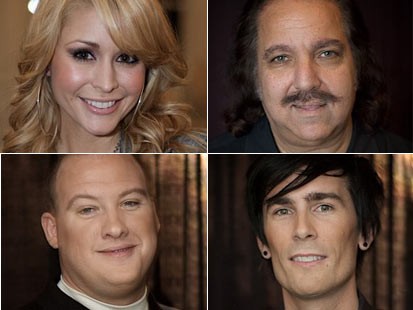
A response by Joseph Citarella, Director of Sex Week 2008 was published here. He noted that in fact there was a debate about pornography. The debaters were as follows:

Vivid Girl Monique Alexander and “Porn King” Ron Jeremy (top) “face-off” against Porn Pastors Donny Pauling and Craig Gross (bottom).

Because of course who better to debate porn than three men, two of whom are Christian pastors. Guess which side they took? Talk about proving Dines’ point about disappearing the voice of feminist criticism of pornography.

–Ann Bartow

Update: Via e-mail a reader posed an interesting query to porn fans. When is the last time you saw a woman as old as Ron Jeremy performing in mainstream pornography?

Share
Posted in Academia, Feminism and Culture, Women and Economics | Comments Off on “Yale Sex Week Glosses Over Porn’s Dark Side”

The Oddest Things Make Me Laugh

Like this.

Share
Posted in Bloggenpheffer | Comments Off on The Oddest Things Make Me Laugh

“Yours Is A Very Bad Hotel”

A customer complaint in Powerpoint form! Via Nancy Rapaport.

Share
Posted in Bloggenpheffer | Comments Off on “Yours Is A Very Bad Hotel”

“Women Lawyers–Back on Track”

That’s the name of an excellent new blog written and administered by Nicole Black.

Recent posts of interest include: Study: Gender gap in law students’ goals and Closing the LSAT Gender Gap. Check it out!

Share
Posted in Feminist Blogs Of Interest, Legal Profession | Comments Off on “Women Lawyers–Back on Track”

“The Origins of African-American Interests in International Law,” by Henry J. Richardson III

This book explores the birth of the African-American international tradition and, particularly, the roots of African Americans’ stake in international law. Richardson considers these origins as only formally arising about 1619, the date the first Africans were landed at Jamestown in the British North American colony of Virginia. He looks back to the opening of the European slave trade out of Africa and to the 1500s and the first arrival of Africans on the North American continent. Moving through the pre-Independence period, the American Revolution, the Constitutional Convention, and the Westward Migration, the book ends around 1820.

This historical period also roughly corresponds to two other key historical phenomena greatly affecting the Atlantic Ocean basin: the rise of international law as a modern legal system (including European states and their Atlantic colonies) and the rise and flourishing of the international slave trade in African slaves to the Americas by European and New World governments and merchants. Only by placing African slavery in the British North American colonies in the context of the international slave system encompassing and linking the New World can the voices, struggles, demands, claims, and decisions of slaves and Free Blacks in North America towards freedom, relative to their evolving interests under international law, be properly understood. These interests comprise no less than the birth of an African-American international jurisprudence.

Share
Posted in Academia, Race and Racism, Recommended Books | Comments Off on “The Origins of African-American Interests in International Law,” by Henry J. Richardson III

“The University of Southern California released a study yesterday about the preferences of the Academy and found that in almost in any given year of best picture nominations, the roles for people who are neither white nor male are few and far between.”

So reports this NYT article in reference to this study, which also observes:

“The data show there are almost three speaking males for every one female and more than four white speaking characters for every one non-white character,”the study found in its survey of 30 years of best picture nominations.

“Unfortunately, females are grossly underrepresented in these prestigious films,”said Stacy Smith, a professor of communication at U.S.C., and a principal researcher in the study.”The gender-imbalance findings are a microcosm of a much bigger representational phenomenon in American film and television.”…

The full text of the study is available here.

Share
Posted in Feminism and Culture, Sexism in the Media | Comments Off on “The University of Southern California released a study yesterday about the preferences of the Academy and found that in almost in any given year of best picture nominations, the roles for people who are neither white nor male are few and far between.”

The Penn State Pro Porn Center

Penn State’s College of Communications has a Center for the First Amendment. The predominant focus of the Center is apparently to interview pornographers and pornography performers, and then use these interviews to produce “legal scholarship” about pornography. Below are some samples of their work:

STOPPING THE OBSCENITY MADNESS 50 YEARS AFTER ROTH V. UNITED STATES

FREE EXPRESSION, PORNOGRAPHY & THE MAINSTREAMING OF ADULT ENTERTAINMENT: MARK KULKIS AND THE NEW VOICE OF THE ADULT VIDEO INDUSTRY

GAY PORNOGRAPHY AND THE FIRST AMENDMENT: UNIQUE, FIRST-PERSON PERSPECTIVES ON FREE EXPRESSION, SEXUAL CENSORSHIP, AND CULTURAL IMAGES

Media Maestro Makes Inroads for Adult Free Speech

Porn in Their Words: Female Leaders in the Adult Entertainment Industry Address Free Speech, Censorship, Feminism, Culture and the Mainstreaming of Adult Content

Articles I can’t find links to, but appear to continue in the same mode are: The Inside Perspective of the Adult Entertainment Industry and Defense Attorney Louis Sirkin, 14 Vill.Sports & Ent. L.J. 233, 243-84 (2007) (including comments by defense attorney Louis Sirkin and adult industry figures including Larry Flynt, Max Hardcore and John Stagliano); Clay Calvert & Robert D. Richards, Adult Entertainment and the First Amendment: A Dialogue and Analysis with the Industry’s Leading Litigator & Appellate Advocate, 6 Vand. J. Ent. L. & Prac. 147, 149-68 (2004) (centering on an interview conducted with adult entertainment industry defense attorney Paul Cambria); and The Free Speech Coalition & Adult Entertainment: An Inside View of the Adult Entertainment Industry, Its Leading Advocate & the First Amendment, 22 Cardozo Arts & Ent. L.J. 247, 257-302 (2004) (examining the work of the Free Speech Coalition on behalf of the adult entertainment industry, and including interviews with adult entertainment industry defense attorney Jeffrey Douglas and former Free Speech Coalition head and chief lobbyist Kat Sunlove). Let me add, for anyone readying to launch the entirely predictable and false accusation that I am trying to censor anyone, that I have linked to each of the articles I could find links for, and will add any new links to the unlinked articles that anybody sends me. Read them, and make up your own mind about their scholarly legitimacy.

Any scholars that write press releases and propaganda for pornographers disguised as law review articles, and rely on pornographers for legal analysis are unlikely to be taken very seriously by anyone with much intelligence, and indeed it doesn’t appear that they are. What I find surprising is that Penn State would fund a Center so utterly without balance. It appears to be run by three white men who are utterly smitten by pornography, but completely disinterested in any traditional academic research on the issue. They function like PR mouthpieces for pornographers. Additionally, the distortions and misstatements in their writings are myriad. I will address some of those later, in the context of questioning why some student editors of law journals decline to do even basic fact checking of some of the articles they facilitate publication of. The question I have for now is where the funding for this Center comes from, and you might already anticipate my best guess.

–Ann Bartow

Share
Posted in Academia | Comments Off on The Penn State Pro Porn Center

For the New Yawkahs!

This. For anyone who didn’t have the awesome privilege of attending Cornell, some of those students stole trays from the dining halls and they are riding them down Libe Slope. And, see also.

–Ann Bartow. Y’all come visit SC to thaw out if y’all need to, hear?

Share
Posted in Bloggenpheffer | Comments Off on For the New Yawkahs!

“How to publish your own sex tape — 3 easy rules”

Here, FWIW. Note especially:

… The XXX ex video is an all-too-popular genre. Always keep in mind: Porn is forever. Your performance will probably outlast your relationship. …

Share
Posted in Feminism and Culture | Comments Off on “How to publish your own sex tape — 3 easy rules”

“It’s tough enough for rape victims to come forward. Now there’s another reason for them to think twice about reporting the crime: They may get stuck with a hefty bill for the rape kit used to collect evidence against their attacker.”

So begins this U.S. News article, entitled “Rape Victims Can Be Hurt Financially, Too.” The article notes that rape kits cost $1,600 and sexual assault victims are billed for them in a number of states. Via Jezebel.

Share
Posted in Acts of Violence, Feminism and Law, Women's Health | Comments Off on “It’s tough enough for rape victims to come forward. Now there’s another reason for them to think twice about reporting the crime: They may get stuck with a hefty bill for the rape kit used to collect evidence against their attacker.”

Three Grumpy Observations About Air Travel To And From The Windy City

1. United Airlines flights to Columbia from Chicago out of Gate F11 are always delayed, sometimes for hours, and often you have to sprint to an alternative gate at the last minute.

2. Note to the chipper strangers sitting next to me in the air terminal early in the morning: There is a reason I am working at my computer rather than discussing the weather with you, and the reason is, I would rather work at my computer than discuss the weather with you. No offense. Okay, you win. Yes it gets hot in the summer in South Carolina. Yes it gets humid during South Carolina summers too. But here’s the thing: It’s very comfy there this time of year, so I don’t need to own a coat the size of a flock of quilted sheep, like the one you are holding.

3. It only costs $2 to take the train from downtown Chicago to the airport, which is a wonderful bargain. But for some reason a lot of men riding it are given to unsubtle self-pleasuring.

–Ann Bartow

Updated to add: Yikes, glad everybody aboard is safe.  

Share
Posted in Academia, Bloggenpheffer | Comments Off on Three Grumpy Observations About Air Travel To And From The Windy City

Barbie Tarot

Full set here.

Share
Posted in Bloggenpheffer | Comments Off on Barbie Tarot

For People Who Have Everything Except Taste?

These.

Share
Posted in Bloggenpheffer | Comments Off on For People Who Have Everything Except Taste?

“Women can be seen as ambitious and capable, or they can be seen as likable, a host of studies have shown, but it’s very hard for them to be seen as both…”

That’s a sentence found in this article, which I found via this blog post, whose author  found it here. Basically there is some kind of chain link letter thing happening here, but no related curses, at least no audible ones here abouts. Just sighs of resignation, and no doubt unrealistic hope for tomorrow.

–Ann Bartow

Share
Posted in Feminism and Politics | Comments Off on “Women can be seen as ambitious and capable, or they can be seen as likable, a host of studies have shown, but it’s very hard for them to be seen as both…”

“What We Think: Gender Roles, Women’s Issues and Feminism in the 21st Century: An Anthology”

Coming to local bookstores in 2008!

More at  this website. And there is a related blog!

Share
Posted in Recommended Books | Comments Off on “What We Think: Gender Roles, Women’s Issues and Feminism in the 21st Century: An Anthology”

Trailer for the film “Teenage Mother” (1967).

Oy.

Share
Posted in Feminism and Culture, Sexism in the Media | Comments Off on Trailer for the film “Teenage Mother” (1967).

The United Nations has launched a $44 million program to reduce female genital mutilation by 40 percent by 2015.

More information here and here.

Share
Posted in Acts of Violence, Feminism and Culture, Feminism and Religion, Sisters In Other Nations, Women's Health | Comments Off on The United Nations has launched a $44 million program to reduce female genital mutilation by 40 percent by 2015.

Teleconference and Live Audio Webcast on Roe v. Wade

Tomorrow, Thursday, February 21, 2008, the ABA Center for Continuing Legal Education will sponsor a 90-minute teleconference and audio webcast, “Roe v. Wade – Where We’ve Been and What Lies Ahead: A Conversation with Sarah Weddington and Friends.”   Sarah Weddington is the attorney who litigated Roe v. Wade. The panel will attorneys from the ACLU and Planned Parenthood.

More about the program is available here.
-Bridget Crawford

Share
Posted in Reproductive Rights, Upcoming Lectures | Comments Off on Teleconference and Live Audio Webcast on Roe v. Wade

Profile of Annie Coker, California’s First African-American Woman Lawyer

This month’s California Bar Journal contains an interesting profile of Annie Coker, who was the first African-American woman to be admitted to the practice of law in California. Coker received her law degree from Boalt in 1929 and was admitted to practice in the same year. Coker worked in private practice in Alexandria, Virginia for a time, and then returned to California in 1939, taking a job with the State Office of Legislative Counsel where she worked until she retired in 1966. Coker passed away in 1986.

The profile is all the more interesting because it talks about its genesis. Twenty years ago, Alameda County Superior Court Judge Brenda Harbin-Forte was inspired to find out about the first African-American woman lawyer in California when she attended an event on women lawyers that was presented by the historical society for the northern district of California. No mention was made at the event of women of color, which moved Judge Harbin-Forte to do the research that led her to Annie Coker’s unofficial biographer who, in turn, put her in touch with Coker’s former co-workers. The judge sums it all up in the following passage at the end of the profile:

“‘I’m absolutely inspired by her,’ said Harbin-Forte. ‘For her to have come up at the time she did, and to be admitted at a time when the level of discrimination and the lack of opportunities for African-Americans, particularly in the legal profession, was high is amazing to me.

‘She’s been such an inspiration. My heart sang when I was able to learn about her.’ ”

-Anthony C. Infanti

Share
Posted in Firsts, Legal Profession | Comments Off on Profile of Annie Coker, California’s First African-American Woman Lawyer

Belle Lettre on Sexual Harassment

Here, in a post entitled:

What the Hell: I Am Mad, and I Can Type. If I Don’t Have a Voice Here, Then Where Do I?

Share
Posted in Feminism and Law, Women and Economics | Comments Off on Belle Lettre on Sexual Harassment

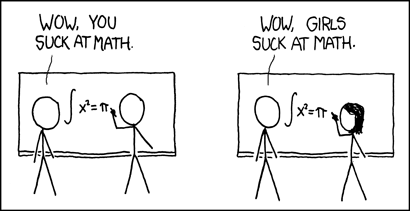
“How It Works”

From xkcd (A webcomic of romance, sarcasm, math, and language.)

Share
Posted in Feminism and Culture | Comments Off on “How It Works”

“The first increase in union membership in a quarter of a century was recorded in 2007 with employment sectors traditionally dominated by women driving the turnaround.”

That’s the first sentence of this article, entitled “Women Add Union Sectors, Fueling Labor Revival.”

Share
Posted in Feminism and Politics, Women and Economics | Comments Off on “The first increase in union membership in a quarter of a century was recorded in 2007 with employment sectors traditionally dominated by women driving the turnaround.”

Know a lost literary classic suitable for use in law school?

Leave your suggestions here!

Share
Posted in Academia, Feminism and Law, Law Schools, Law Teaching, Uncategorized | Comments Off on Know a lost literary classic suitable for use in law school?

Justice Anthony Kennedy: Thanks for Twenty Years of . . .

Well, thanks for what? Today is the twentieth anniversary of Justice Kennedy taking his seat on the Supreme Court. There are certainly things to thank him for. His switch in Casey saved Roe from being overturned. He authored groundbreaking rulings in gay rights, saying the Equal Protection Clause does not tolerate animus towards gay men and lesbians and that liberty under the Due Process Clause includes the right to choose your sexual partner and activities.

But each of those came with a cost or, at the least, a lost opportunity: Roe’s “essential holding” was preserved, but the rest of it was gutted; momentum for protecting sexual orientation under the Equal Protection Clause with greater scrutiny was lost when he applied rational basis review; and, while Bowers was overruled in Lawrence, the doctrinal lack of clarity of the opinion has limited its usefulness in the lower courts.

I’m currently working on a symposium piece for the South Carolina Law Review looking at Justice Kennedy’s legacy for sex and gender jurisprudence. Aside from some of the high profile cases, it’s not good; not good at all. Here’s an excerpt from a look at the numbers in his sex discrimination cases:

Looking at Justice Kennedy’s position in all of these compiled cases shows a Justice who is generally hostile to claims of sex discrimination. Overall, he voted against the sex discrimination claim 65% of the time (42.5 out of the 65 cases with classifiable outcomes (excluding Ayotte)). Removing the 22 unanimous cases from the analysis shows an even starker hostility to sex discrimination claims. In the non-unanimous cases, Justice Kennedy voted against the sex discrimination claim 78% of the time (33.5 out of 43 cases). Focusing the microscope even closer and looking at the narrowly divided cases in which one Justice’s switch would have made a difference (those with 5-4 or 5-3 outcomes) shows that Justice Kennedy almost never sides with the sex discrimination in close cases. In such cases, he voted against the sex discrimination claim 97.5% of the time (19.5 out of 20 cases). His one half-vote in favor of a sex discrimination claim in a closely divided case was his vote to preserve the”essential holding”of Roe v. Wade in Casey; but even that came with his vote to uphold all of Pennsylvania’s abortion restrictions save one.

The problem, of course, is that Kennedy is now the “median” Justice, taking over for Justice O’Connor. She was a much more reliable vote in favor of claims of sex discrimination. With Kennedy’s new position, the future of sex discrimination jurisprudence on the Court is bleak. Just how bleak is evident from looking at the sex discrimination cases on which the two Justices sat together:

Of the 66 cases studied here, Justice O’Connor and Justice Kennedy sat together for 58 of them. Eighteen of those were unanimous decisions, so that leaves 40 cases in which there was at least some disagreement among the Justices. Their votes in those 40 cases can be broken down as follows:

– Justice O’Connor and Justice Kennedy agreed on the position against the sex discrimination claim 17 times (43%).
– Justice O’Connor and Justice Kennedy agreed on the position in favor of the sex discrimination claim 9.5 times (24%).
– Justice O’Connor voted in favor of the sex discrimination claim 13.5 times when Justice Kennedy voted against it (34%).
– In not one case did Justice Kennedy vote for the sex discrimination claim but Justice O’Connor did not.

Stated differently, in their overlapping non-unanimous cases, Justice O’Connor voted for the sex discrimination claim 58% of the time (23 out of 40 cases) whereas Justice Kennedy voted for the sex discrimination claim only 24% of the time (9.5 out of 40 cases).

I’m still in the process of finishing up the article, but I couldn’t resist posting these numbers on this twentieth anniversary for Kennedy. Progressives have no choice but to hope for Kennedy in the future, but the past gives no reason to believe that hope is going to be anything but empty.

– David S. Cohen

Share
Posted in Feminism and Law, Feminist Legal Scholarship | Comments Off on Justice Anthony Kennedy: Thanks for Twenty Years of . . .

Contraception Is Expensive: Men and the Little Green Ones

According to this article in the Daily Women’s Health Policy Report, the increase in contraceptive costs sold at student health centers on college campuses and some clinics is a “crisis.” David S. Cohen previously blogged about the issue here.

The cost of birth control pills has skyrocketed because the law changed to eliminate the incentive drug companies had to provide colleges with large discounts on some drugs. The News and Observer also report on this issue here.

I had a friend in college whose boyfriend used to take the green (inactive) pills for the seven days of her “off” week. This was his act of solidarity with her, meant to sensitize him to the responsibility of taking a pill at approximately the same time every day and the uncertainties that arise when we ingest synthetic material. It seemed like a progressive experiment at the time. But with the increased costs of oral contraceptives, I’d rather have a partner pay 50% of the cost of the pills, instead of taking the little green ones.

-Bridget Crawford

Share
Posted in Feminism and Culture, Reproductive Rights, Women and Economics, Women's Health | Comments Off on Contraception Is Expensive: Men and the Little Green Ones

“How to Train a Husband,” Newsweek Style

I had to look twice to make sure I correctly read the headline. Apparently there is no news to report, so Newsweek reviews a new book called “What Shamu Taught Me About Life, Love and Marriage,” written by a formal animal trainer.

Attention, frustrated wives: if you want your husband to start listening to you and stop leaving his socks on the floor, all you need is a little patience and a lot of mackerel. Such is the putative relationship advice of Amy Sutherland, a journalist who spent a year at an animal-trainer school and decided to apply the trainers’ techniques to her husband’s annoying habits.

If we are to believe Sutherland, men are stupid animals and women need to learn a few tricks for their care and feeding to achieve connubial bliss. Sutherland’s underlying premise is, of course, that women’s are stupid, too — stupid enough to buy this book.

-Bridget Crawford

Share
Posted in Feminism and Culture | Comments Off on “How to Train a Husband,” Newsweek Style